The first thing Chris Zhu put on paper was a counting problem. In 2019, while at the Roxbury Latin School, he presented work on permutations with a particular pattern called a double descent. The name sounds like a difficult ski run, but it belongs to a branch of mathematics concerned with how objects can be arranged. His paper also examined rim hooks, shapes that appear in the same combinatorial territory. He took the work to an MIT PRIMES conference and posted a formal version online. It was the sort of project that rewards patience with small distinctions: change the order, and the answer changes with it.
Seven years later, the objects had become much heavier. In August 2026, Etched, the company Zhu co-founded, said its first AI inference rack had arrived at Jane Street and was running in the trading firm's data center. The distance between a teenager's formula and a powered, liquid-cooled machine is large enough to make any ordinary career map look silly. The connection is his appetite for choosing one exact problem and following it until it has consequences outside the page.
A useful friendship in Math 55
At Harvard, Zhu met Gavin Uberti in Math 55, the university's demanding introductory mathematics course. Both studied math and computer science. By 2022, their discussions had moved from coursework to the cost of running large language models. Zhu later described reading into the field on his own and getting hooked. Uberti was finishing a gap year; Zhu was on campus. They talked over Zoom every other day. Over winter break, the project became serious enough to require more than calls and equations.
Their proposition was strikingly specific. Most AI chips are general-purpose devices asked to do many kinds of computation. Zhu and Uberti thought the transformer architecture behind the new generation of language models might be important enough to deserve hardware built expressly for it. In Zhu's account, they wrote a paper arguing that such a design could offer a dramatic improvement in performance per dollar over conventional graphics processors. That was a projection, not a measured result from a shipped chip. At the time, they had an argument and a company to assemble around it.
Etched was incorporated in October 2022. Zhu has called the beginning a LaTeX file and a bet. That description is apt for two math students, but it also conceals the chasm between a plausible calculation and a piece of silicon. Computer chips take months to design and fabricate. Their usefulness depends on software, memory, packaging, power delivery, cooling and the customer's willingness to use the finished system. The simple version of the thesis could fit in a document. The full version would eventually fill a rack.
“I figured this would be one of those things I would regret so hard if I didn’t try it.”Chris Zhu on leaving Harvard, 2023
By March 2023, Zhu and Uberti were still taking classes. A month later, Etched closed a $5.36 million seed round led by Primary Venture Partners, and they left school for the Bay Area. Zhu said he liked Harvard and the people he had met there. He also concluded he could not give school and a semiconductor startup the attention each demanded. The decision reads as neat in retrospect because the company survived it. At the time it meant giving up a familiar course for a business whose first commercial product existed mainly in plans.
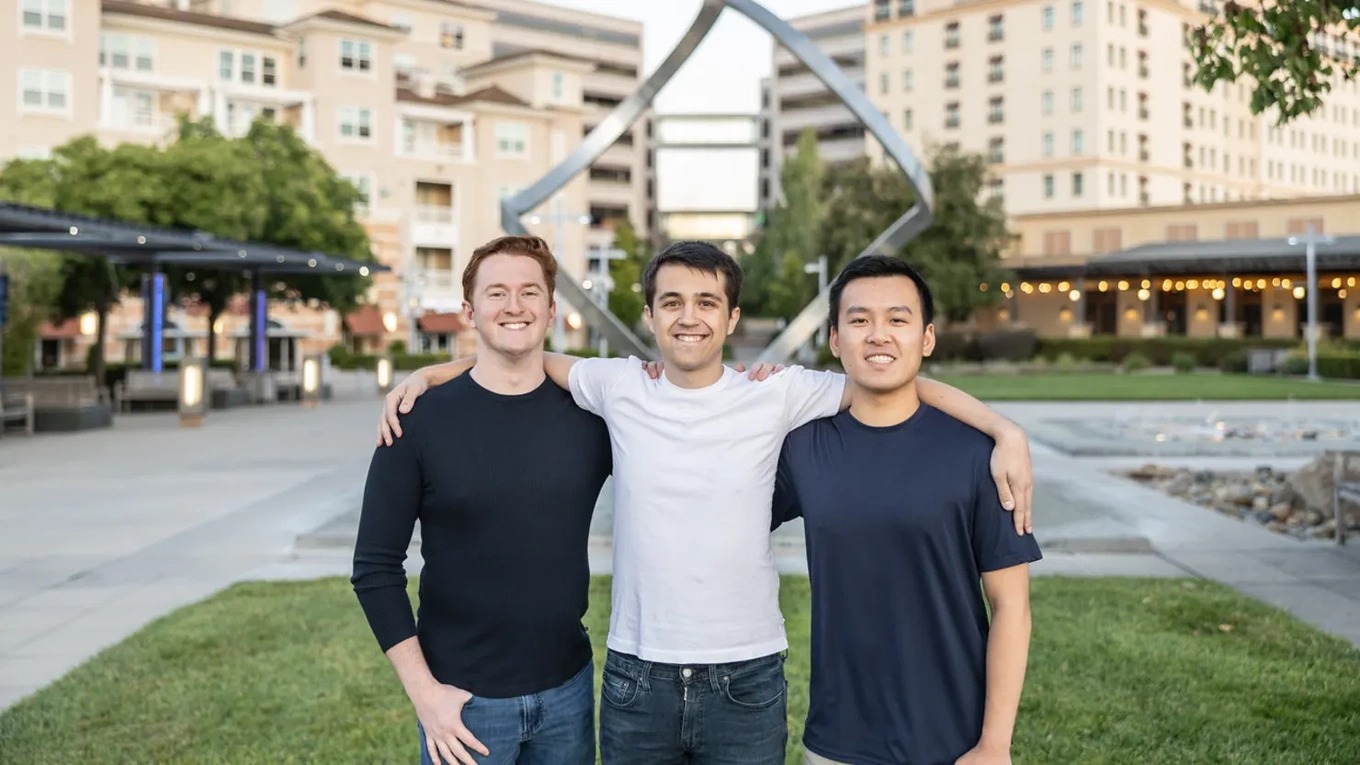
Four people, eight desks
The new office was a room at CANOPY in Menlo Park with eight desks and, at first, four people. Zhu liked its quiet, its views and the fact that someone else handled the office setup. Proximity mattered. He wanted to recruit semiconductor engineers from the Bay Area and have colleagues working together in person. For a young hardware company, the local supply of expertise was as practical a reason to move as Silicon Valley's reputation.
His early days were less like a solitary inventor's workshop than a rotating list of small obligations. A hiring call in the morning might be followed by accounting, technical work and a conversation with a vendor. He told an interviewer that he used to joke about people whose calendars were completely booked. Once responsible for a company, he discovered how much progress required arranging a call and taking it. It is a modest admission, and one of the more revealing details of the founder story. The transformation from researcher to executive can arrive as a meeting invitation.
Zhu's schedule also acquired a peculiar rhythm. The team came in during the morning and might remain until seven, eight or nine at night. Asked about a nine-to-five, he laughed. He said he enjoyed the work, even as it spread across engineering and company chores. Outside the office, his favorite place to return to was Franconia Notch in New Hampshire's White Mountains, where he said he had hiked and backpacked dozens of times. That fondness for a long trail fits the evidence better than any tidy label for his personality: he has described liking both the climb and the unglamorous preparation it requires.
The difficult middle
In 2023, the company's proposed chip had a nickname: Sohu. Zhu spoke then about a five-to-ten-year ambition to make hardware for more kinds of AI models, including image and video generation. The immediate assignment was narrower, a processor for the transformer models driving language generation. That focus made the engineering question more tractable and the business question sharper. If the workload grew as expected, a specialized system could have an advantage. If customer needs changed, the specialization would be a constraint. The wager had to survive both mathematics and the market.
The company added Robert Wachen as a co-founder and built a team around the three. Its work also evolved from a chip pitch into a complete inference system. In June 2026, Etched said its first A0 silicon had returned from TSMC's N4P process. A0 is the first manufactured version of a design, a milestone that invites testing rather than a victory lap. Etched said it was validating rack-scale hardware with customers and had more than 400 engineers, including veterans of major chip and AI organizations. It also described production work tied to more than $1 billion in customer contracts.
The expanded product tells its own story about the engineering problem. A chip must be connected to memory; many chips must communicate; the rack must handle heat and power; the software must make the hardware usable for actual models. Etched's 2026 account describes a shared memory design and a fast interconnect intended to make that whole system more responsive. These remain company claims about performance, and customer deployment is a more concrete milestone than a chart of projected speed. Yet the shift from a component to a system makes clear how much had changed since the paper stage.
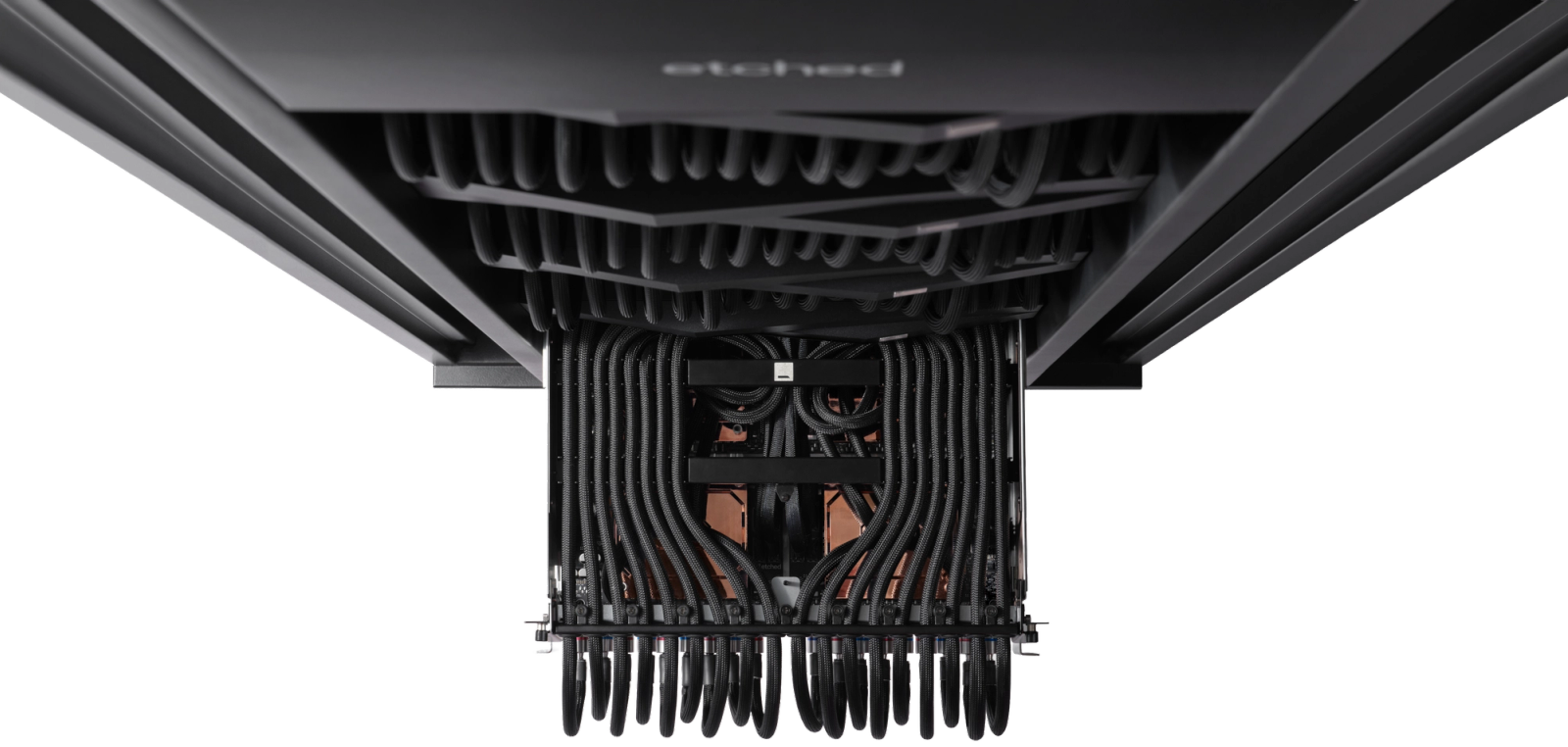
Zhu's own public description retained a mathematical bluntness. He wrote that the original bet was for intelligence to become cheap enough that the world's demand for it would be enormous, while the systems to serve it did not yet exist. The first half of that sentence is a forecast about demand; the second is a challenge to hardware builders. A successful design on a lab bench answers only part of it. A rack running someone else's production workload begins to answer the rest.
A machine leaves the office
On August 18, 2026, Etched announced that its first rack had shipped to Jane Street. The trading firm said it had tested the chip, was pleased with early results and had the rack running in its data center. Jane Street also led a $700 million financing round that valued Etched at $21 billion, according to the company. The money and valuation drew attention, but the more useful image is less abstract: a box that had to be built, delivered, powered and used by a customer.
There is a large difference between one rack and a production fleet. Etched's announcement itself points toward the next set of work: factories, supply chains, fleet software and deployment at far greater scale. In that sense, the first shipment is both an answer and a fresh question. It establishes that the project escaped the document and the prototype room. It leaves open how consistently the company can manufacture systems and how broadly customers will adopt them.
The valuation belongs to Etched, not to Zhu personally. It cannot tell us his stake or his wealth. The career facts are more interesting anyway: a secondary-school mathematician published on an oddly named pattern; a Harvard course connected him to a co-founder; a dorm-room project consumed enough of his attention that he left school; and the startup eventually put a machine in a customer's data center. Each step made the previous one look a little less improbable.
Choose one demanding workload. Design a whole machine around it. Then see whether the machine works when it leaves your building.
Zhu has not presented the story as a solitary feat. In his account of Etched's growth, he thanked Uberti, Wachen and the team that built the hardware. That is more than founder etiquette. A chip company needs people who can do things no equation can do alone: negotiate with suppliers, debug silicon, write compilers, assemble racks and keep production moving. His path from combinatorics to hardware is personal, but the result is irreducibly collective.
There is a pleasing symmetry in the name Etched. In 2019, Zhu was studying arrangements whose properties depend on exact order. At Harvard, he and Uberti chose a model architecture and asked what would happen if its computation were fixed into silicon. Now the arrangement extends to a rack and the organization that makes it. The intellectual habit survives the change of scale: pay attention to structure, because the details decide what can be counted, built and shipped. The next proof will arrive in more than one crate.