Robert H. Swanson Jr. wanted a job that would last twenty years. He had children approaching college age, a career in semiconductors and a growing impatience with the place where he worked. Starting a company in his early forties was a peculiar way to seek security. Then again, he had already learned that a large employer could be a remarkably unreliable source of it.
In September 1981, he helped establish Linear Technology. Its specialty was analog integrated circuits, an awkward choice at a moment when the word “digital” appeared to explain the future. Swanson knew the objections. He also knew factories, customers and engineers. The question was whether that knowledge could support a business long enough to put his own working life on firmer ground.
There is something useful about beginning his story with that modest ambition. It restores the uncertainty. Before Linear became an acquisition worth billions, it was a group of people deciding which risks they could afford, which customers might pay them and which mistakes from their previous jobs they intended to leave behind.
A car payment, then a career
Swanson grew up in Wilmington, Massachusetts, north of Boston. He liked mathematics and science, but his early ambition was to fly. He attended Wentworth Institute of Technology and later earned a bachelor’s degree in industrial engineering from Northeastern University. Aviation remained an option until the timing became inconvenient: a Navy pilot-training opening was months away, while the payments on his car were considerably more punctual.
He needed work. In 1960, he joined Transitron Electronics. His statistical training helped him get hired; the company needed someone who understood a chi-square test. A temporary solution to a household expense became an introduction to semiconductor manufacturing. He learned to measure devices, examine production data and understand how the things were made.
The appeal of this beginning is its smallness. No childhood prophecy is required. A young graduate has a bill to pay and a skill someone needs. The industry acquires an engineer almost by accident. Swanson’s subsequent career would involve much larger calculations, but that first calculation was admirably concrete.
Learning what a factory owes its engineers
Transitron led to Fairchild Semiconductor. In his account of the move west, Swanson remembered recognizing that Fairchild’s planar process threatened the technology he had been working on. Staying busy with yesterday’s promising device could be an efficient way to become irrelevant. The move brought him to San Rafael, California, and into another part of the young industry’s expanding network.
At Fairchild, he worked in quality, production control and operations. These were jobs in which an attractive idea still had to survive a production schedule. A circuit could be clever and a factory could remain late. The commercial problem included both. That practical education helps explain why the later Linear story has so much to do with delivery and manufacturing.
In August 1968 he joined National Semiconductor. Over the following thirteen years, his responsibilities included managing operations in Europe and leading the linear integrated-circuit business. He became acquainted with the different demands inside a semiconductor company: technical progress, investment, production and the organizational arrangements that could either connect them or make everybody wait.
First chip-industry job
Operations and analog leadership
A company of his own
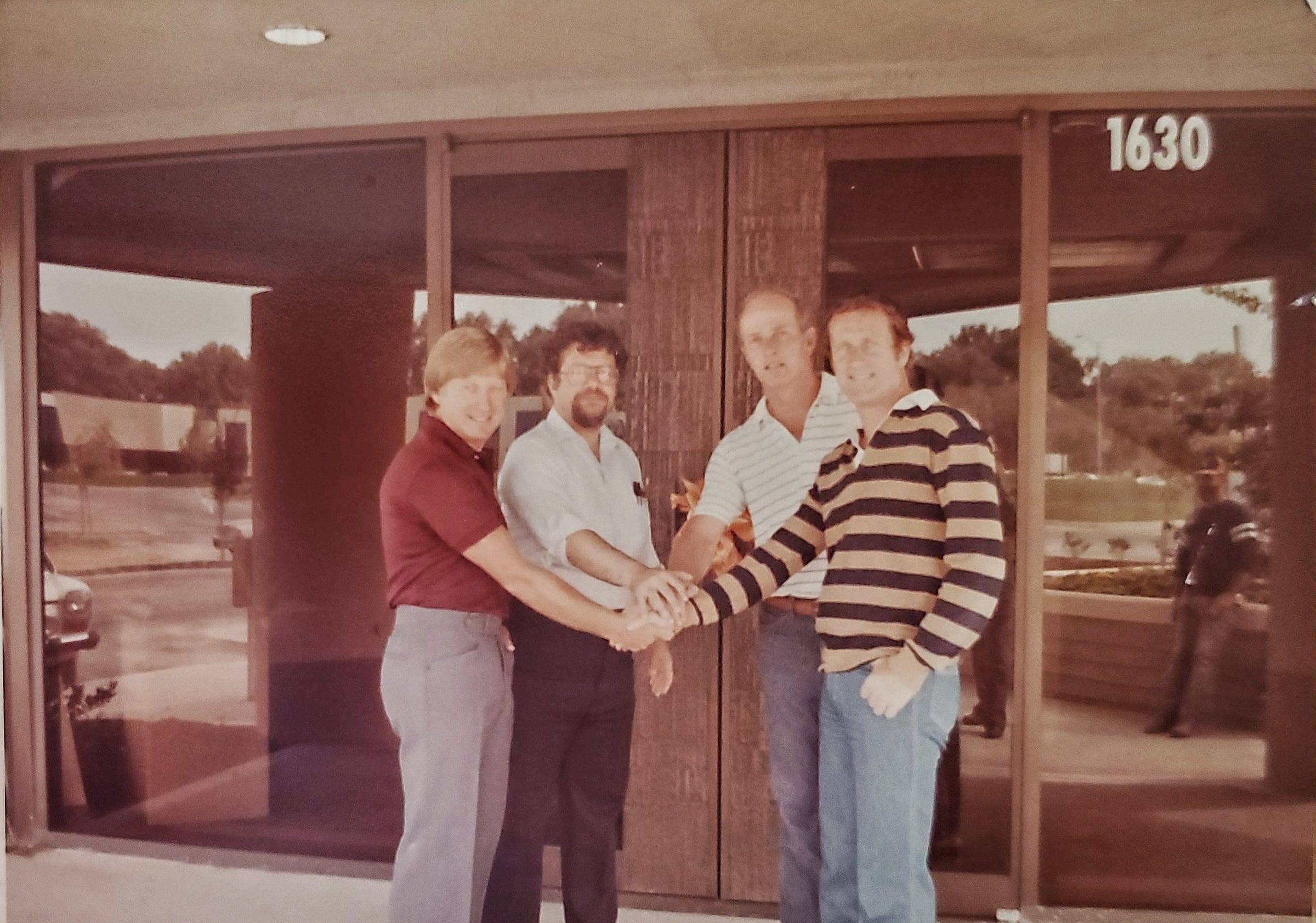
By 1981, he was ready to leave. Bob Dobkin, who led advanced analog development at National, became a central partner. The partnership joined a circuit designer’s judgment to an operator’s understanding of how a company worked. Both had spent enough time inside established organizations to possess a fairly detailed collection of grievances.
The future needed a power supply
It is tempting to make Linear’s founding sound like a serene act of conviction. Swanson’s recollections are more entertaining. He remembered going into Dobkin’s office to ask whether the digital revolution really endangered their business. Dobkin kept assuring him that analog would endure. Confidence, apparently, sometimes required a recurring appointment.
The technical case was straightforward. Digital equipment still meets a physical world. Signals must be measured and conditioned; energy must be controlled. More computing does not abolish the need to supply power to the computer. An industry can change its preferred vocabulary without changing that obligation.
Swanson later recalled a teardown of a Hewlett-Packard instrument promoted for its digital signal processing. Inside were one digital signal processor and ninety-two analog components. It was a pleasing inventory for someone who had spent years explaining why his specialty was still alive. The fashionable part had brought quite a large supporting cast.
He did not claim to have predicted every portable product that followed. His argument was more durable than a forecast of a particular gadget. If customers needed improvements in precision, power consumption or signal handling, there was work for a business organized around those improvements.
The price of saying no
By May 2004, Linear had recorded seventy consecutive profitable quarters. Swanson explained its approach in practical terms: watch emerging markets, anticipate what customers will require, develop useful parts and protect pricing when those parts offer something distinctive. He was also prepared to leave a niche when price pressure undermined its appeal.
There is discipline hidden inside that last decision. Revenue can flatter a company while using up its engineering time. A small supplier has finite attention, and every attractive request competes with the next product it might develop. Choosing a market means accepting the opportunities that choice excludes.
Linear concentrated on analog building blocks that customers could use in their own systems. Its business depended on making those parts valuable enough to justify their price. For Swanson, performance included the experience surrounding the chip: whether it arrived, whether it worked as promised and whether someone could help a customer use it.
That gives his management a recognizable shape. He could be blunt about competition and demanding about the economics, while placing considerable weight on technical competence. A premium price has to survive an engineer’s inspection. Enthusiasm in the sales office will not repair an unsuitable component.
The fifty-cent argument
One early disagreement captures the tension. Linear’s field applications engineers sometimes recommended a fifty-cent Texas Instruments part when Linear offered a one-dollar alternative. Swanson objected. His own employees explained that the cheaper component met the customer’s needs; several other Linear parts were already in the design. Forcing an unnecessary purchase would damage trust.
He accepted their reasoning, reluctantly. The episode gives him a more interesting role than the founder who is always right. Here he was the person who needed persuading. The engineers’ freedom mattered because they could use their judgment in a way that initially irritated the boss.
A customer who asks for technical advice is lending a supplier some authority. There is a temptation to spend that authority immediately on another sale. The fifty-cent argument shows what happens when employees defend a longer relationship instead. Swanson’s contribution was allowing their explanation to change his decision.
“We can’t compete on price.”
Bob Swanson, 2011
Keeping people when orders disappear
Longevity did not mean a smooth revenue curve. After the dot-com bubble burst in 2001, Linear’s annual sales fell from roughly a billion dollars to half a billion. Swanson described the need to cut costs and close a four-inch fabrication facility after the company had invested in a larger one. The business had to adjust to a much smaller market.
The experience informed its response to the financial crisis later in the decade. Factory shutdowns and pay reductions were among the measures used to reduce expenses, while preserving the team. Swanson stressed that the business could remain profitable and generate cash on its reduced sales base.
The distinction matters to anyone trying to understand his attachment to manufacturing. A factory contains equipment, but it also contains people who know what the equipment does when reality departs from the instructions. Rebuilding that knowledge takes time. Keeping a team together is an operational decision as well as a statement of loyalty.
There were limits and difficult choices. His account includes them. The useful lesson is the attention paid to what would remain after the downturn: the ability to design another part, solve another production problem and answer the next customer’s question.
A blank page earns its keep
The culture also had room for Jim Williams, the analog engineer whose application notes helped designers understand circuits in unusual depth. In 1987, Swanson noticed that one note had a blank final page. They were paying for that page, he pointed out. Williams responded by drawing a cartoon, beginning a feature that became familiar to readers of his notes.
It is a tidy little collision between the cost-conscious executive and the inventive engineer. Paper was an expense; a cartoon made the paper worth reading. Neither participant had to surrender his character for the company to benefit. A complaint about waste became permission for a joke.
In July 2015, Swanson and Dobkin received the ACE Lifetime Achievement Award at the Embedded Systems Conference in Santa Clara. Linear then employed 4,865 people across more than fifty locations worldwide. The enterprise begun as a prospective twenty-year job had acquired a rather extensive payroll.
What lasted beyond the twenty years
Swanson had handed the chief executive role to Lothar Maier in January 2005 and become executive chairman. On March 10, 2017, Analog Devices completed its acquisition of Linear Technology. Swanson joined the Analog Devices board following the closing. That June, he resigned for personal reasons.
The transaction ended Linear’s life as an independent public company. It also put a date on the scale of his original undertaking: more than thirty-five years separated incorporation and acquisition. The work had outlasted his initial horizon by a comfortable margin.
His story leaves behind several quite ordinary objects: a car payment, a production schedule, a cheaper component and a blank sheet of paper. Each exposed a decision about what deserved attention. Swanson built a career by taking those decisions seriously, including the occasions when another engineer supplied the better answer. The future could make its announcements. Somebody still had to make the power supply.
Continue the conversation
Interviews, moving pictures and the next chapter.
Watch: Swanson and Dobkin on Linear’s founding ↗Watch: the 30th anniversary conversation ↗Read: Swanson’s 2011 interview ↗Read: a conversation with both founders ↗The 2017 acquisition announcement ↗Explore Analog Devices ↗