When Robert Mehrabian married Victoria, he acquired an unexpected responsibility. “I inherited three horses when we got married,” he recalled in 1990. He was a young professor. Victoria trained the horses; he rode them once they were ready. The arrangement had the appeal of a sensible division of labor, particularly for the less accomplished rider.
There is something useful in that small domestic admission. Mehrabian’s public career can look like a procession of imposing titles: engineering dean, university president, chief executive, executive chairman. The horses offer a less ceremonial introduction. Here was a scientist comfortable admitting that somebody else knew more, and quite happy to let her get on with it.
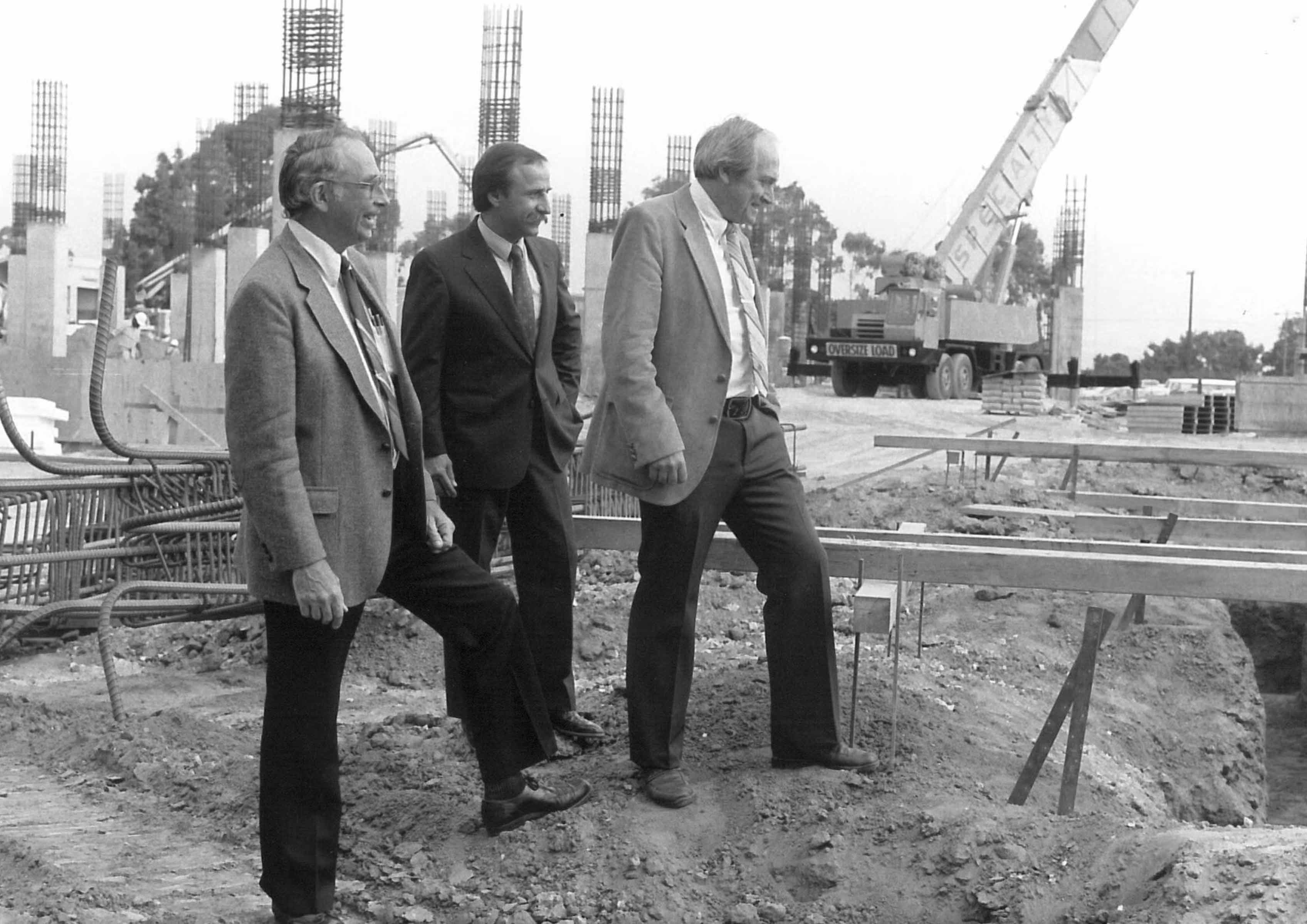
Decades later, his work would encompass imaging sensors, ocean instruments, aerospace electronics and a succession of acquisitions. But an earlier photograph gives this sprawling career a physical setting. Mehrabian stands with two colleagues on a construction site at UC Santa Barbara, surrounded by unfinished concrete and reinforcing steel. The laboratories are still an idea taking shape. He is already in the middle of them.
A philosopher takes up metallurgy
Mehrabian was born in Tehran in 1941 to Armenian parents. Armenian was his first language; his schooling also involved Persian and English. He came to Phillips Exeter Academy for his senior year of high school, encountering American life through an institution hardly inclined to make the academic work easy. Mathematics and science helped him find his footing.
He graduated from Exeter in 1960 and earned his MIT bachelor’s degree in 1964, followed by a Doctor of Science in 1968. The path contained a detour that makes his later interest in crossing departments more understandable: he had begun as a philosophy major. Questions with untidy answers interested him before the material properties of metals became his profession.
At MIT, his research explored ways to shape metal while it behaved more like putty. Working with students and another professor, he helped develop processes that offered an alternative to the familiar choices of casting liquid metal or working a solid. This was laboratory research with a factory waiting at the other end. Its usefulness mattered.
He stayed at MIT as a researcher and professor, moved to the University of Illinois Urbana-Champaign in 1975, and then entered government service in 1979. At the National Bureau of Standards, now NIST, his work brought industry and government into shared materials programs. University, factory and public institution were becoming connected parts of his working life.
Sixty-nine hires, and room to work
In 1983, Mehrabian became UCSB’s engineering dean. A college can be enlarged in several ways: more students, more rooms, more committees. His consequential investment was in the people doing the work. Over seven years, the college recruited 69 faculty members. At least 22 later entered the National Academy of Engineering, National Academy of Sciences or Royal Society.
Those later elections give the appointments an unusually long measuring stick. The decisions came first; much of the recognition arrived afterward. Hiring a promising researcher requires a judgment about work that has yet to happen. Hiring colleagues who can make one another better adds a second uncertainty, and a much more interesting possibility.
Mehrabian encouraged shared equipment and facilities, making collaboration part of the college’s physical arrangements. The Materials Department was established in 1987, with Tony Evans as founding chair. Engineering II was completed that year, adding 96,000 square feet for laboratories, classrooms and offices. Researchers needed both colleagues and somewhere to put the apparatus.
The construction photograph shows Roger Wood on the left, Mehrabian in the center and James Logan Merz on the right. It is a pleasingly unpolished institutional portrait: suits, dirt, exposed steel. In the finished building, a student might see an ordinary corridor. In this picture, the corridor still requires a considerable act of imagination.
Appointments first. Recognition later.
during his deanship
NAE, NAS and/or Royal Society
Pittsburgh needed a bridge out of the laboratory
Carnegie Mellon appointed Mehrabian its seventh president in 1990. He arrived interested in the university’s combination of engineering, science, drama, arts and humanities. For someone who had once studied philosophy, the mixture had an attraction beyond the engineering school. A technically accomplished graduate, he believed, also needed to understand other people and deal with ambiguity.
His presidency put attention into the undergraduate experience as well as research. A vice provost for education position was created. Applications rose to more than 13,000 in 1996, exceeding twice the number in his first year. The East Campus building program added places to study, perform, gather and live. An institution’s ambitions had to survive the ordinary experience of attending it.
Beyond campus, he participated in southwestern Pennsylvania’s Regional Economic Revitalization Initiative and encouraged technology transfer. A Carnegie Mellon facility at the Pittsburgh Technology Center occupied a former mill site along the Monongahela River. The geography made the change legible: research activity was finding a place in a landscape shaped by an earlier industrial economy.
In 2012, the university named its Collaborative Innovation Center for him. The building had opened in 2005, years after his presidency ended, and brought company researchers close to university teams. Apple, Intel and Disney had offices there. The honor recognized groundwork whose consequences continued after he had moved on. That is a demanding test of institutional leadership: whether the place keeps doing useful work without you.
The professor goes shopping
Mehrabian entered Allegheny Teledyne’s executive ranks in 1997. When Teledyne Technologies became independent in November 1999, he was its president and chief executive. He added the chairmanship in 2000. After nearly three decades in academia and government research, he was responsible for a public company, where the consequences of an experiment could be read in the accounts.
The portfolio developed through purchases that added adjacent technical capabilities. DALSA joined in 2011, bringing digital imaging technology, cameras and specialty semiconductor expertise. The e2v acquisition followed in 2017, adding imaging sensors, radio-frequency technology and semiconductors. These were businesses with particular skills, particular customers and engineering knowledge that took time to acquire.
Then came FLIR. Completed on May 14, 2021, the transaction cost approximately $8.2 billion, including net debt. It brought thermal imaging and unmanned systems into Teledyne’s Digital Imaging segment. The scale was a departure from smaller additions, and the work after closing would necessarily be larger too. Buying a business concludes one negotiation and begins a long operating assignment.
The technical connection mattered alongside the purchase price. Teledyne and FLIR covered different parts of the imaging spectrum and different applications. Underwater systems, land systems and airborne systems could sit within one portfolio. The intellectual attraction resembles the university work: distinct specialties become more useful when the connections between them are understood.
The comparison has limits. A department is not a subsidiary, and a university president answers to a different collection of constituencies. Still, the recurring problem is recognizable. You must judge technical work, choose capable people, provide resources and decide which combinations deserve patience. An acquisition announcement can be written in an afternoon. Making the combination worthwhile takes considerably longer.
Three additions to the field of view
- 2011DALSA
Digital imaging, cameras
and specialty semiconductors - 2017e2v
Imaging sensors, radio-frequency
technology and semiconductors - 2021FLIR
Thermal imaging
and unmanned systems
A company is a plural noun
The public story of an acquisitive company can become excessively singular. In September 2026, as Teledyne announced vice chairman Jason VanWees’s planned retirement, Mehrabian described their relationship as an equal partnership in growth strategy and capital allocation. VanWees had led the identification and acquisition of 75 businesses for cumulative consideration of $12.8 billion.
The same announcement introduced another connection across Mehrabian’s careers. Mary Grace DeForest, appointed to lead investor relations and mergers and acquisitions from November 1, had been a Carnegie Mellon student when he knew her. She joined Teledyne as a manufacturing engineer in 2011 and advanced through operating roles. The university connection now reappeared in the corporate succession plan.
Mehrabian himself became executive chairman again in January 2024, after returning to the CEO role between October 2021 and December 2023. George Bobb became president and CEO in April 2025. Mehrabian’s December 2025 employment agreement runs through December 2028, retaining responsibilities for the board, acquisitions, strategy, technology and margin initiatives. The change of title left him with plenty of work.
The decisions came first; much of the recognition arrived afterward.
ON THE LONG VIEW OF FACULTY RECRUITMENT
What remains after the title changes
On October 21, 2026, Teledyne reported third-quarter sales of $1.6849 billion, up 9.4 percent from a year earlier. Operating profit reached $347.2 million. These are results produced by an organization of many businesses and many people. They also show the continuing scale of the enterprise Mehrabian has helped direct since its independence.
Another measure arrived in June 2025, when UCSB named its engineering college for him. Robert and Victoria’s endowments support 17 chairs, with additional flexible funding for faculty and research. The gift returns resources to the activity that occupied him as dean: finding researchers, giving them room and allowing work to develop beyond the next reporting period.
When he discussed his dean’s job in 1990, Mehrabian insisted that “first and foremost, I’m a faculty member.” The statement is useful to remember alongside the corporate titles. His career began with students and experiments, and his university philanthropy keeps him connected to both. There is continuity beneath the changes of office.
The construction photograph is worth a second look. Three people stand where other people will eventually work. None can know every discovery the building will accommodate or every student who will pass through it. They can choose the people, make the space and get the structure right. Then somebody else has to do the next interesting thing.