Thirty-eight micrometers is an awkward size for a business story. It is too small to admire and easy to ignore. Yet that was the space researchers left between enamel and composite in an experiment involving Infinix, Nobio’s dental restorative brand. Inside that gap, plaque could accumulate. Outside it sat a much larger question: what if the material repairing a tooth could also interfere with the bacteria threatening the repair?
- Infinix embeds antibacterial QASi filler in composites and an adhesive system.
- Its buyers are dental professionals, purchasing familiar restorative consumables.
- Published experiments support specific antibacterial and mineral-loss effects; lifetime filling survival is a different question.
The attraction is easy to understand. A restoration returns shape and function to damaged tooth tissue. But the meeting point between tooth and filling remains biologically busy. Nobio built its proposition around this interface. The repair material gets another assignment: act against bacteria that contact it.
A repair with a second job
QASi stands for quaternary ammonium silica. The antibacterial groups are attached to particles incorporated into the restorative material. Nobio describes a contact-active mechanism that disrupts bacterial membranes. The particles stay in the material rather than being deliberately released into the surroundings. That distinction matters: a released ingredient can be depleted; an embedded surface function follows a different design logic. Nobio explains the mechanism here.
This is a materials business, with the patient at one end and a clinician holding the product at the other. Infinix offers Universal Composite, Flowable Composite, Bulk Fill Flow Composite and Universal Prime & Bond. The adhesive uses separate primer and bonding components. The ambition is to put an additional function into supplies a practice already knows how to use.
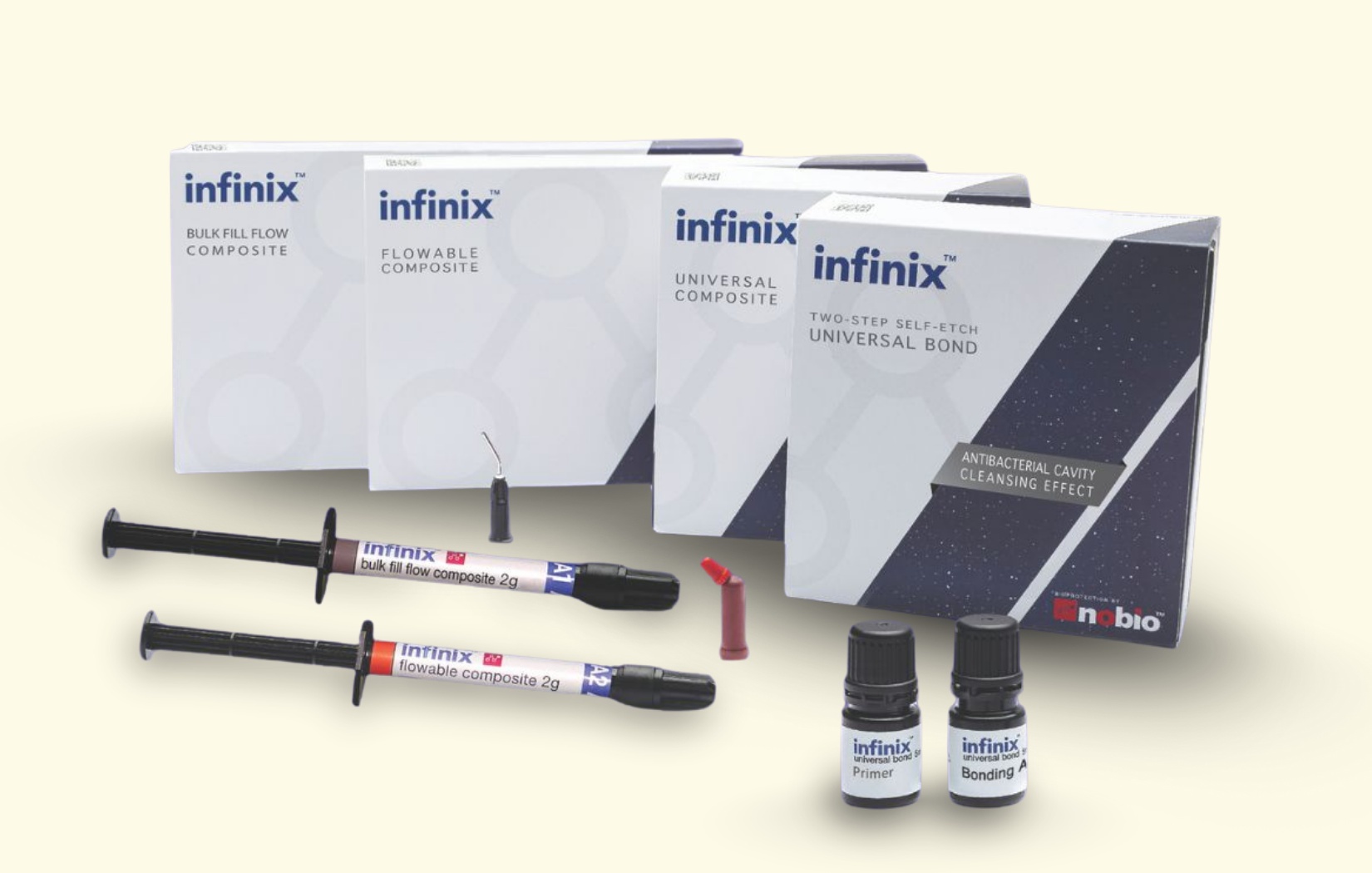
The underlying research began at Hadassah Medical Center and the Hebrew University of Jerusalem, led by dental researcher Ervin Weiss. Nobio licensed the technology in 2015 and continued development. Its roots help explain the company’s mix of clinical dentistry, chemistry and engineering. Infinix is the dental expression of a broader antimicrobial materials platform. Nobio’s 2019 announcement traces that origin.
The experiment that makes the idea concrete
In the UCSF-led study published in 2021, participants wore removable partial dentures carrying enamel slabs beside composite samples. One side used the antibacterial material; the other used a control. This split-mouth arrangement made each participant their own comparison. The researchers intentionally left that 38-micrometer space to let plaque collect.
Twenty people were recruited. Mineral-loss results came from 17 after four weeks. Mean mineral loss was 235 beside the antibacterial composite and 774 beside the control, with a statistically significant difference. The endpoint was enamel demineralization in a constructed gap model. It was a precise test of part of the decay process, rather than a count of fillings that survived for decades. The published paper describes the design and results.
Less mineral loss beside the test material
Nobio funded the investigator-initiated work through UCSF. That relationship belongs alongside the result. So does the scale of the experiment. A promising mechanism becomes more useful when a reader can see exactly what was measured and resist silently upgrading it into a larger claim.
A separate 2022 preliminary study combined laboratory work with a six-month experiment involving three volunteers. It reported antibacterial effects and explicitly called for a full-scale, long-term clinical study. Three people can help investigate a mechanism. They cannot describe the range of mouths, habits and restorations encountered across everyday practice. Its authors set out those limits.
The mouth keeps changing the test
A 2025 Journal of Dentistry paper brought another useful complication into view: saliva from children at high risk of caries. The researchers tested samples from 34 children against Infinix, conventional composite and amalgam outside the mouth. Infinix showed slower acidification and lower bacterial growth under the experimental conditions. This was an ex-vivo materials test, rather than a trial showing fewer replacement fillings in children. The study focuses on pH dynamics.
That progression reveals the commercial challenge. Dentists buy materials for individual patients, while experiments isolate manageable pieces of a difficult biological system. Contact activity also depends on contact. An antibacterial restoration cannot turn every surface of a mouth into its own surface. Placement technique, the restoration’s physical demands and ongoing care still matter.
“The goal is providing long lasting bacterial inhibition at the restorative margins”Ervin Weiss, Nobio’s 2021 award announcement
The customer is therefore buying a clinical tool with a defined role. A practice considering it can compare the product’s indications with its own procedures, review the technique guide, and ask which patient outcomes the supporting research actually tracks. That is a more useful purchasing conversation than treating every antibacterial material as interchangeable. Infinix’s partnership program also invites dental service organizations to discuss protocols and training across locations, extending the proposition beyond a single dentist trying a single syringe. The program describes those options.
Sold by the syringe, judged over time
The costs are tangible. On October 16, 2026, Infinix’s online listings showed Flowable Composite and Bulk Fill Flow Composite at $97 each, Universal Composite at $172, and Universal Prime & Bond at $197. The bulk-fill listing specified a two-gram syringe. These are supply prices, not patient bills or a calculation of savings per tooth. The storefront lists the range.
Getting a material to that shelf required capital. Nobio announced a $3.6 million investment in July 2018, led by aMoon and oral surgeon Ole Jensen, for regulatory work and manufacturing. The funding announcement specified those uses. The composite family subsequently received an FDA clearance covering reduced demineralization. Clearance and commercial adoption are separate hurdles.
The field is moving, too. In November 2025, Premier’s MultiMatch Flow Chameleon AntiMicrobial Composite received FDA clearance using Infinix Flowable Composite as its primary predicate. That makes Infinix a regulatory reference point, while giving buyers another antibacterial option to consider. Premier’s filing identifies the comparison.
There is a useful business lesson here: locate a specific failure mechanism, then put the proposed remedy inside something customers already use. Infinix asks a practice to consider a different material within restorative work. Whether that earns a permanent place on the tray will depend on evidence, handling and economics accumulating together, one restoration at a time.