The electrocardiogram is a familiar kind of medical paperwork: peaks, troughs, a physician looking for trouble. Its familiarity is part of the problem Anumana has chosen to investigate. A test can become so well understood that we stop asking whether it contains something else. What if a recording of the heart’s electrical activity could also suggest that its pump was weakening?
- The input: a routine, 10-second, 12-lead ECG.
- The product: medical AI that flags specific cardiovascular risks for clinicians.
- The business: turn research into a result that fits the hospital’s everyday work.
The clue was already in the test
Anumana’s first commercial answer was ECG-AI LEF, software that screens for low left ventricular ejection fraction. Ejection fraction describes the proportion of blood the left ventricle pushes out with a contraction. An ECG records electrical activity; an echocardiogram assesses the heart with ultrasound. Anumana’s proposition is to use patterns in the former to help identify people who may need the latter.
The company emerged in 2021 from nference and Mayo Clinic, with $25.7 million in Series A financing. Mayo brought cardiovascular research and clinical records; nference brought AI expertise. Murali Aravamudan, Anumana’s co-founder and founding chief executive, offered a linguistic analogy at launch.
“We think of it as the Rosetta Stone for cardiac medicine.Murali Aravamudan · April 2021
The name suits the proposition. Anumana is Sanskrit for inference: reaching a conclusion from observations and reasoning. Here, the observation is an electrical recording. The inference is that a patient may have a condition requiring further investigation. The distinction matters. A flag begins a clinical conversation.

A half-point worth looking at
The persuasive evidence is less theatrical than the metaphor. Mayo’s EAGLE trial enrolled 22,641 adults without prior heart failure across 45 clinics or hospitals. Primary care teams received either access to an investigational AI-ECG result or usual care. Researchers asked whether the additional information changed the rate of new low-ejection-fraction diagnoses within 90 days.
It did. New diagnoses occurred in 2.1% of the intervention group and 1.6% of the control group. That is a difference of 0.5 percentage points. Expressed another way, those rounded rates imply roughly five additional diagnoses per thousand people tested. The endpoint concerned detection, rather than proof that the software prolonged life.
22,641 adults · 45 clinics or hospitals
Investigational algorithm · trial endpoint: EF ≤50%
Overall echocardiogram use did not rise significantly, although patients with positive AI results received more of them. That is the useful behavioral detail: information helped direct attention. The trial’s definition of low EF was 50% or less; the current commercial LEF device targets 40% or less. The research and the product should be read with their own specifications attached.
The difficult part comes after detection
First FDA clearance for LEF was announced in October 2023. Turning clearance into routine use requires another set of skills. Someone must order the analysis, receive the result, decide what follows and arrange payment. Anumana’s customers are healthcare organizations and their clinicians. The patient benefits through that clinical relationship.
The company’s deployment approach puts processing inside the health system, with results flowing into existing electronic records and compatible ECG management systems. In July 2025, Anumana became the first certified third-party offering announced for Philips’ ECG-AI Marketplace. Distribution through equipment and systems already in use gives the software a practical route to the examination room.
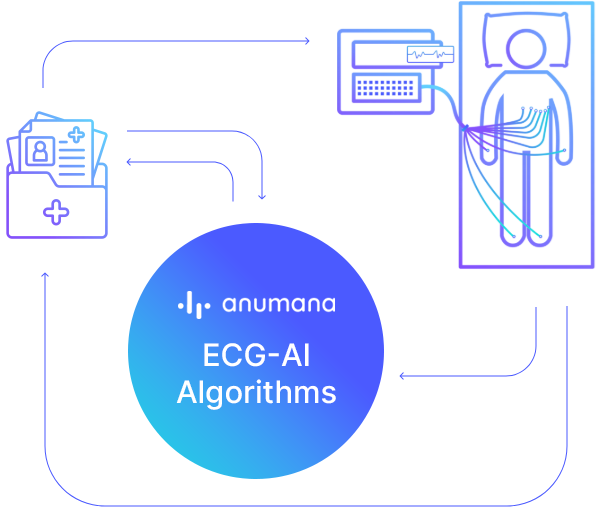
Payment is another hinge. Medicare outpatient reimbursement eligibility for LEF began in January 2025, according to Anumana’s announcement. That creates a payment route; it does not tell a hospital its contract price or guarantee reimbursement in every circumstance. The business combines commercial medical software with pharmaceutical and device-company collaborations.
It also has competition. Bunkerhill Health received FDA clearance for ECG-EF in September 2025, addressing reduced-ejection-fraction screening from routine ECGs. Anumana’s position rests on its Mayo research lineage, clinical evidence, integration and expanding portfolio. Buyers have reasons to examine the full workflow alongside the algorithm.
One ECG, several questions
In March 2026, Anumana announced clearance for its pulmonary hypertension algorithm. In April came cardiac amyloidosis, a disease involving abnormal protein deposits in the heart. These products ask different questions of the same familiar input. Each needs its own evidence and an appropriate patient population.
The company reported 73% sensitivity and 74.4% specificity for pulmonary hypertension in an independent study of adults with breathlessness. Its amyloidosis announcement reported 78.9% sensitivity and 91.2% specificity in a separate multicenter population. Those figures are not a head-to-head contest. They describe different studies, conditions and clinical tasks.
They also expose the limits of the proposition. Some disease will be missed; some flags will be false alarms. Value depends on clinicians interpreting the result and patients getting appropriate follow-up. A practice without capacity for the next test cannot turn every useful alert into useful care.
From the exam room to the procedure room
Anumana’s scope has widened. Its 2022 acquisition of NeuTrace added electrophysiology data and procedural AI capabilities. Boston Scientific joined its Series C financing in 2025, alongside a collaboration covering AI support for procedures including ablation and left atrial appendage closure. The announcement did not disclose the round’s size.
By June 2026, that broader direction had a concrete regulatory marker: FDA clearance for WatchMate Software, which uses echocardiographic images to support left atrial appendage closure planning and sizing. It is a different job from ECG screening, with a different input. Anumana is now pursuing both finding risk and helping clinicians plan an intervention.
The lesson other builders can borrow is practical: start with information people already collect, establish whether it changes decisions, then earn a place in the work surrounding that decision. Anumana’s bet is that the familiar heart test still has something to say. The business depends on what clinicians can do after hearing it.