David Snydacker had a perfectly serviceable answer to the lithium question. Prices would rise. Producers would respond. The market would do the sort of thing markets are supposed to do. He was a battery researcher at Northwestern, and friends wanted to know whether electric cars would run out of their essential ingredient. At first, the question seemed easier than the chemistry he dealt with every day. Then he tried answering it properly.
That small act of intellectual housekeeping became Lilac Solutions. Founded in 2016, the company works on extracting lithium from brine using ceramic ion exchange materials. Snydacker’s route there involved a rock band, student seminars, computational research and an eventual admission that a battery expert could have a substantial gap in his knowledge of batteries’ supply chain. It is an origin story with the welcome complication of somebody changing his mind.
A drummer takes a materials class
Before the lithium, there was Red Wire Black Wire. Snydacker played drums in the band for five years; its releases included Compass EP and Robots & Roses. At Wesleyan University, where he completed his undergraduate studies in 2009, his subjects included chemistry, molecular biology and biochemistry. His research used quantum mechanics to investigate molecular interactions. His extracurricular life came with rather more percussion.
He wanted to work on clean energy. Initially, he imagined doing that at an oil company. Instead, he turned toward graduate school and materials science, the discipline producing advances in batteries and solar technology. By his own account, he had never taken an engineering or materials course when he applied. Five applications produced one acceptance: Northwestern. A scientific career can hinge on a surprisingly modest admissions tally.
In Christopher Wolverton’s research group, he studied lithium-ion battery materials and the possibilities of lithium-metal batteries. His research biography describes calculations for cathodes and coatings, the less photogenic components that determine whether an attractive battery concept can survive real use. The same biography records leadership of the Northwestern Energy Technology Group and his work co-founding the Northwestern Energy and Sustainability Consortium. He was spending considerable time getting people from different disciplines into the same conversation.
The questions kept coming
Those conversations mattered. The energy seminars brought together doctoral researchers, undergraduates and business students to discuss technologies beyond the boundaries of their coursework. For Snydacker, they were a place to learn how engineering might connect with industry in the coming years. They also supplied friends willing to interrupt a discussion of electric vehicles with an inconvenient question about raw materials.
Would moving away from oil simply create a different resource dependency? Was there enough lithium? Similar questions arrived through Facebook. Snydacker began looking upstream from the battery itself, into the business of getting lithium out of the ground and into a usable form. He could see that established battery companies were already working hard for incremental improvements. The supply chain offered a different problem to solve.
The distinction was between the existence of a resource and the practical ability to produce it. Lithium-bearing brine contains a great deal besides lithium. Traditional evaporation ponds concentrate it by allowing water to disappear over time. A better extraction material could potentially separate out the desired ions more directly. Suddenly, a question about mining had become a problem a materials scientist could get his hands around.
Working with colleagues, he used Wolverton’s Open Quantum Materials Database to identify 13 candidate ion exchange materials. The database gave the search a computational starting point. Making useful extraction media would still require experimental work, repeated testing and a system capable of handling the liquid around it. The screen could nominate candidates. It could hardly commission a plant.
Chemistry acquires a payroll
The company began taking shape alongside the end of his doctorate. Early collaborators included Alex Grant, recruited into engineering, and chemist Ryan Zarkesh, whom Snydacker met through a cousin. There were grant applications, consulting work in batteries and an initial laboratory in Berkeley. These were practical arrangements for keeping an idea alive while it became something a customer might buy.
In 2016, Lilac won $15,000 in the green energy and sustainability track of Northwestern’s Venture Challenge. A Department of Energy Small Business Innovation Research grant followed in 2017. That funding allowed Snydacker to become the company’s full-time CEO. By June 2017, the team had completed a demonstration-scale process for manufacturing its ion exchange beads. Research now had to answer the recurring commercial question: can you make enough of the stuff?
He also had to learn to call people. Northwestern’s NUvention: Energy course helped move him from laboratory work into conversations with prospective customers around the world. By 2020, the company was pursuing existing lithium producers, other industrial operators and developers starting new projects. Snydacker had moved to the Bay Area to be closer to battery startups. The scientist’s working geography was becoming the entrepreneur’s network.
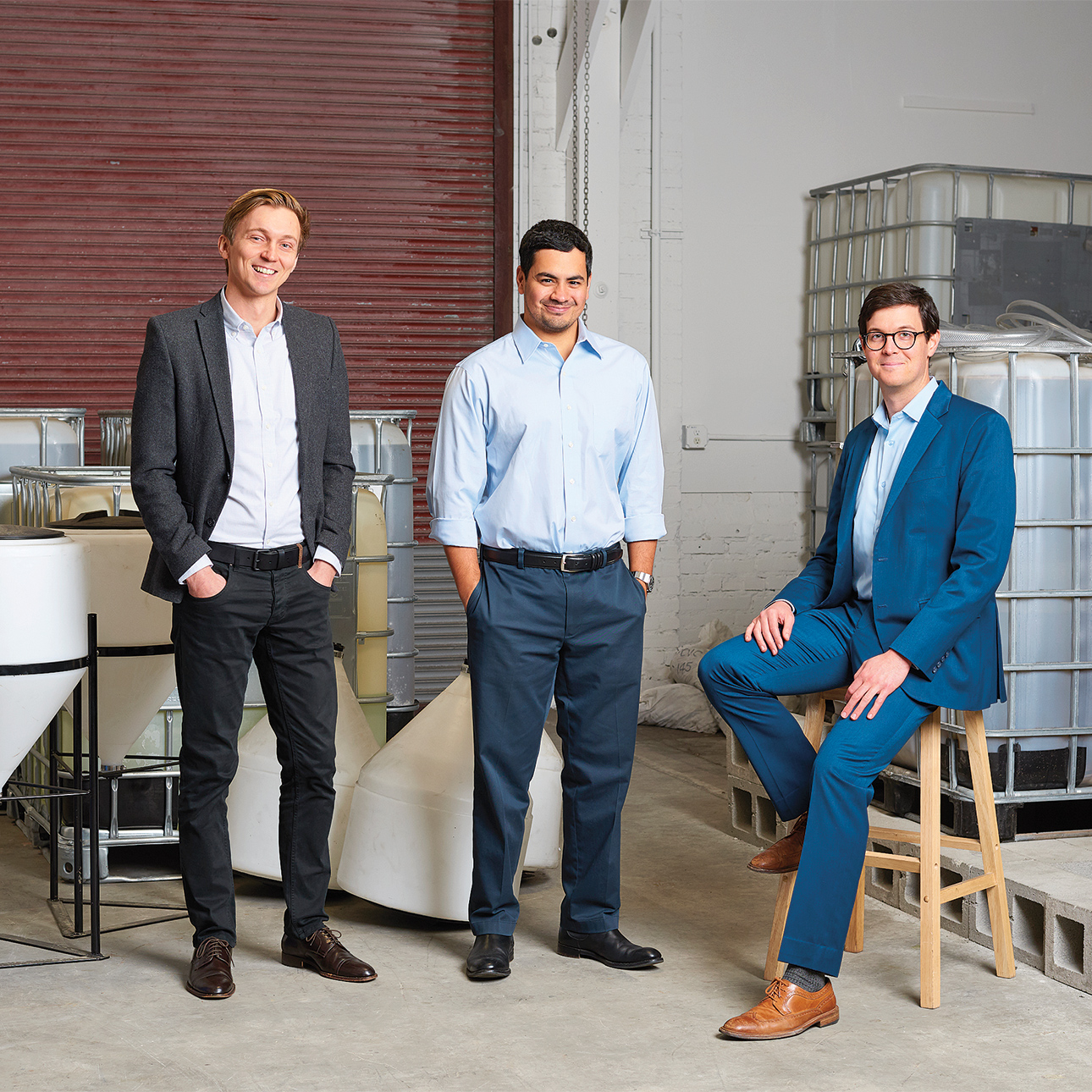
The attraction remained rooted in climate and energy. In 2020, he described choosing the field because climate change would shape the coming century and he wanted to work on solutions. His enthusiasm had a personal register, too. He called himself an electric vehicle nerd. Outside the business, music and hikes with his family still featured in his life. The drummer had acquired a doctorate and a company, with some interests surviving the additions.
Investors eventually supplied much larger sums. Lilac announced a $145 million Series C in February 2024, bringing reported total funding to $315 million. At that point, the company said it had tested more than 70 brine samples and accumulated more than 500,000 testing hours. The figures described a growing body of technical work. The company was preparing for a different kind of examination: delivering commercial operations.
A founder changes chairs
Two weeks after the funding announcement, Snydacker announced that Raef Sully would become CEO. Snydacker moved to President and Chief Technology Officer and remained on the board. Sully had joined as chief operating officer after running Nutrien’s nitrogen and phosphate business. Lilac’s next phase called for the experience of someone who had managed major industrial facilities.
Snydacker’s explanation had some fun with his own résumé. Lifeguarding, drumming and condensed matter physics, he wrote, were hardly conventional preparation for a mining chief executive. He had originally intended to recruit a CEO. The early company instead required someone sufficiently absorbed in the chemistry to keep it moving. Years later, handing over the job allowed him to bring technology and materials manufacturing back under his direct leadership.
“Hardly the archetype for a mining CEO.”David Snydacker, on his early résumé, February 2024
The change also makes the present-day description straightforward: founder, President and CTO. Sully runs the company. Snydacker continues the technical work and participates in strategy. A founder can remain central to a business while accepting that its next set of problems calls for another person in the chief executive’s chair.
The case for making it smaller
By late 2025, Snydacker and longtime colleague Amos Indranada were explaining a thesis that connected materials chemistry to construction costs. More productive ion exchange media could handle more lithium in less reactor volume. Smaller equipment requirements could mean smaller buildings and associated systems. Their December essay applied that logic to competition in energy supply chains, where the cost of constructing industrial facilities matters enormously.
Their example compared media requirements for a hypothetical 25,000-tonne annual lithium project: roughly 2,000 cubic metres using conventional adsorbents against about 100 using Lilac’s fifth-generation material. Those are Lilac’s design comparisons, rather than a record of two identical operating factories. They explain what Snydacker is trying to achieve: make a microscopic materials advantage large enough to alter a project’s economics.
Same production target.
Less extraction media.
Illustrative company comparison for 25,000 tonnes per year. Media volume only; not total plant size or measured commercial output.
There is chemistry after extraction, too. The recovered solution, called eluate, must be concentrated and refined into a saleable product. Its purity and lithium concentration influence the equipment required downstream. The plant’s economics therefore depend on what leaves the extraction stage as well as what it captures. A bead earns its keep across a flowsheet, rather than in an isolated laboratory result.
The physical commitments are accumulating. In January 2026, Lilac announced completion of construction of its media manufacturing line in Fernley, Nevada, with commissioning underway. It also signed a ten-year agreement for Traxys to purchase all planned Phase 1 lithium carbonate output from the Great Salt Lake project. Manufacturing capability and a buyer address different parts of the same journey toward production.
In June, Hatch was selected to manage engineering, procurement and construction for that planned facility, with first lithium targeted for 2028. In August, Lilac announced selection for a $100 million Department of Energy award, subject to final negotiations. September brought an environmental approval for Lake Resources’ Kachi project in Argentina, which uses Lilac’s technology. Kachi was moving into further engineering; a permit was a step toward production.
For Snydacker, the question from the seminars has acquired buildings, contracts and regulators. His work now sits inside the distance between a material that performs and an industrial operation that delivers. The original answer about markets responding to prices was pleasantly compact. He has spent a decade helping build the much more cumbersome answer that involves actual equipment.