A building is enough to confuse a satellite. The moment a phone passes through a roof, the clean certainty of GPS can dissolve into guesswork. Rob Palfreyman saw a company in that failure. Years later, he encountered another problem shaped like an ordinary object: clothing that could sense a worker's posture and respond with mechanical support. His career has moved from chips to maps to apparel, but the central question has barely moved at all. What should technology do when the familiar system loses the plot?
Palfreyman is an electrical and electronic engineer by training, educated at the University of Southampton. His early management career ran through the component, wireless and location industries, including Integrated Device Technology, Cambridge Positioning and Nemerix. Those jobs sat low in the technology stack, close to the machinery that makes a digital service possible while remaining invisible to the person using it. It is an excellent place to develop a taste for unglamorous problems. A location pin on a screen looks effortless only because somebody has dealt with radios, databases, signal noise and the rude fact of concrete walls.
The room GPS forgot
In 2009, Palfreyman co-founded sensewhere with Tughrul Arslan and Zankar Sevak. The company emerged from the University of Edinburgh and set out to provide useful positioning inside buildings and dense urban spaces, the places where satellite signals weaken or vanish. Its approach combined signals already present in the environment, including Wi-Fi and Bluetooth, with an automatically built location database. The system could switch among sources and learn from devices moving through the world. No army of technicians needed to map every corridor by hand.
The technical idea came with a commercial wager: scale would be won by lowering the cost and ceremony of deployment. Palfreyman handled product strategy, investor relations, customer acquisition and an operation spread across Europe, China and the United States. By 2017, sensewhere said its service had handled 50 billion location requests and reached more than 600 million monthly active users. Tencent became a customer and investor, putting the technology to work in services connected with WeChat and Tencent Maps. TomTom was also named among its customers.
The numbers are conspicuous. The more revealing detail is architectural. Sensewhere did not ask every venue to become a bespoke infrastructure project. It tried to turn the scattered signals of everyday digital life into a shared positioning layer. The product's intelligence lived behind the experience. A person did not need to admire the database. They simply needed the blue dot to stop behaving foolishly.
“GPS doesn't work inside buildings, because the structure of the building blocks the signal.”Rob Palfreyman, explaining sensewhere's premise in 2017
Palfreyman described the indoor-location market as niche, then immediately spoke about global use. That apparent contradiction is one of his recurring commercial habits. A narrow technical problem can have an enormous addressable surface when it appears everywhere. Airports, shopping centers, schools, hotels and offices all share the same roof-shaped inconvenience. Solve the inconvenience once, then let software travel.
Edinburgh, Mountain View, Shenzhen
Sensewhere's geography mattered almost as much as its code. The headquarters sat in Edinburgh, where Palfreyman praised the concentration of universities, graduates and public support. In 2017, the company had 18 of its 24 employees there, with other offices in Mountain View, Beijing and Shenzhen. He described the Edinburgh team as containing nine or ten nationalities. That mix was practical, not ornamental. A product meant to work globally needed engineers, partners and customers who could keep it from becoming provincial.
China was not treated as a distant sales territory. Tencent's investment and distribution gave sensewhere a route into a huge base of mobile users. Palfreyman later wrote that local partnership helped navigate the country's fragmented digital ecosystem and technical constraints. His career offers a correction to the romantic picture of international expansion as a triumphant airplane landing. It looks more like years of demonstrations, local relationships, regulatory understanding and the patient reuse of people who have proved dependable.
When the map became a garment
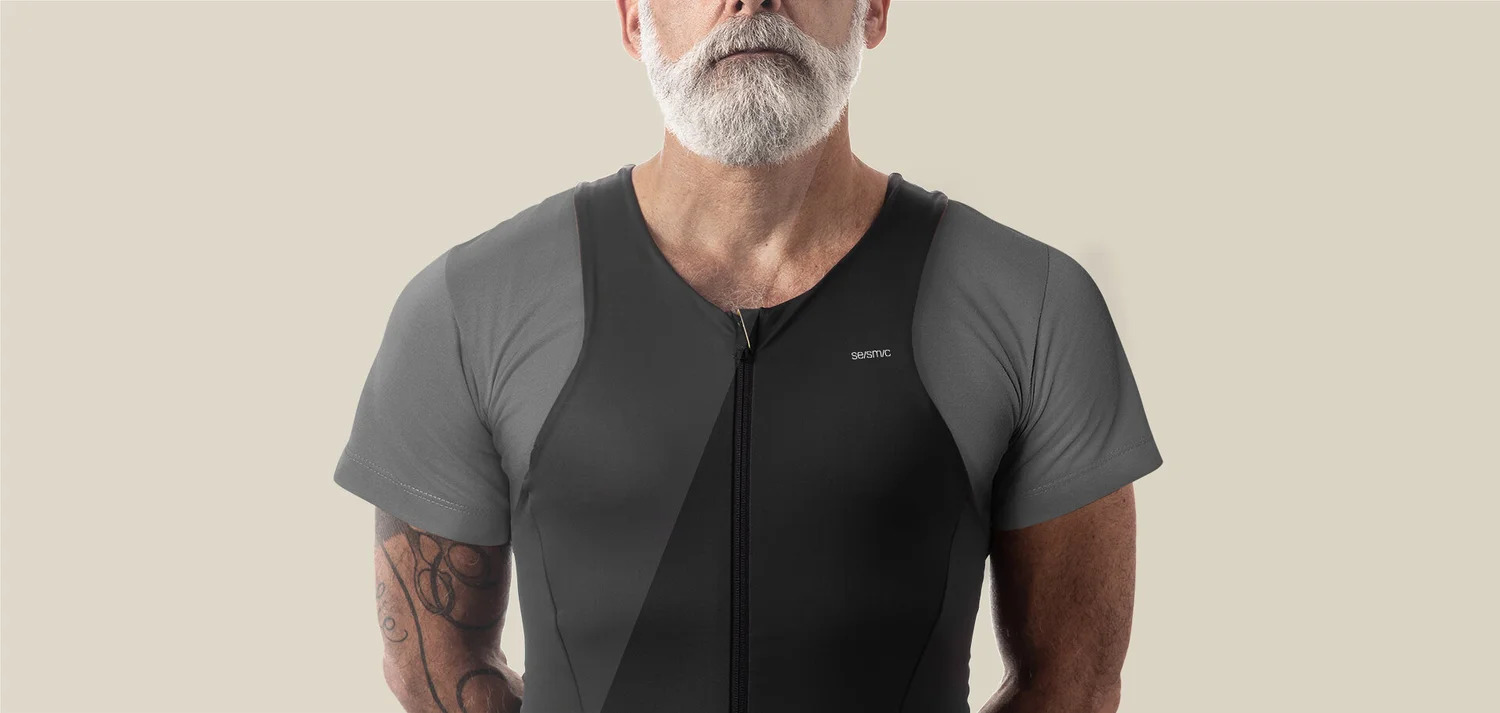
In 2021, Rich Mahoney announced that he was stepping down as Seismic's chief executive and that Palfreyman would take the role. Mahoney stayed on the board. Seismic had been spun out of SRI International, where the underlying technology began in a DARPA-funded program. The company was pursuing a product it called Powered Clothing: a fusion of apparel and robotics built around sensors, processors and software-controlled Flex-Drive electric muscles.
The leap from indoor positioning to wearable robotics looks larger on a résumé than it does in the underlying logic. Sensewhere asked a device to interpret its surroundings and respond to context. Seismic asks a garment to interpret posture and activity, then provide support at the useful moment. Both products live in the gap between sensing and assistance. Both depend on sophisticated machinery becoming quiet enough to feel natural.
Calling the product clothing is a consequential design choice. A robot suggests a special encounter, perhaps a fenced area or a trained operator. Clothing belongs to the morning. It has to fit, breathe, move and survive a working day without becoming the day's main subject. Seismic's industrial version uses a vest-like form, with its actuation around the core and hips. The engineering may be the novelty, but adoption is likely to turn on everything that feels ordinary.
The useful machine is sometimes the one a person can forget they are operating.
Palfreyman's first visible commercial move at Seismic echoed an older playbook. In April 2021, the company hired Intralink to pursue sales, manufacturing and channel partnerships in China and South Korea. He had worked with the same group since 2000, first at Cambridge Positioning Systems and later at sensewhere. Three companies, one cross-border relationship. Founders often describe networks as if they were collections of names. This one behaved more like infrastructure: tested, maintained and called back into service when the next product needed to cross an ocean.
Start at the awkward edge
Indoor rooms and physical workflows reveal where familiar systems stop being useful.
Make context do work
Ambient radio signals or body-motion data can become the raw material of a product.
Hide complexity carefully
A blue dot and a work vest are familiar surfaces for complicated machinery.
Keep the good bridges
A market-entry relationship can become more useful each time the product changes.
A career built below the surface
There is a temptation to describe Palfreyman's path as a sequence of pivots. Semiconductors become wireless location; location becomes advertising context; software becomes clothing. Yet the skills accumulate more neatly than the labels suggest. Components teach respect for constraints. Positioning teaches how to extract meaning from imperfect signals. A global platform teaches distribution. Wearable robotics demands all three, plus the humility to make a machine accommodate the body rather than expecting the body to accommodate the machine.
His public comments are relentlessly operational. He talks about customer contacts, technical expertise, manufacturing partners, investor relations and talent pools. Even the aspiration behind sensewhere, to become a broadly used indoor-positioning solution, was paired with an argument about low cost and scalability. The grand vision always arrives with a deployment mechanism tucked under its arm.
That may be the most reusable part of the story. Palfreyman does not appear to be collecting futuristic objects. He is working on the seam where a technical capability meets a normal behavior. People already carry phones into buildings. Workers already put on clothes. The task is to add intelligence without adding a ritual elaborate enough to defeat the benefit.
There is also a lesson in choosing a name for the thing. Indoor positioning made sensewhere legible as a service before anyone needed to understand its signal model. Powered Clothing places Seismic's work in a wardrobe before placing it in a robotics lab. A good category can do part of the operator's job: it explains where a product belongs, who might use it and what kind of expectations should govern it. The phrase does not erase the engineering. It gives the engineering a doorway into a buying conversation. For a leader who has spent decades moving between technical teams, investors, partners and customers, that translation is not packaging added at the end. It is part of the product architecture.
Seismic's 2022 announcement brought that idea into a commercial worker-safety product. The company described connected apparel that recognizes posture, provides mechanical support and produces data for improvement. It is a long way from a location database, yet the old instinct survives: notice what the environment is saying, make sense of it in real time and return something useful before the user has to ask.
A roof once created the problem. Now it is a stoop, a squat or a repeated motion. Palfreyman keeps moving toward the places where technology's confidence fades. There, among noisy signals and ordinary routines, he tends to find enough context to build with.
Keep exploring