The revealing word in RJ's company description is “tacticians.” A tactician has a particular job. Someone else must decide which job matters. In a business that can sell a website, a social account, a mobile experience or a search campaign, that division of labour raises an awkward question: who is keeping track of what the customer actually needs to do?
- The offer: digital strategy supported by a network of specialists.
- The territory: web, social media, mobile and search.
- The useful idea: choose a customer goal before choosing a channel.
RJ, the marketing business associated with Rick Jessup and rickjessup.com, describes its purpose in those terms. Its public positioning puts the client's goals and brand ahead of awards or the mere presence of social media in a proposal. That is a modest promise with an interesting implication. A campaign can be competently executed and still be the wrong campaign.
Consider a hypothetical retailer. Its social posts attract attention. Its website looks respectable. Its search ads send visitors somewhere. Each supplier can point to completed work. Yet the retailer's question remains embarrassingly simple: did any of this help someone buy? RJ's proposition belongs in that gap between the things a marketing team delivers and the thing a customer comes to accomplish.
The person before the platform
Jessup's professional history helps explain the breadth of the proposition. His public XING résumé lists account management at CryptoLogic, ownership of Richard Jessup Marketing, North American marketing at Net Entertainment and marketing at Ingram Micro, followed by client engagement at 58Ninety beginning in 2008. These are career entries, rather than an RJ client list. Together, they put commercial relationships, technology and marketing in the same working life.
There is also a smaller, more sociable trace: Jessup appears on a PodCamp Toronto 2009 registration page, with links to Twitter and his OverAnything blog. The detail is appealing because it catches digital marketing before today's familiar stack of dashboards and automation became the default furniture. Here is a practitioner participating in the community around publishing and conversation.
RJ's LinkedIn page describes a self-owned business founded in 1994. Its stated arrangement is a strategy practice connected to tactical expertise. Read that as an operating idea: a business need can call for different combinations of skills. The interesting question for a prospective customer is how those skills will be assembled around the brief.
Four channels, one unfinished journey
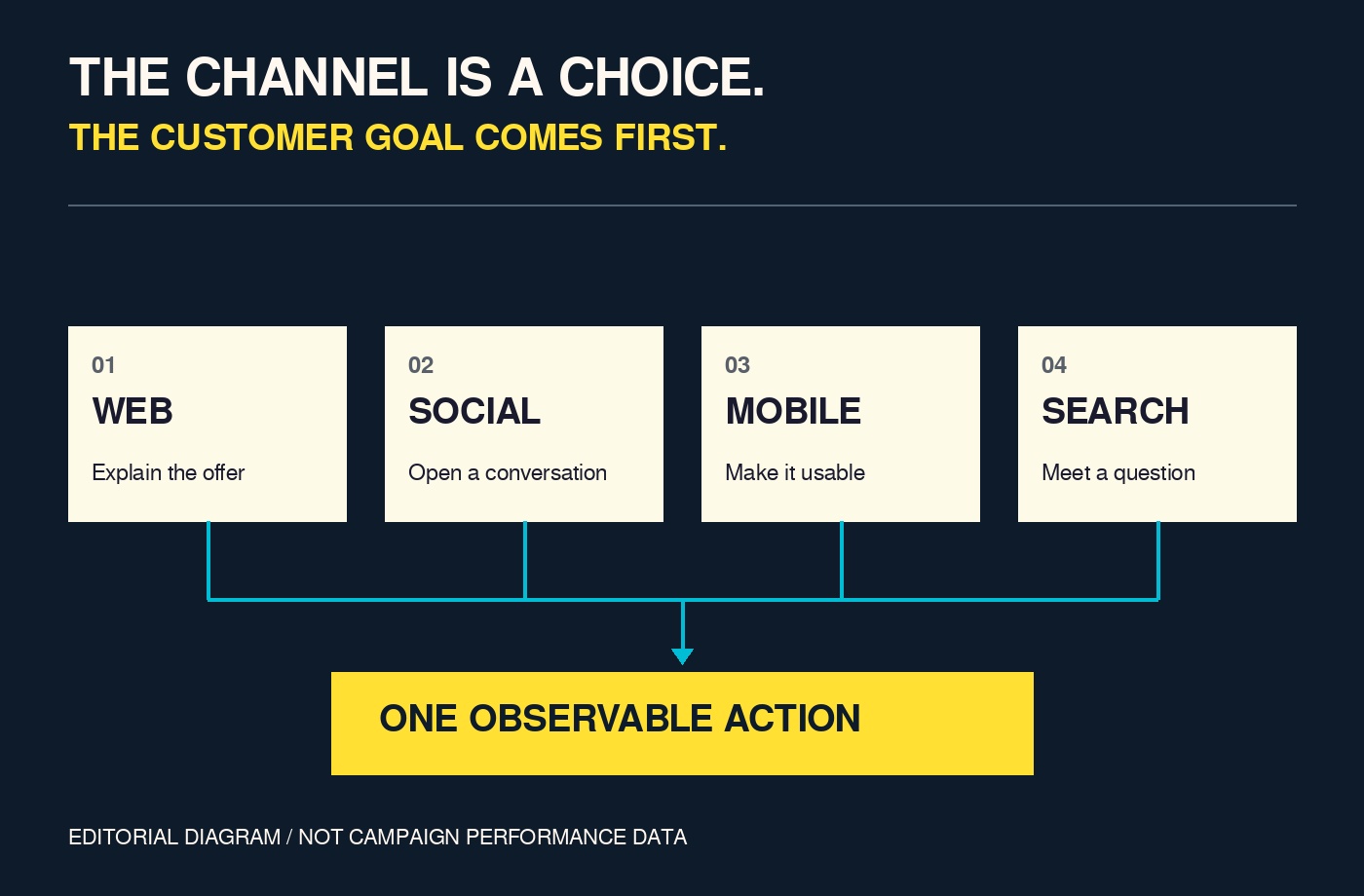
The four specialties on RJ's profile are easy to recognise individually. Web gives a business a place to explain an offer. Social creates opportunities for discovery and exchange. Mobile asks whether the experience survives the device in someone's hand. Search meets a person already looking for something. This is an editorial way to understand the mix, rather than a proprietary RJ framework.
Put them together and the unit of work changes. A social post may create the question that a website answers. A search result may lead to a mobile page that either clarifies the offer or makes the visitor give up. The customer crosses these boundaries without asking which supplier owns them. A useful strategy has to cross them too.
That makes RJ's positioning relevant to brands and organisations buying digital marketing expertise. It also gives an agency buyer a useful way to think about outside strategic help. The purchase is judgment about how the pieces fit, followed by the specialist work needed to put that judgment into practice. For a buyer, the distinction matters when several competent vendors disagree about where to spend the next dollar.
“Digitally-focused strategy with a network of tacticians”
RJ's company description
The invoice is only part of the decision
RJ sits in the services market. Its offer is consulting and marketing expertise, rather than access to a packaged software product. The practical alternatives include hiring an independent strategist, asking a full-service agency to own the assignment, or coordinating specialists inside the client's own team. These are alternative buying models, not a claim about particular competitive bids.
A sensible comparison would separate the cost of deciding from the cost of doing. In a hypothetical engagement, research and planning, creative production, website work and paid distribution would need their own scope. The useful question is whether the proposed work makes those responsibilities clear. A small planning fee can accompany expensive implementation; a large media budget can conceal a weak customer experience.
There is a cost in the client's time as well. Someone must explain the offer, approve the work and decide what counts as a result. The network model makes that coordination especially worth discussing. Before commissioning any strategy practice, ask who owns the handoffs and who can change the plan when the evidence becomes inconvenient.
Copy the question, then test the answer
The most portable lesson from RJ's positioning is a short exercise. Write down one action a customer should be able to take. Then walk through the route to it. For a hypothetical appointment business, that might mean finding the service, understanding the price and booking a suitable time. For a business selling expertise, it might mean recognising a relevant problem and requesting a conversation.
At every step, ask what would stop that person. An unclear promise? A page that is difficult to use on a phone? A missing answer? This exercise does not require buying every channel RJ names. Its value is in exposing the point where a collection of marketing activities ceases to function as a coherent experience.
There are limits to what the idea can accomplish. If a client cannot fulfil the promise in the advertising, better distribution may simply introduce more people to the problem. If nobody can agree on the desired customer action, specialists can stay busy without resolving the disagreement. And if the assignment is already precise, a capable specialist may be all the buyer needs.
RJ's useful distinction is therefore a matter of sequence. Decide what should happen for the customer. Choose the expertise. Make the connections work. It is an appealingly plain way to judge a marketing proposal: after all the platforms have been named and all the deliverables counted, can somebody explain what happens next?