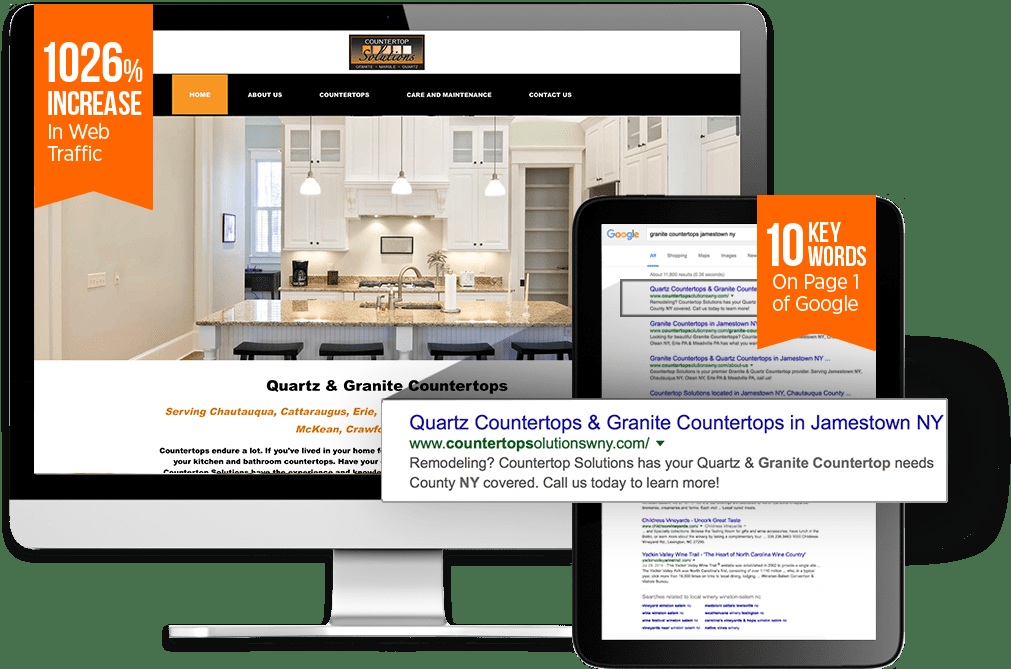
Countertop Solutions had a problem that a bigger advertising budget could easily make worse. The Jamestown, New York, business wanted more residential work. But local contractors were already customers. Going after homeowners in precisely the wrong way risked competing with the people who helped keep the workshop busy. Growth required a map with a little tact.
- Hearst DMS bundles websites, search, advertising and customer follow-up.
- Its distinctive asset is access to Hearst media alongside local marketing execution.
- The useful lesson: fix the customer journey before buying more attention.
Hearst Digital Marketing Services supplied a new website and an SEO campaign aimed at surrounding towns. Social and reputation services followed. The geographic choice was the strategy: find residential demand beyond the shop’s immediate circle while preserving relationships at home. The company’s historical case study reports a $4,000 job within the first few weeks and eventual expansion of the workspace.
The town next door
There is something wonderfully unglamorous about that solution. No new category had to be invented. The shop needed people in particular places to discover a service it already knew how to provide. Hearst DMS works in this space between a business’s practical ambition and the machinery that determines whether anyone finds it.
The company says it serves more than 17,000 local businesses with a team of 700. Its customers include caterers, pool contractors, wineries and turf installers. These are businesses where a useful inquiry can become an appointment, an estimate and a substantial job. Marketing has to make sense at that human scale.
Its range is broad: websites, organic search, paid search, display ads, email, social media, reputation management, video and native advertising. The attraction is having those pieces managed together. A business owner can buy a coordinated program instead of becoming the unpaid project manager for several specialists.
The publisher in the room
Many agencies can build a website or run search ads. Hearst DMS also belongs to a media owner. Its About page explicitly pairs website and search services with targeted display advertising on local news and national sites, naming SFGATE and Car and Driver. That gives its offer a distribution component beyond the usual agency toolkit.
The distinction matters when a business wants both immediate inquiries and recognition. Search advertising addresses someone already looking. Display can introduce a business before that search happens. Neither automatically produces a customer; they do different work. Hearst’s proposition is that a common plan can make the handoff more deliberate.
DMS calls its three disciplines “Promote,” “Trust” and “Engage.” The labels describe a familiar sequence: be seen, appear credible, give someone a reason to act. The less familiar part is treating reviews, search results and follow-up messages as dependencies within the same assignment.
A good-looking site can hide
Coyne Catering offers the cautionary example. According to Hearst’s customer account, its previous agency delivered disappointing service and a website on a platform that made search visibility difficult. DMS rebuilt the site around photographs, video, venue profiles and event information, then added organic and paid search campaigns.
The reported result included more than 16,000 unique visitors and 100 contact-form inquiries over a year. Those are historical, company-published results. Their value here is the diagnosis: presentation and discoverability had become separate jobs. A prospective customer cannot admire a website they never encounter.
Ohio Custom Pool & Patio faced another version of that disconnect. Its website was buried in search and performed poorly on phones. The owner was buying leads that rarely became sales. DMS combined local SEO with a mobile website, reporting and account-manager calls. The case describes a shift toward qualified inquiries generated through the contractor’s own presence.
The inquiry you already paid for
At Weathervane Winery, the bottleneck appeared later. Search, social and web services brought inquiries, but contacts were scattered. When the winery wanted to promote an event center, it needed a usable audience of people who already knew the business.
DMS’s automation service synchronized contacts from email, the website and phone into a master list. The case records 195 offers claimed, alongside referrals and positive reviews. The transferable idea is modest and valuable: collect inquiries in a form that lets you continue the conversation. Otherwise, each campaign begins by purchasing attention all over again.
“In the past year with Hearst DMS, we have consistently received over 120 calls a month!”Cherrie Lictus, Countertop Solutions
Historical company-published testimonial
The bill, and the business behind it
One historical example puts money on the table. South Florida Putting Greens had spent more than $3,000 monthly with a boutique agency. Hearst’s account says DMS supplied a website and a broader marketing bundle at half the previous cost. It also attributes $750,000 in revenue to the program over a year. That is a customer-case claim, rather than an independently established return or a current price.
The operating model helps explain the bundle. Alongside direct client work, DMS offers white-label fulfillment to agencies and media companies, including training, workflow support and a performance dashboard. Shared delivery can sit behind many local sales relationships. Buyers are paying for ongoing execution and coordination as well as advertising reach.

Start with the awkward question
Business owners can borrow the discovery process. DMS assesses the existing web presence and competitors, captures business goals, then builds a service mix. Ask what a customer is worth, which towns matter and which services deserve more demand. Those questions make a budget useful before a campaign begins.
A coordinated program fits businesses that need several marketing jobs done and have the capacity to answer inquiries. It is less compelling when a narrow specialist task would suffice, margins cannot support acquisition costs, or the business cannot handle new work. Countertop Solutions supplies the memorable lesson: sometimes the smartest first move is deciding exactly where growth should happen.