The useful thing about a tedious textbook is that it leaves plenty of room for rebellion. At the University of Florida, Ritam Rana and three friends were staring down 30 pages of statistics material when their attention wandered toward a better question. “What if we could convert this boring PDF into a video?” they asked. The page did not become more charming. The question became a company.
Those four friends were Rana, Ritvik Varada, Arjun Talati and Jonathan Maynard. They had met at Florida and shared the familiar student complaint that complicated ideas often arrive in their least inviting clothes: dense paragraphs, static diagrams, no pacing, no voice and no hint that someone considered the reader’s dwindling will to live. Their proposed remedy was Knowlify, software that could turn source material into narrated, animated explanation.
Rana now runs the company as co-founder and chief executive from San Francisco. Knowlify is part of Y Combinator’s Summer 2025 batch. It sells a self-serve platform and a managed studio, aiming at training, onboarding, product education and internal communication. Upload a document or begin with a prompt; the system helps build a storyboard, visuals, narration and a finished video. The proposition is simple enough to survive a meeting: your company already wrote the knowledge down, but your audience may prefer a play button.
What if we could convert this boring PDF into a video?The question that started Knowlify
Before the PDF, there was a boat
The founder story becomes more legible when it starts several years earlier, on water. Rana’s name appears on the Water Dogs’ 2021 RoboBoat technical design report. The high-school team built an autonomous catamaran called Sir Docks-A-Lot, which is either an excellent robot name or evidence that engineers should be permitted to name everything. The report describes fiberglass hulls, laser-cut templates, cameras, LiDAR, GPS, Arduino boards and a self-leveling sensor gimbal.
Its deeper subject is iteration. The Water Dogs used ROS Gazebo to test code in simulation before taking the craft onto a lake, where every small bug became wetter and more time-consuming. They combined signals from several sensors, assigned weight to uncertainty and tried to keep the boat moving toward a goal without colliding with expensive reality. Rana later described developing control algorithms, clustering LiDAR point clouds and helping the team to a fifth-place finish.
His student project list has the cheerful range of someone learning by shipping. There was a Minecraft server plugin that he says accumulated more than 3,000 downloads, an autonomous tennis robot trained to recognize balls, a Discord-controlled door lock, a Unity game, an NBA player classifier and a stock-and-crypto prediction app. Some projects were serious, some playful, and all required an input to become an action. The pattern would return at Knowlify: absorb an unruly pile of information, find the useful signal, then make the next step visible.
The class project finds a market
Knowlify’s first frame was education. The founders wanted visual explanations with the clarity they admired in 3Blue1Brown, the mathematics channel known for making abstractions move. Their Y Combinator launch described a “personal 3Blue1Brown for any topic, on demand.” Yet customers soon supplied a broader reading list. Textbook publishers, universities and researchers appeared, followed by onboarding teams, training managers, marketers and communications leads. A student problem had an office job.
Rana and the team followed that pull. Their updated YC description presents Knowlify as an AI video company for business. Training manuals, standard operating procedures, product specifications and internal updates all suffer from the same indignity as the statistics chapter: they can be important without being inviting. The company began offering both software for teams that want control and a studio for teams that want the result delivered.
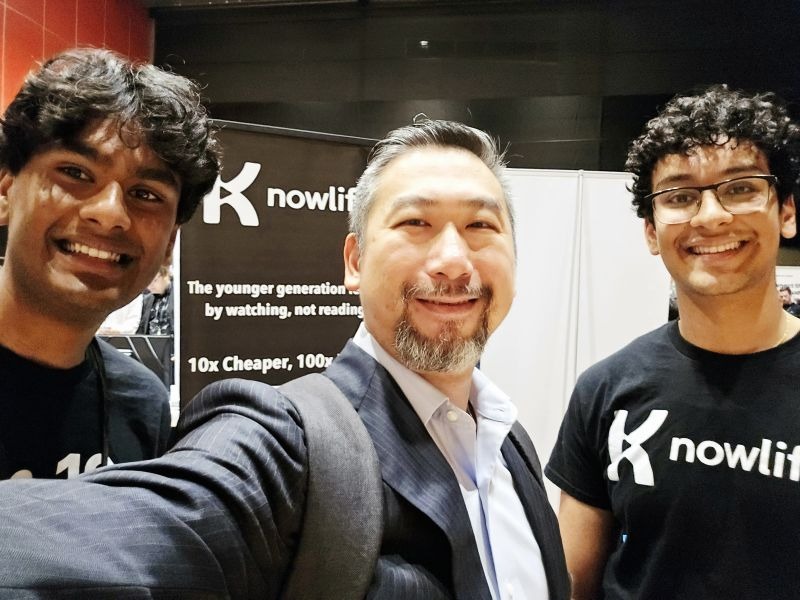
The move was geographic as well as commercial. In spring 2025, Rana announced that the team was heading to San Francisco after receiving early investments. Soon afterward came acceptance into Y Combinator’s S25 batch. His post set an unapologetically ambitious target of reaching $150,000 in monthly recurring revenue by summer’s end and thanked his co-founders for working “day and night” on the product. The number reveals the appetite; the thanks reveals the unit of work. Every public telling of Knowlify’s origin uses “we.”
From 200,000 to 400,000
In October 2025, Knowlify announced a $3 million funding round. Rana returned to the statistics classroom in his telling of the news, recalling the four founders “sittting in our Stats class” and asking how to escape the dense material. By then, the company said it had generated more than 200,000 videos. The typo was left to fend for itself; the startup had a larger count to manage.
By August 2026, Rana said the total had passed 400,000. Output doubled between those public markers. The more interesting shift was qualitative. Knowlify’s current pitch speaks less about rescuing a single student and more about helping a company explain itself consistently: the same brand, the same tone, a repeatable visual language, with fewer weeks surrendered to production.
The company’s Product Hunt launch sharpened its aesthetic position. Rana argued against two common AI-video defaults: uncanny digital presenters and generic stock footage with text placed on top. Knowlify instead emphasized custom animation, an editable storyboard, reference images and trained planning and voiceover models. In comments, Rana put it plainly: “I don’t believe avatars are the way for knowledge sharing and that has been our thesis since day 1.”
The awkward middle is the product
It is tempting to describe AI video as a magic conversion: PDF goes in, charming animation comes out. Rana’s public exchanges are more useful because they dwell in the awkward middle. A long, text-rich PDF produces better context than a page made mostly of screenshots. Users can steer the narrative and modify scenes. Reference-image support has been developing. A typical one-to-three-minute explainer can take about five minutes to generate its first version, after which a human still chooses what deserves changing.
That last detail contains the actual product. Explanation is not merely compression. It is selection, rhythm and respect for what could be lost. A compliance procedure cannot sacrifice its exception clauses for a prettier transition. A technical paper may need the diagram that makes the argument work. Knowlify must make video quickly while protecting meaning, and it must give users enough control to correct the machine without returning them to an editing suite built for professionals.
Rana’s own route offers some preparation for that tension. At the University of Florida, he participated in the Emerging Scholars Program with professor Eekta Jain and worked in the Jain Lab as an undergraduate. His career includes AI engineering at Abundant, a YC F24 company. The robotics work trained him to distrust a single sensor. The research experience placed him near questions of human interaction. The scrappy software projects rewarded short feedback loops. Knowlify bundles all three habits: triangulate the input, consider the viewer, ship the next version.
We’re now creating a future where the main way to consume and understand content will be through video.Ritam Rana, August 2026
What he is really trying to replace
Rana sometimes speaks as if reading itself has received a termination notice. It makes a good launch line, but Knowlify’s work suggests a subtler ambition. The company depends on written source material. It is not burning the library; it is adding a screening room. Documents remain the record, dense with detail and blessedly searchable. Video becomes the guided tour, choosing a route through the shelves for someone with six minutes before the next call.
The distinction matters because the company is now operating beyond classrooms. In a student explainer, misunderstanding may cost a quiz point. In a workplace procedure, the stakes can involve time, money or quality. Rana’s author page reflects that practical turn. In 2026 he wrote about vendor uptime, service agreements, character limits, manual editing, agency economics and methods for turning standard procedures into watchable walkthroughs. The subjects are less romantic than “the future of knowledge,” but considerably closer to the buyer’s calendar.
He has also kept one foot in the communities that made him. The Rust in Piece robotics team lists Rana as a FIRST alumnus and strategic adviser who offered guidance on its engineering portfolio, community events and roundtable discussions. It is a small biographical detail with pleasing symmetry: the student who once documented an autonomous boat now advises other young builders on how to explain their work.
Knowlify still has to prove the broadest version of its thesis. Four hundred thousand generated videos show use, not universal comprehension. A play button can attract attention, but animation alone cannot guarantee that the viewer understands. Rana’s challenge is to make the product’s output feel authored, accurate and worth finishing, even when the first author is software.
For now, the company’s origin remains a compact founder lesson. Begin with an annoyance you know intimately. Build with people who shared it. Let unfamiliar customers show you the larger version of the problem. Then keep the original question close enough that the product does not forget whom it serves. Somewhere, a 30-page statistics chapter is still waiting. Rana would like to give it a timeline, a voice and, mercifully, a play button.