The job interview took place in a Berkeley pub, except it was not quite a job interview. Olivia Risset arrived ready to explain why a young battery company should hire her. Richard Wang and his co-founder, Mauro Pasta, arrived with other fellows from their startup community. They had invited her to happy hour. Risset had prepared for an audition; she had walked into a conversation.
She became Cuberg’s first employee. Wang would later acknowledge how little he had known about interviewing, and how fortunate the company had been with that hire. There is something useful about beginning his story here. Before the acquisition, the awards, and the new company proposing to make fuel from aluminum, there was a scientist learning a profession for which a doctorate offered only partial preparation.
Today Wang is co-founder and chief executive of Voya Energy. He previously built Cuberg, a lithium-metal battery business acquired by Northvolt in 2021. Across those companies, a question keeps returning: who needs this invention enough to help it survive its expensive early years?
A battery needs someone to buy it
Wang’s formal education began with mechanical engineering at Caltech, where he earned his bachelor’s degree in 2011. At Stanford, he moved into materials science and engineering, completing his doctorate in 2016. His research with Yi Cui received support from both NSF and National Defense Science and Engineering graduate fellowships. In 2014, he also studied battery degradation during an internship at Tesla.
His publication record from those years includes work on open-framework electrode materials and on ion insertion, with papers appearing in journals including Nature Communications and Advanced Energy Materials. The subjects were specific and technical. They place his later role as a company builder alongside an earlier career spent studying how materials behave inside electrochemical systems.
That training put him close to the materials inside a battery and the compromises outside it. A cell has to perform. A product has to fit a price, a production line, and a customer’s priorities. Those demands can be remarkably indifferent to the elegance of the research.
Wang and Pasta discussed the problem while working in Cui’s group. When they founded Cuberg in 2015, they were entering an industry already littered with ambitious battery ventures. A better battery could still be too expensive. Buyers of familiar products had familiar budgets. Asking them to admire a scientific improvement was easier than asking them to pay for one.
The early strategy therefore favored specialist customers. A TomKat Center grant helped the founders develop the business, and publicity brought an unexpected approach from an energy-industry company. Its battery-powered probes operated in high temperatures. Cuberg’s electrolyte concept addressed a difficulty that mattered to that particular buyer. The first opening came from a specific operating requirement, rather than a mass-market launch.
The aircraft’s expensive kilogram
Aviation became an important market for Cuberg because weight changes the calculation. An aircraft must carry its energy supply into the air. Improving the amount of energy stored for a given weight can make a battery valuable in ways that a buyer comparing prices alone might overlook.
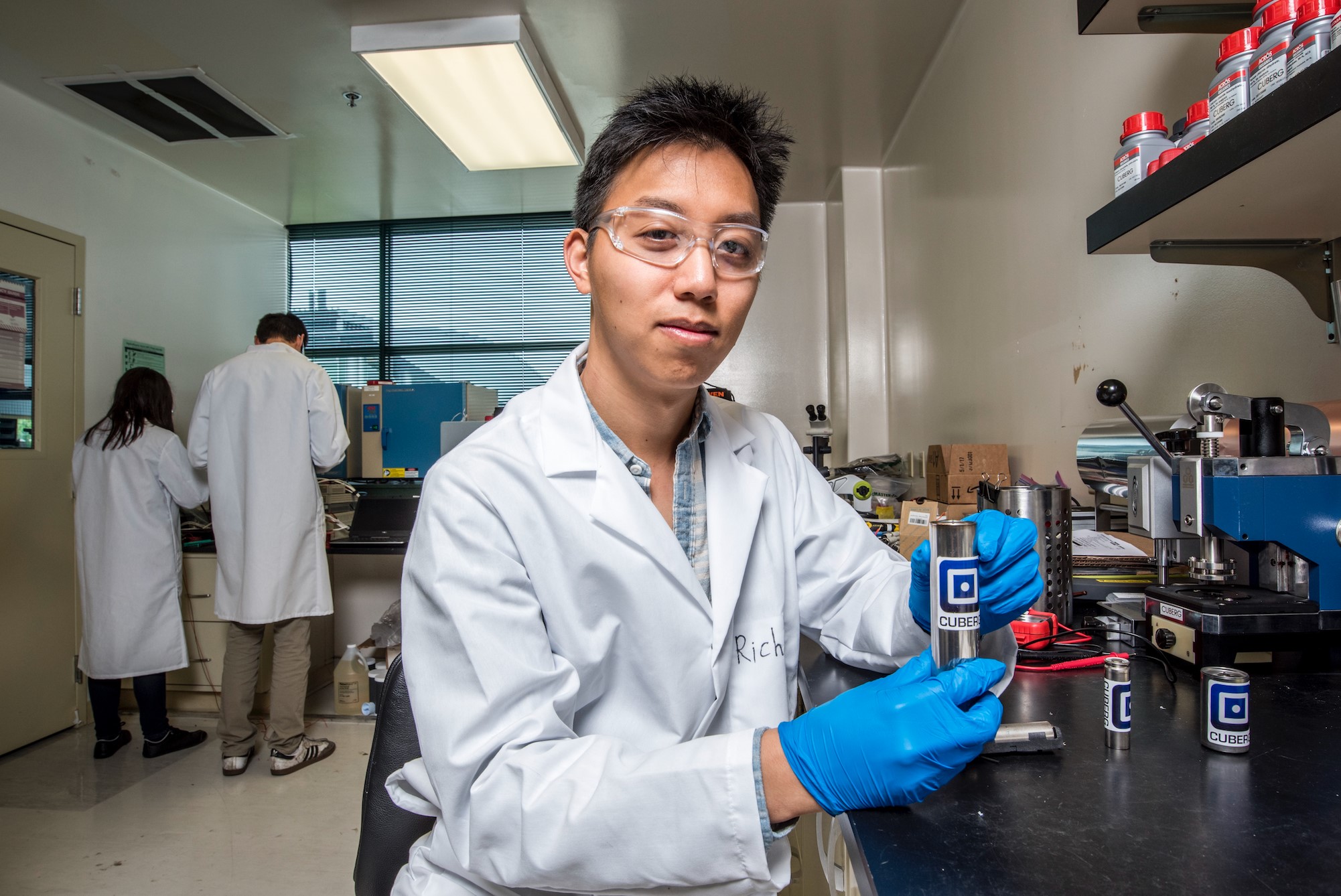
Cuberg developed lithium-metal cells, using metallic lithium in place of the graphite anode associated with conventional lithium-ion batteries. Wang’s commercial task was to connect that chemistry to an application. Electric aircraft offered a demanding audience: performance mattered, but so did the pack, its integration, and the requirements surrounding flight.
In conversations about aviation, he returned to the whole system. A cell company could not simply hand over a promising component and assume the aircraft manufacturer would solve everything around it. The business needed to understand how its technology would work once assembled into something that actually had to fly.
By January 2024, Wang was discussing Cuberg’s battery module at the BloombergNEF Summit in San Francisco. The company reported externally validated specific energy of at least 270 watt-hours per kilogram for its eVTOL module. That figure described a module, a meaningful distinction from an isolated cell result. His subject had expanded from material formulation to the equipment an aircraft developer might evaluate.
At least 270 watt-hours per kilogram, externally validated for the company’s eVTOL battery module.
Learning how to hire beyond happy hour
The pub encounter was an early chapter in another education. As Cuberg grew, Wang introduced a more structured hiring process. Candidates gave technical presentations on a topic they chose and another chosen by the company. Interviews also explored personal and cultural qualities, with consistent questions across applicants.
Wang treated the process as something he could learn and improve. A hiring article from Carbon Lighthouse, shared through the fellowship community, influenced the approach. An energy startup was borrowing a useful method from another energy startup. The network supplied more than laboratory space.
There was a connection hidden in that first hire, too. Steven Kaye had suggested Risset speak with Wang and Pasta. Years later, Kaye would become Wang’s co-founder and chief technology officer at Voya. A helpful introduction had become one small part of a much longer working network.
“When we first started out, I really didn't know much about effective interviewing and hiring.”
Richard Wang, reflecting on Cuberg’s early team
The admission is refreshingly practical. Wang’s account allows room for luck, advice, and revision. The first team could gather informally; a growing company needed repeatable ways to judge people. The founder’s own habits had to change along with the size of the enterprise.
What the acquisition was supposed to supply
Wang joined the Activate fellowship in 2016, gaining time and support during the transition out of university research. Cuberg also drew on grants and strategic investment. By the time of its acquisition, its supporters included organizations with very different reasons to care about advanced batteries, from Boeing to public energy agencies.
Northvolt acquired Cuberg in 2021. Wang described the attraction in terms of manufacturing capability and access to capital. A small team could develop the technology; a larger battery company could bring resources needed to scale it. The acquisition gave that division of labor an organizational home.
Industrial progress had an unglamorous physical dimension. In one California-funded project, Cuberg converted a 5,000-square-foot office into a pilot production facility. The work involved acquiring, installing, and commissioning equipment for the steps of cell assembly. A promising formulation needed an environment in which people could make consistent prototypes.
Wang served as principal investigator on that project. Its goals included increasing production and getting battery prototypes into customers’ hands. The report records a team growing from 12 to 125 full-time members over the project, with more than 25 employees directly involved. Scale meant organizing the people as well as the production steps.
The company eventually grew to 225 employees. Wang’s work received Forbes 30 Under 30 recognition in energy in 2017 and MIT Technology Review Innovators Under 35 recognition in 2022. Those markers trace a career moving out of the laboratory, though the more revealing evidence is the growing range of problems he had to handle: customers, hiring, equipment, and capital.
His next customer is waiting for power
Voya began with Wang, Matt Horton, and Kaye as its founders. Horton brought experience commercializing electric transportation and charging infrastructure; Kaye brought a career in advanced materials and battery development. Wang brought the experience of taking a research-based company through acquisition and growth.
The new company publicly launched in November 2025, announcing a $13 million seed round led by founding investor Energy Impact Partners. In August 2026, Voya announced a further $35 million Series A and unveiled an energy system built around an aluminum-based fuel and an electrochemical generator.
The intended customer is easy to picture in commercial terms: an operator with a site that needs dependable electricity and cannot wait for more grid capacity. Data centers are an initial market. Industrial facilities and other infrastructure also sit within Voya’s stated ambitions. Once again, Wang is working backward from a constraint that makes a customer care.
Voya says its system converts aluminum fuel into electricity without combustion. The concept pairs a transportable material with generation equipment at the point of use. In his public discussion of metal fuels, Wang has explored why diesel remains difficult to replace: it combines storage, transportability, and dependable power in a form customers already understand.
Fuel regeneration is part of the longer-term circular-system ambition.
The next steps remain industrial ones. Voya’s published roadmap places containerized generator deployment in 2027 and commercial launch in 2029. These are plans. Funding and laboratory progress give Wang a route toward those dates; operating equipment for customers will determine what follows.
The beginner who kept his notes
Looking back on Cuberg in 2026, Wang described a mixture of luck, strategic reasoning, and maneuvering. He did not present the early business as a perfectly executed blueprint. That perspective fits his earlier account of hiring, and his return to Stanford to discuss the difficulties between invention and commercialization.
His interests at Stanford also included Engineers for a Sustainable World, the Solar Decathlon, and the Stanford Symphony Orchestra. His university years had room for an orchestra as well as engineering projects. Those activities belong to the same period as the technical training and business experiments, before Cuberg became the main entry in his professional biography.
Wang now has a different metal, a different machine, and another set of prospective buyers. The recurring work is familiar: find the requirement that makes an invention useful, assemble people who can deliver it, and keep the enterprise alive long enough to learn. At Cuberg, even the first interview needed a little improvisation. At Voya, the customer’s question is rather direct: when can the power arrive?