The Robot That Ate the Pool Boy
A cable-free pool robot turned into a global category leader, a Fluidra check, and a plan to automate the entire backyard. Here is how Aiper got the pool boy out of the pool.
There is a very old chore that almost nobody enjoys and almost everybody with a pool has performed: leaning over the water with a long pole, dragging a net through the deep end, and fishing out leaves while your back complains. For decades the "solution" was a machine tethered to the pool by a cable, running off the filter pump, dragging a hose behind it like a reluctant dog. Aiper looked at that setup and asked the question that turned into a company: why is there still a cord?
Founded in 2017 and now run from Atlanta with engineering roots in Shenzhen, Aiper makes cordless, battery-powered robots that drop into a pool, map it, scrub the floor, walls and waterline, and park themselves when they are done. No cable snaking across the deck. No pump to plumb. You press one button, or open an app, and go back to the lounge chair. In under a decade that idea went from a single product to a brand that a December 2025 study by Euromonitor International named the world's No. 1 smart robotic pool cleaner by 2025 manufacturer sales volume.
01 — The ideaCutting the cord on a boring chore
The robot-vacuum wave hit living rooms first, and most startups piled into the same crowded room. Aiper went outside. The pool-cleaning market was large, unglamorous, and dominated by companies thinking in hoses and pumps rather than batteries and apps. That mismatch was the opening. Strip the cable off a pool cleaner and two things change at once: the machine gets dramatically easier to use, and the whole product stops looking like plumbing and starts looking like consumer electronics - something with industrial design, a companion app, and a spec sheet people compare.
The name encodes the pitch. "Aiper" reads as "AI" plus "per," as in person - roughly, AI working for the individual. The company frames its whole reason for existing around giving people their time back, which for a pool owner is measured in Saturday mornings not spent skimming.
02 — The productsSeagull, Scuba, and a talking buoy
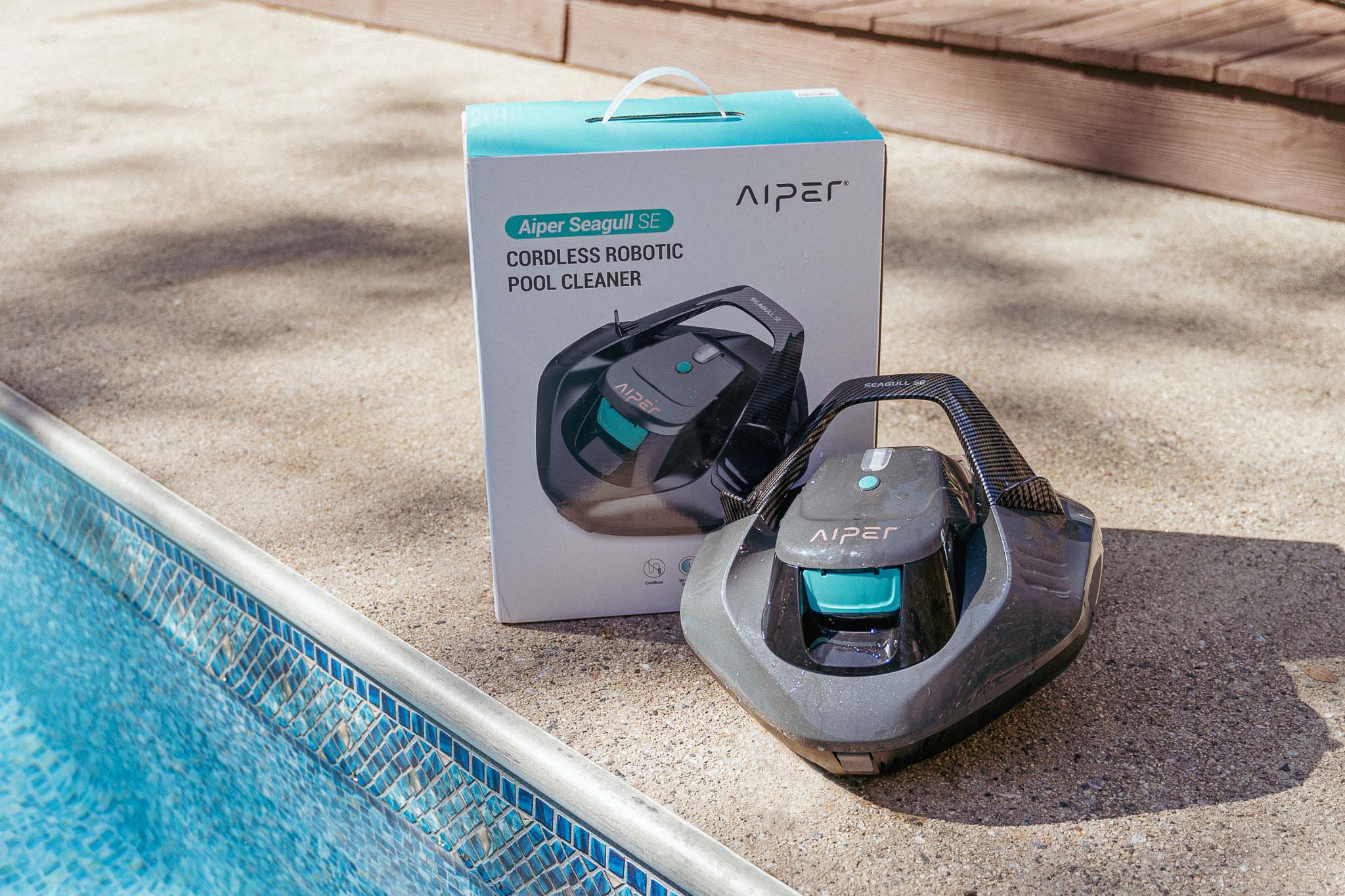
Aiper's range climbs from simple to serious. The Seagull family - the SE and the quad-motor Seagull Pro that arrived in 2023 - covers above-ground and mid-size pools with runtimes around 90 to 150 minutes per charge. The Scuba line goes after in-ground pools. The Scuba S1, launched in 2024, became the company's best-seller, cited with more than 500,000 owners. Above it sits the Scuba X1 series, whose top X1 Pro Max stacks nine motors, roughly forty sensors, dual scrubbing and a wet-charging dock - a genuinely odd amount of engineering aimed at the bottom of a swimming pool.
Figures are approximate and vary by pool size, mode and conditions. X1 Pro Max cited at up to ~15 hours.
The cleverest piece is the least visible. Water blocks Wi-Fi and Bluetooth, which is why most submerged robots go silent the moment they dive. Aiper's answer is HydroComm, a floating buoy that uses ultrasonic signals to stay in touch with the robot underwater and relay commands from your phone - switch modes, or call the machine back to the wall - while the Pro version adds solar charging and real-time water-quality monitoring for pH, temperature and more. It is the difference between a robot you launch and hope for, and one you can actually talk to mid-dive.
When we design new generations of cleaners, we start by listening - really listening - to pool owners.
03 — The customersWhoever owns the pool
Aiper's buyer is the residential pool owner - above-ground and in-ground, entry budgets to premium - who would rather not vacuum. The company's 2026 materials cite more than four million users worldwide, up from earlier three-million figures, sold across fifty-plus countries through its own site, Amazon, and a retail network growing toward ten thousand stores. The model is straightforward direct-to-consumer and retail hardware, with docks, filters and water-quality buoys giving owners reasons to come back after the first purchase.
There is a marketing tell in the customer list, too: the Arizona Diamondbacks made Aiper their official robotic pool cleaner in 2024. A Major League Baseball team now has a preferred pool robot, which is either a sign the category has arrived or a very good joke that happens to be true.
04 — The competitionCorded incumbents vs. battery upstarts
The benchmark for raw cleaning has long been Maytronics and its Dolphin cleaners, which are corded and very good at their job. Polaris, a brand under pool giant Fluidra, is the pump-driven old guard. The newer cordless field includes Beatbot, the closest premium AI rival, plus WYBOT and others. Aiper's wedge is convenience and price: no cable to untangle, an app in your pocket, and models that undercut the premium tier while still climbing to a flagship above two thousand dollars.
| Approach | Cordless | App control | Setup |
|---|---|---|---|
| Aiper (battery robot) | Yes | Yes | Drop in, press start |
| Corded robot (e.g. Dolphin) | No | Varies | Plug in, mind the cable |
| Pump-driven (e.g. Polaris) | No | No | Hose to the filter |
Simplified comparison of cleaning approaches, not a head-to-head performance test.
05 — The moneyFluidra buys in
The clearest outside validation came in April 2025, when Fluidra - the global pool-industry leader and the parent of Polaris - led a strategic investment reported at more than one hundred million dollars. That is the incumbent choosing to back the cordless upstart rather than fight it, alongside investors including Yunqi Partners, XVC and Fosun RZ Capital. Aiper had raised earlier capital too, including a round led by XVC in 2022. Total funding and revenue are not cleanly disclosed; figures circulating in databases should be treated as estimates.
Joining forces with Fluidra gives us an incredible opportunity to accelerate our innovation and growth.
06 — The expansionFrom the pool to the whole yard
Here is where Aiper stops being a pool company. In 2025 it introduced IrriSense, a smart irrigation sprinkler, and started calling its target the "smart yard" - the idea that the same cordless, app-controlled automation people accepted for the pool can spread to the surface skimmer, the lawn, the garden. The Surfer S1, a solar-powered robotic skimmer that patrols the water surface all day without a plug, was the first step onto that path back in 2024.
At CES 2026 the strategy showed up as a full lineup: the AI-driven Scuba V3 flagship line with dual-camera navigation, the EcoSurfer Senti solar skimmer with water-quality monitoring, and IrriSense 2 - several of which collected CES Innovation Awards. It was Aiper's fourth straight year as a CES honoree, which is less about trophies than about a hardware brand turning a trade show into a reliable marketing engine.
07 — The takeawayWhat is copyable, and where it breaks
The reusable lesson is not "make a pool robot." It is that a tired, ignored chore - run by incumbents who stopped questioning their own defaults - can become a modern category the moment someone removes the obvious friction and rebuilds the thing as consumer electronics. Cut the cord, add the app, take the design seriously, and let an event like CES do a chunk of the marketing.
Where would it not work? Battery robots trade some brute cleaning power and runtime for convenience, and reviewers still hand corded Dolphins the edge on the hardest jobs. The premium models climb past two thousand dollars, which is a lot of robot for a small pool. And the smart-yard bet is exactly that - a bet that owners want to automate the lawn and the surface the way they automated the floor. Aiper has the ranking, the Fluidra backing and the product cadence to make the case. Whether the backyard becomes as automated as the living room is the open question the next few pool seasons will answer.