Richard King had a question about a startup’s product. The chief executive brought in the marketing manager. The marketer needed the head of product. The head of product sent a Slack message to a remote backend developer. Four people, one answer. Somewhere in that little procession lies a convincing argument for the profession King would spend the following years organizing.
He recounted the exchange in April 2019. His question concerned the product’s capabilities at scale. Nobody needed to invent a new feature or commission a research project. They needed to explain something the company already made. The information was there; getting it into the conversation required a small corporate relay.
King’s interest was in the handoff. A business could employ people who understood its technology and people who understood its audience, yet leave an awkward distance between them. Product marketing, he argued, belonged in that distance. Today, as founder and CEO of Product Marketing Alliance, he runs a business devoted to helping the people who work there.
One company. Four people. The knowledge was already inside.
A room before a curriculum
PMA’s Slack community began in March 2019. King wanted an independent voice for product marketers, who were having to gather the information for one job from several different places. He started by giving them somewhere to find one another. Content came next, followed by education, with talent and tools on the horizon.
The commercial beginning had a rather less orderly plot. In August, King decided to make PMA a business because he wanted to sell T-shirts at an event. The checkout device failed to arrive. The shirts were given away. Retail had offered its opinion, and it was brief.
His retrospective on early growth was equally plain. The ambassador program worked at each stage he described. Facebook, selling shirts and LinkedIn advertising appeared among the things that did not. His practical advice included simple polls, clear channels and active moderation. Keeping a community useful required people doing the work.
“I also think you need dedicated people to make a community great”
Richard King, 2020
The sequence says something about the enterprise. A conversation can expose the question that a course ought to answer. An ambassador can explain why a problem matters before a founder turns it into a product. For a company selling professional learning, those exchanges are also a way of keeping the classroom close to the job.
By the third quarter of 2021, PMA reported 20,000 members in its Slack channel. King’s year-end review also recorded a London summit with more than 300 product marketers and virtual events that drew thousands. The original gathering place had become one part of a wider schedule of learning, research and encounters.
March: the Slack community opens.
Slack members reported in Q3 2021.
Product marketers at the London summit in Q4 2021.
The classroom gets a periodic table
King’s teaching has a recurring concern: making a sprawling role legible. His Udemy biography describes a background managing marketing teams, development teams and product strategy for business software companies. The territory spans several departments before anyone has decided what to call the person standing in the middle.
In January 2023, LinkedIn Learning released his 55-minute Product Marketing Foundations course. Its scope included the role’s responsibilities, a framework for the work, relationships across the business and the possibility of a career in the field. The beginner, in other words, needed help understanding both the assignment and the organization surrounding it.
Later that year, an article under his name introduced PMA’s Product Marketing Periodic Table. Sales enablement, pricing, research and positioning sat alongside the skills and measures involved in the work. Chemistry had lent a profession its classroom furniture. At least these elements could be discussed without protective goggles.
The format makes an otherwise slippery problem visible. A job can contain research, storytelling, customer knowledge and commercial decisions without making their relationship obvious to a newcomer. Putting the pieces on a page gives people something to point at. It also gives their colleagues a fighting chance of understanding why the role extends beyond preparing the next launch announcement.
There is a commercial logic to teaching the role from the beginning. Before someone can choose a specialist course, they have to recognize the work they are trying to improve. The foundations course offers that first orientation. The table offers another way in: a reader can locate one familiar task and see the other responsibilities surrounding it.
The founder among the practitioners
King describes himself publicly as a builder, with five startups and three exits. He is also CEO of The Alliance, the broader community business. His public account of what interests him brings product, marketing, sales and data together, then adds the less glamorous questions of operating a company: finding talent, running teams and combining efficiency with a workable culture.
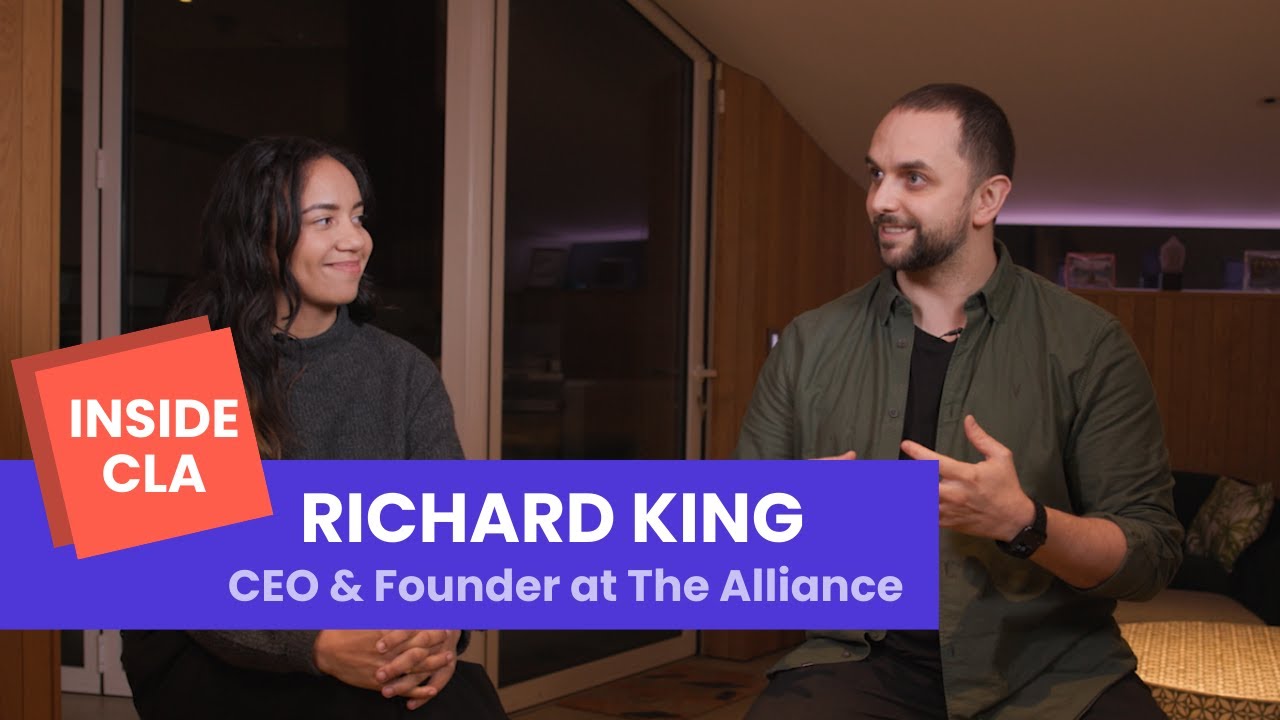
In the first Inside CLA interview, the conversation covered managing rapid growth, deciding when to start another community and treating internal teams as communities themselves. The question grows with the business. Once a founder has gathered people around a common profession, he also has colleagues whose own work needs coordination.
A smaller connection supplies a useful detail. In October 2023, product marketer and author Harvey Lee thanked King for supporting his book. King had read a home-printed manuscript six months earlier and supplied a testimonial. Lee’s post celebrated the shared black T-shirts as well as the endorsement. The merchandise, it seems, had found a happier second act.
That episode puts a person beside the institutional titles: someone willing to read a colleague’s unfinished pages. It is a modest scene, but a suitable one for a business whose proposition rests on practitioners giving one another their attention.
The answer is already somewhere in the company
By August 2025, King was writing about another version of the opening problem. Product marketers were expected to produce research even when no dedicated research function existed. His advice began with the evidence already accumulating around them: objections in sales conversations, customer comments, support threads and the reasons deals were won or lost.
He proposed making that evidence a habit. Collect it, look for recurring problems and turn it into a short account of what the company is hearing and what should happen next. AI could help summarize interviews or group objections. The marketer still had to decide what deserved attention.
There is a pleasing continuity here. In the early startup exchange, a useful answer had to travel through four people. In this later guidance, useful answers are distributed across entire functions. King is still asking how the organization can put its knowledge to work before the next decision has already been made.
For the practitioner, this is a demanding kind of authority. Access to the information brings a responsibility to make it useful. A folder full of transcripts does little for a sales team facing a repeated objection. Someone must connect the observation to the choice the business is about to make.
For an education business, the same problem becomes a question of selection. Which recurring difficulty deserves a lesson? Which needs a conversation with another practitioner? A community provides both possibilities, but someone still has to pay attention to the difference. The value depends on how well the response fits the question.
The next colleague is a machine
The AI material in King’s recent work follows that practical interest. In October 2025, he discussed how product positioning might change as buyers use AI tools for discovery. Building on work by product marketer Gordon McConnell, he argued for clear, consistent descriptions across reviews, comparisons and other places where buyers encounter a product.
His concern was the explanation a company receives back from the outside world. A carefully prepared message in an internal document is only one part of that picture. The words customers repeat, and the descriptions appearing elsewhere, can carry their own account of what the product means.
In April 2026, PMA published the opening installment of his six-part Claude series. It organized AI around recognizable product marketing work, including competitive information, launch briefs and analysis of customer interviews. The teaching question remained familiar: which tool helps with which piece of the job?
King has also made his writing available through a Delphi AI version of himself. The newsletter invites readers to ask it questions about research, positioning and go-to-market work. For someone selling access to shared knowledge, it is an especially literal experiment: a conversation with the accumulated back catalogue.
When Tuesday refuses to cooperate
His September 2026 writing returns to a thoroughly human nuisance. The product team gives a shipping date. Product marketing books the webinar, prepares the emails and briefs sales. Then the date changes, and the marketer inherits a new collection of conversations.
King recommends separating the build date from the communication schedule, agreeing dependencies early and developing a narrative that can continue across a quarter. A beta, a release and a customer’s later experience can each give a team something useful to say. One delayed feature need not take the entire communication plan with it.
It is advice about working with an organization as it behaves. The engineering schedule has its reasons; the marketer has commitments too. Naming those dependencies makes the work visible while there is still time to do something about them. A calendar becomes more useful when everyone knows whose promise each date represents.
Across the community, the courses and the newer tools, King keeps circling a recognizable problem. People need to understand enough of one another’s work to make something happen together. Back in that startup meeting, four people eventually produced an answer. His career has given the people responsible for such answers somewhere to compare notes before the next question arrives.