Resy was born from a very New York observation: a restaurant could be full every night and still be a miserable business. In late 2013, Ben Leventhal - who had already co-founded Eater - was eating on the Upper East Side with entrepreneur Gary Vaynerchuk and technologist Michael Montero. The chef stopped by. The dining room was alive. The economics, they learned, were not. Great restaurants had scarce inventory, thin margins and software bills that rose with every guest. Surely, the trio thought, a desirable Friday table had value.
The first Resy tried to expose that value directly. Launched in 2014, its app let participating restaurants charge diners for prime-time reservations. A Tuesday seat might cost $10; a Friday could run $50 or more. Leventhal later recalled that Resy kept about 20 percent and the restaurant received the rest. Some restaurants, uneasy about pocketing the money, sent their share to charity. The pitch borrowed the language of airlines, hotels and Uber: inventory changes in value, so let price clear demand.
It was tidy in a spreadsheet and awkward in a dining room. Critics saw a velvet rope with a checkout button. Restaurants would participate, but the trickle of $5 and $10 fees could not support the giant business in the founders’ imaginations. By the end of 2014 - roughly five months after launch - Leventhal knew the model would not work.
Diners paid a variable fee. Resy took a cut. The economics stayed small and the optics became the story.
Restaurants paid a flat subscription for booking, tables and guest data. Consumers booked without a Resy fee.
The customers wrote the second pitch deck
The failure did leave Resy with a valuable asset: the attention of restaurateurs. Their feedback was unromantic and consistent. Forget pricing the hot table. Build a reservation widget for the restaurant’s own website. Build table management. Replace per-cover fees with one predictable subscription. Help a group recognize the same guest whether she books uptown or downtown.
“Look, this is cool, but this is not what we really need.”Restaurant feedback, as recalled by Ben Leventhal
Resy moved fast. The widget was the first unlock because it allowed a restaurant to book its own customers without paying for each person seated. Early plans ran about $99 or $399 a month, regardless of whether the software handled one cover or 10,000. The universal guest database was another quiet advantage: notes, preferences and visit history could follow a diner across a restaurant group instead of dying on a local server.
This is the part founders can copy. An initial product does not need to win if it earns unusually honest access to a difficult customer. Listen for the complaint that appears in different words at every meeting. Then ship the smallest workflow that removes it. Resy’s paid-table provocation opened doors; the boring booking widget kept them open.
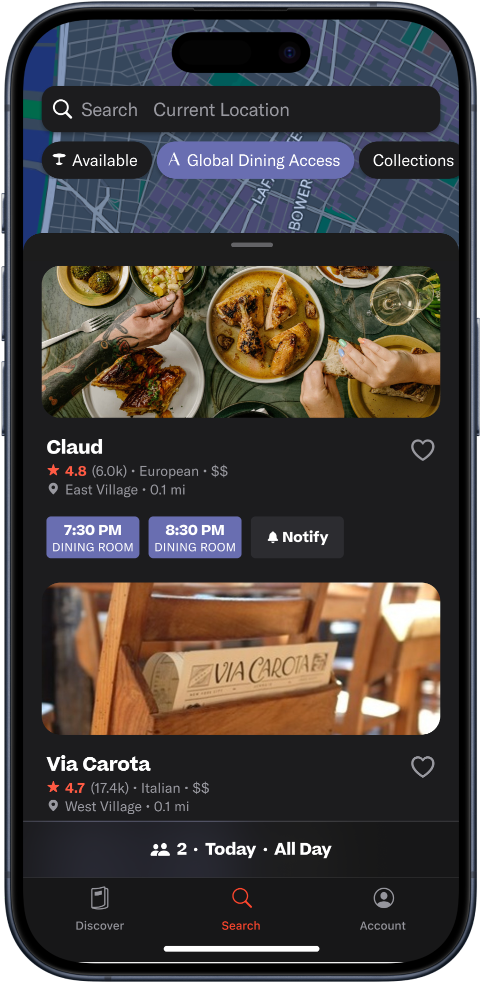
The app is the invitation. ResyOS is the room.
Today Resy works as two connected products. Diners use the app and website to find restaurants, choose the seating area, book, join a waitlist or set Notify alerts when a table is unavailable. The Discover tab mixes editor-written city guides with collections and algorithmic suggestions. That content is not decoration. It points demand toward restaurant partners and reduces the “where should we go?” paralysis that arrives around 6 p.m.
Behind the host stand, ResyOS handles reservations, floor plans, table assignments, waitlists, guest profiles, messages, events and reporting. Platform 360 adds deeper analytics and automated guest insights. Connections to point-of-sale and customer-management systems move context where staff can use it: Toast’s Digital Chits, for example, can surface a guest’s preferences, visit history or special occasion on the devices already in a server’s hand.
The customer is therefore not one person. It is the independent restaurant trying to reduce no-shows, the multi-location group trying to remember its regulars, the host pacing a Saturday service, the traveler looking for dinner and the American Express member hoping a card unlocks something more vivid than points. Restaurants pay the software bill. Diners generally book free. American Express gains a reason for cardmembers and merchants to stay close.
American Express bought a loop, not a button
By early 2017, Resy worked with nearly 1,000 restaurants, seated 1.4 million diners a month and raised a $13 million Series A led by Airbnb. It acquired the guest-feedback company Servy, Spain’s ClubKviar and then U.S. competitor Reserve. The Reserve deal took Resy to roughly 4,000 American restaurants and a 10,000-restaurant global network.
American Express acquired Resy in 2019 for an undisclosed price, later reported at about $200 million. The strategic logic was cleaner than the original paid-table pitch. Amex already had affluent diners, restaurant merchants and a loyalty program. Resy supplied software at the point where those groups meet. Global Dining Access later gave eligible cardmembers selected reservation inventory, Priority Notify and special events. A card benefit became something you could eat.
The flywheel is unusually legible. Coveted restaurants attract diners. Diner demand makes ResyOS more useful to operators. American Express adds high-spending members and marketing. Restaurant supply makes membership feel more valuable. Editorial guides, events and now conversational AI send more people back into the loop.
The reservation war moved upstream
OpenTable remains the broad incumbent, with enormous consumer reach. SevenRooms emphasizes guest data and direct relationships. Yelp pairs local discovery with booking and waitlist tools. Tock built around deposits, tickets, tasting menus and wineries - until American Express bought it in 2024 and began bringing its inventory into Resy in 2026.
The contest is no longer just a search result with a blue 7:30 button. It is about who owns discovery, identity and context before the guest arrives. Resy restaurants became discoverable in Claude in April 2026. By July, ChatGPT users could search live availability and complete a Resy booking. The company is placing inventory inside the conversation where “Italian, downtown, quiet enough to talk” becomes a decision.
That expansion also creates pressure. Scarcity invites bots, brokers and resentment. In New York, hard-to-get reservations became resale inventory. Resy blocked suspicious traffic and accounts while supporting anti-piracy laws. It later reported a 90 percent year-over-year decline in New York no-shows attributed to bots and brokers by July 2025. The number is Resy’s own, but the underlying problem is shared by every marketplace: access feels magical only while people trust the line.

What to steal - and when to leave it alone
Five ideas travel well. Start with supply that customers already desire. Use a sharp wedge to earn industry access. Let repeated operator complaints write the roadmap. Price so customer success does not feel like a penalty. Finally, connect the operational tool to a demand channel; software becomes harder to replace when it also brings the next guest.
But Resy’s method is not universal. It works best when inventory expires nightly, suppliers are fragmented, incumbents charge in a way operators dislike and a small set of prestigious venues can create a halo. It works even better when a partner like American Express can contribute members, marketing and experiences. Without coveted supply, the consumer marketplace is empty. Without enough restaurant margin to fund software, flat subscriptions become a burden. Without controls on bots and favored access, the loyalty layer can corrode trust.
Copy this when…
Customers already chase scarce, expiring inventory; suppliers resent metered fees; and your tool can improve operations while distributing demand.
Skip it when…
Supply is interchangeable, demand must be manufactured from scratch, or privileged access would make the core marketplace feel rigged.
Resy’s useful lesson is not “pivot fast,” the slogan printed on a thousand startup mugs. It is more specific: notice when the people closest to the work are asking you to solve a different problem. The founders wanted to discover the price of a Friday table. Restaurant operators wanted a better way to run Friday night. Building the second thing produced the larger company.
Keep a table open
Explore the consumer product, restaurant software and Resy’s own reporting on the dining business through the links below.