Renee White Fraser’s granddaughter sent her a text about a school assignment. A classmate had been asked to write about someone she admired in a career she hoped to pursue. The girl had chosen a woman in business and communications. She had chosen Fraser. She had no idea that the woman in her essay was her classmate’s grandmother.
For an advertising executive, this was an unusually pleasing piece of audience feedback. No media plan had arranged it. No client had commissioned it. A working life had reached a young person, and the young person had seen a possible future.
Fraser wrote about the surprise with an admission that makes the story better: she did not know how the girl had discovered her. The work had travelled further than its maker could track. Anyone who has tried to measure the effects of communication might appreciate the joke.
Keep the people who won the pitch
Fraser runs Fraser Communications in Los Angeles. She has a doctorate in psychology from the University of Southern California, and her agency brings audience research into the business of making advertisements. Her clients have included Toyota, Lexus, East West Bank and the Metropolitan Water District of Southern California. Cars, banking, water: each presents a different reason for somebody to pay attention.
Her idea for the firm began with something she had observed while running part of a multinational advertising agency. The experienced people who helped attract clients were too far from the continuing work. She wanted senior talent to remain involved throughout an engagement. An agency pitch is rather like a first date with a very expensive projector. The interesting question is who turns up afterwards.
In a 2019 interview, she described a practice of learning a client’s business and choosing media around its particular problem. The recommendation could involve digital, social or traditional advertising. The choice followed the assignment. Her psychological training supplied a reason to keep asking questions before settling on the answer.
The employment side of that arrangement received attention in 2020, when the agency announced its inclusion among the 2019 Best and Brightest Companies To Work For in the Nation. The evaluation covered matters including communication, employee education, recognition and retention. Those are less glamorous subjects than a launch campaign. They are also part of how an agency keeps the people whose judgment it sells.
A hybrid is also a person
A November 2025 conversation with HabitStack host Scott Ward offers a concrete example. Fraser discussed a Toyota hybrid campaign that used the idea “we’re all hybrids.” The move connected a product category with the mixed identities of the people who might buy it. A technical feature had become a way of talking about the customer.
The appeal is easy to understand. A car can arrive in advertising as a collection of specifications, all waiting politely to be forgotten. An idea about identity gives the audience another way in. It asks people to recognize something about themselves before considering what is parked in the driveway.
Fraser and Ward also talked about the difficulties of keeping a culture together when teams work remotely. The same interview reached into the agency’s exploration of AI-powered consumer personas. These were questions under discussion, rather than a claim that a new technology had finished the work of understanding people. Her interest remained recognizably human: how decisions get made, and what a leader needs to understand about the people making them.
Two hundred conversations, and a request
Radio gives Fraser another way to investigate a life. She co-hosted Unfinished Business with business owner Betsy Berkhemer-Credaire. Her subsequent work has included Why Women; the agency’s current website presents The Dr. Renee Fraser Show. Across these conversations, she has made room for people to explain how a career actually happened.
In a reflection on interviewing more than 200 women for Why Women, Fraser pulled out three recurring themes. Preparation helped people use opportunities when they arrived. Asking for assistance could change a career’s direction. And the satisfaction of success often extended into mentoring and community work.
The request for help is an especially useful detail. A polished biography can make a career look self-propelled, as though introductions, advice and timely encouragement were merely scenery. Asking puts those other people back into the plot. It also gives the listener something more practical than a command to be exceptional.
Women interviewed for Why Women, according to Fraser’s reflection on what those conversations taught her.
Getting closer to the boardroom
Fraser’s interest in women’s leadership has a practical expression in Pathways. Her biography for the 2024 Los Angeles County Women’s Leadership Conference describes her becoming a volunteer co-director in 2019. The program, associated with the NAWBO California Education Fund, combines six months of education and mentoring for women of color, with active board directors serving as mentors.
Six months gives the relationship a shape. There is time to return with another question, test an assumption and learn what board service involves. A distant ambition acquires people who can discuss it from experience. For a candidate trying to understand the room, that access matters.
The same biography records a decade as Los Angeles co-chair of 50/50 Women on Boards and service on its national board. Fraser has also taught research and evaluation and guest lectured at USC. These activities ask her to do something slightly different from running an agency: make her experience useful to somebody preparing for a responsibility of their own.
There is an earlier example of that willingness to discuss the route. At a UCLA workshop on careers beyond academia, Fraser was among the speakers explaining how they had moved from a doctorate into their working lives. Her own path offered graduates an example of applying an understanding of human behavior outside a university. A qualification can lead somewhere its holder had to help invent.
A holiday card with somewhere to go
Some of that connection between communication and action appears in a small agency project. For its 2011 interactive holiday card, Fraser Communications linked to a video it had made for United Way of Los Angeles and the Home For Good effort to address homelessness. Recipients could watch, forward the message or share it on Facebook. The agency donated $5 for each view.
The campaign received the 2012 Internet Advertising Competition award for Best Advertising Email Message. Its mechanism was straightforward enough to explain without an awards presentation. Attention generated a donation, and sharing invited another person to take part.
Fraser’s involvement with United Way extended beyond that project. She co-chaired the Business Leaders Task Force connected with Home For Good. Later, discussing United Way’s Young Civic Leaders Program, she recalled the enthusiasm she felt seeing girls develop their abilities as advocates. The advertising executive was paying attention to people learning to use their own voices.
“I would advise myself to be bolder.”
Renee White Fraser, on advice to her younger self
The room beyond Los Angeles
Her civic work has taken her beyond the city, including to an international Red Cross gathering in Geneva. In her account of the trip, Fraser described joining roughly 150 participants from different parts of the world. She approached it as a chance to deepen her understanding of people and cultures. A professional life spent studying audiences still had room for the person doing the studying to learn.
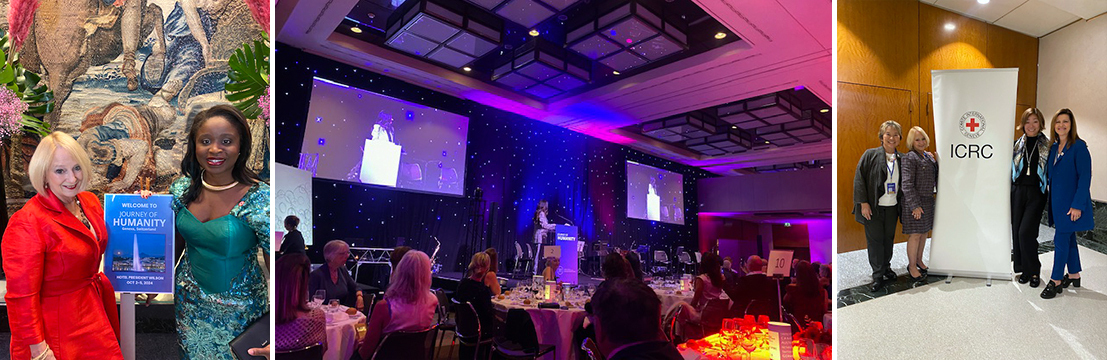
Another gathering, in Nashville, followed her recognition as a 2025 Enterprising Women of the Year recipient. Fraser recalled more than 250 women attending. What stayed with her included hearing entrepreneurs from Afghanistan and Rwanda, some participating in the Peace Through Business program, describe building businesses amid adversity.
Her reflection moved quickly from receiving recognition to what a leader might do with it. The conference offered conversations about sales, scale and AI, but she returned to mentoring and opening doors. An award had brought people together. The useful business was what they could exchange once they were there.
What survives the big win
Fraser has received other public recognition. The Los Angeles Business Journal gave her its Women Leading the Way award in 2017. The International Women’s Entrepreneurial Challenge Foundation honored her in 2019. These belong in the record, though they leave much of the working day unaccounted for.
Her own writing fills in smaller things. In a reflection called The Power of Small Joys, she turns to coffee brought by a colleague, food shared at an office potluck, a handwritten note from someone mentored years earlier. She mentions the pleasure of a friend noticing a billboard without realizing whose work it was.
There is something particularly apt about the billboard. Advertising usually wants its audience to remember the client. The person who helped make the work can remain invisible. Fraser’s pleasure in that little recognition allows both things to be true: she cares about the communication, and she enjoys knowing it has landed.
In her writing on women’s leadership, visibility becomes a responsibility. She argues for talking publicly about the work, submitting it for recognition and letting younger women see who is doing it. A career can provide a useful example long before its owner receives any evidence of the effect.
There is a tension here that an advertising professional would recognize. People want their work to speak for itself, but somebody has to help it reach the listener. Fraser’s argument for making leadership visible gives that familiar task a personal use. The audience may include someone who has yet to choose a profession.
Which brings the story back to a school assignment. Fraser had spent years working on what people notice, remember and act upon. Somewhere along the way, a girl had noticed her. The granddaughter’s text delivered the news. For once, the audience researcher got to be surprised by the audience.
Keep the conversation going
- Fraser Communications
- Renee Fraser on LinkedIn
- The Dr. Renee Fraser Show
- Watch: United Way’s Renee Fraser profile
- Listen: the HabitStack conversation
- Read: the school essay reflection
- Read: Pathways and leadership conference biography
- Read: Women Leading the Way, 2017
- Agency Instagram
- Agency Facebook
- Read: the Home For Good holiday card