Kim L. Hunter flew from Los Angeles to New York with a proposal and a number. He wanted to establish a fellowship for ethnically diverse graduate students, named for public relations founder Harold Burson. When Burson asked what it would cost, Hunter said $50,000. Burson had expected a request for $250,000. He agreed to help. Fundraising occasionally rewards the person who remembers to ask.
Hunter recalled that exchange in 2020, remembering a friendship that included lunches and visits to Burson’s Upper West Side apartment, even with snow outside. His parents had taught him that an invitation into someone’s home signaled respect. Here, professional regard had become friendship, and friendship could become an opportunity for a student neither person had yet met.
That sequence runs through Hunter’s working life. Build a relationship. Understand what someone can contribute. Put the connection to work. His career in communications has produced three organizations, each addressing a different point at which a promising person might otherwise be overlooked.
A family name becomes a business
LAGRANT sounds like a company name because Hunter made it one. It is also his middle name, inherited from his great-great-grandfather. In his account for Diverse Voices, he described it as the name he felt proudest of. The capital letters on the agency sign contain a small family history.
In 1990, he founded LAGRANT COMMUNICATIONS in Los Angeles. His education combined a business administration degree from the University of Washington with a master’s in international management from the University of St. Thomas in Minnesota. The agency gave that business training a specific application: helping organizations communicate across differences in culture and experience.
Consider the professional problem. A company can know its products intimately and know surprisingly little about the people it hopes will buy them. A public agency can understand a program’s rules while struggling to explain why anyone should pay attention. Hunter built a career in the space where institutional knowledge needs help becoming a useful conversation.
The audience has a life outside the brief
Hunter’s client experience includes Southern California Edison, American Airlines, Walmart, Starbucks, Verizon, Carnival Corporation and General Motors. He has also worked with Los Angeles World Airports and the city’s Public Works department. Those assignments place a communicator in very different settings, with different expectations of what a message should accomplish.
His work spans brand positioning, crisis management, and community and government relations. Each requires attention to the person receiving the message. The vocabulary that reassures one audience can leave another cold. For a communicator, cultural understanding belongs inside the work from the beginning; adding a few suitable words at the end cannot do the same job.
He has taken that concern into teaching, too. At California State University, Northridge, he taught “Diversity and the Media” for three academic years. He also served on Los Angeles’s Cultural Affairs and Animal Services commissions. Communications, in this version of a career, extends well beyond the account meeting.
Eight years later, a different kind of investment
In 1998, Hunter established The LAGRANT Foundation to address underrepresentation in advertising, marketing and public relations. An agency could advise its clients about audiences. A foundation could help change who entered the profession and eventually did the advising. The two enterprises address related questions from different directions.
The foundation’s program combines scholarships, career development, internships and mentorship. The combination matters. Tuition support addresses one expense. Meeting a professional who can explain a hiring process addresses another obstacle. Experience at an agency gives a student something concrete to discuss when an interviewer asks what they have actually done.
Its professional development reaches into the unglamorous details: résumés, interviews, writing, business etiquette and navigating company politics. These are subjects on which people with established professional networks can receive informal instruction for years. Making the instruction available to someone else is practical work, even when it lacks the sparkle of a scholarship presentation.
Thirteen students and a familiar professor
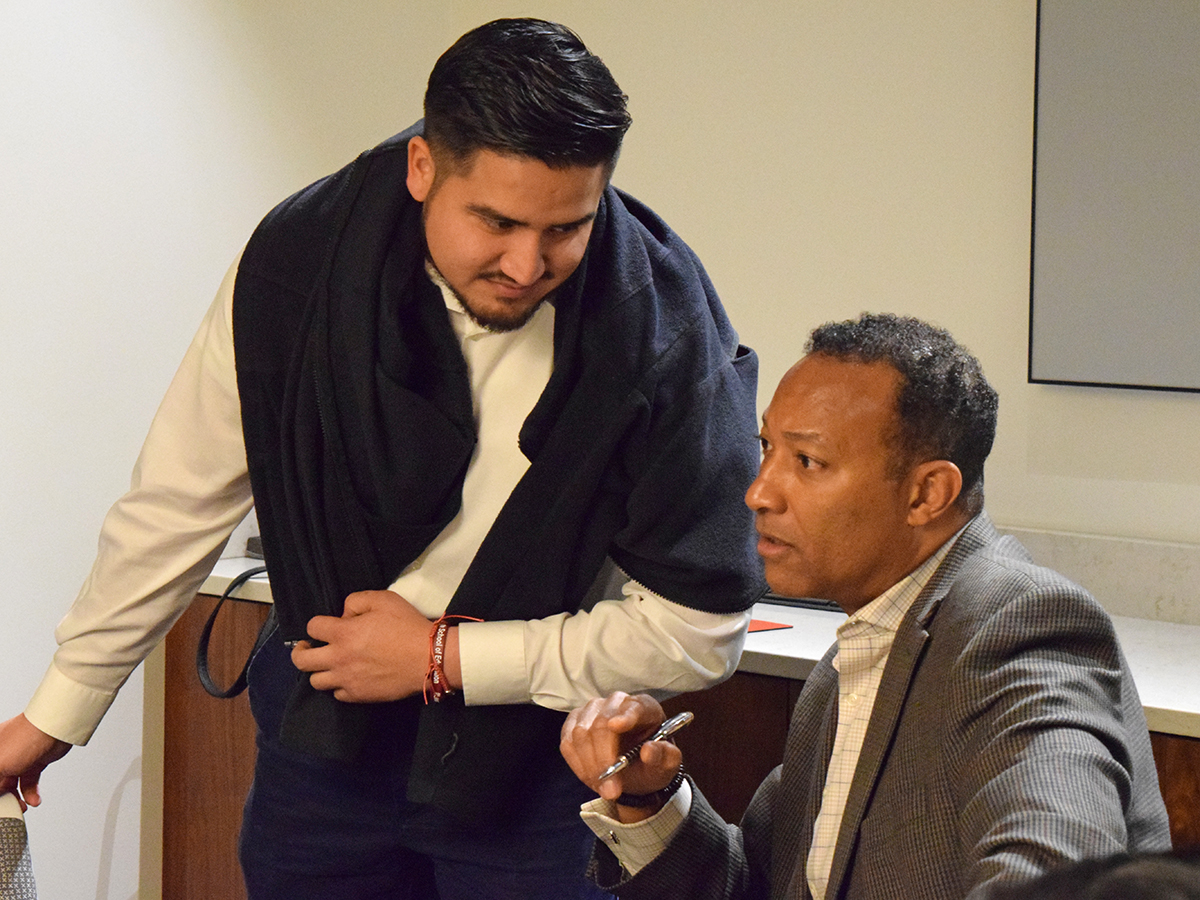
On January 30, 2012, Hunter returned to the University of Washington for a CEO roundtable at PACCAR Hall. Thirteen underrepresented minority students studying business and communications attended. Hunter was an alumnus of the class of 1982 and a former Educational Opportunity Program student. This was familiar territory, revisited from the other side of the table.
Among those present was marketing professor emeritus Thaddeus Spratlen. Hunter told the group that Spratlen had been the business school’s only professor of color during his student years and had served as a role model. The encounter gives his later work a concrete antecedent: he remembered someone whose presence had mattered to him.
He discussed résumés, interviews and the importance of internships. Students asked questions and spoke with him individually. The scale was modest enough for a conversation. For a young person trying to understand an unfamiliar profession, access can begin with precisely that sort of room.
What students want to be known for
At Elon University in November 2019, Hunter joined students for the Unity in Communications dinner. The initiative supported students of color and LGBTQ students in the School of Communications. By then, the school had counted six LAGRANT Scholars over the preceding three years, including one student selected twice.
One first-year student, Hector Lopez-Sanchez, described wanting to understand the workforce without being reduced to a representative of diversity. “You want to be you,” he said. It is a useful complication in a conversation often conducted through categories. Opportunity should give a person more room to develop an identity, skills and interests.
Hunter’s presence offered students a working executive to question about the field. The evening also let them connect with one another. A professional network has peers as well as senior figures, and an early career can benefit from both. The dinner made space for those connections before the next application deadline.
“You want to be you.”Hector Lopez-Sanchez, student at the 2019 Elon dinner
The second hiring problem
Helping someone land a first internship leaves another question open: who helps an experienced professional reach a more senior position? Hunter also founded KLH & Associates, where he serves as managing partner. The executive search firm focuses on mid-to-senior-level talent in marketing, advertising and public relations.
Its clients include Fortune 500 companies and communications agencies. Its work includes identifying candidates for corporate communications, public affairs and government relations roles. The firm describes an approach built around understanding the employer’s particular needs and maintaining professional relationships that help it identify qualified people.
Viewed together, the three organizations cover a considerable stretch of a career. A student needs entry. A practitioner needs experience. A senior candidate needs consideration for a role with authority. Hunter has built separate organizations around these needs, giving his concern about representation several practical places to operate.
An introduction with consequences
One example of Hunter’s connecting work involves Brett Pulley, a former journalist and dean of the Scripps Howard School of Journalism. Hunter introduced him to Weber Shandwick president Gail Heimann. In 2016, the agency hired Pulley as executive vice president and managing director of content.
The appointment illustrates how an introduction can make a less conventional candidate visible. Pulley brought experience in journalism and education to an agency role. A hiring process that considers a wider range of professional backgrounds has more possibilities to examine. Someone still has to arrange the conversation.
Hunter has also been willing to challenge the people controlling those possibilities. He described writing to the leaders of ten major agencies and accusing the industry of lacking courage. His preference for directness can carry a sharp edge. The friendly connector and the demanding critic share a concern about who gets a chance.
Recognition, then another cohort
In 2012, the Arthur W. Page Society selected Hunter for its Distinguished Service Award, recognizing service to the communications profession. At the time, it credited him with raising more than $7.75 million over fourteen years for the foundation’s programs. That figure concerns fundraising for the work, rather than scholarship awards alone.
Further recognition followed, including an Individual Achievement SABRE Award and induction into PRWeek’s Hall of Fame in 2017. The honors register how colleagues assess his contribution. The foundation’s continuing programs provide another way to look at it: people keep arriving who need their first useful connection.
In 2026, Hunter is also listed among the judges for the Museum of Public Relations’ NextGen Awards, which recognize emerging communications professionals. His attention remains on people building their careers. After decades spent leading organizations, he is still participating in the decisions that help younger practitioners receive notice.
The host has a few other interests
There is life beyond the professional introduction. Hunter enjoys cooking and has described a Saturday beginning with brunch, possibly followed by whale watching or a garden visit, then dinner with friends. A three-cheese soufflé appears in his menu. His hospitality seems to involve rather more preparation than opening a packet of biscuits.
Asked for a leadership tip, he offered “lead with conviction.” Asked about a lesson that took time, he identified patience as something he was still learning. The pairing suits a career that includes both pointed challenges to executives and years of attention to students whose progress cannot be hurried.
The fellowship proposal to Burson remains a good scene to remember. Hunter arrived with a relationship, an idea and a specific request. A conversation became a commitment. Somewhere beyond that exchange was the person who would get to use it.