Etienne Hernandez-Medina remembers the beginning without polishing it into founder folklore. He was not sketching an empire on a whiteboard or announcing a disruption from a rented stage. He was freelancing, working from his garage and trying to make a place for himself in a profession where he did not always feel seen. “I didn't go into this industry with the intention of owning an agency,” he has said. “I was trying to survive in a world where I didn't always feel seen or valued.”
That is a more revealing origin than the usual startup mythology. It turns H+M Communications, the firm he founded in 2003, into an answer before it becomes a business. If the rooms where campaigns were designed could overlook people like him, he could build a room that paid closer attention. The practical result was an independent public relations and cross-cultural marketing consultancy with a particular fluency in Latino audiences. The personal result was a career spent making visibility an operating decision.
Medina arrived with useful training. At the University of Miami, his studies joined speech communication and political science - persuasion beside power, which is not a bad syllabus for public relations. He later worked at Edelman, where public profiles list him as an executive vice president. Then came freelance work, the garage and a company whose first stronghold was entertainment.
A garage with a view of Hollywood
Hollywood publicity is full of obvious objects: a poster, a premiere, a star at the center of a scrum. Medina's work became interested in the less obvious machinery around them. Who receives the invitation? Who trusts the person delivering it? Which details make a film feel like a cultural event rather than a product passing through town?
Those questions pushed H+M beyond translation. The distinction matters. Translation changes the language of a message. Cultural strategy can change the message, the messenger, the room and the thing an audience is invited to do. H+M's portfolio grew across publicity, creator partnerships, experiences, content and corporate communications, but that set of questions remained the spine.
“I was trying to survive in a world where I didn't always feel seen or valued.”Etienne Hernandez-Medina
By 2016, the approach had produced a conspicuous result. Universal Pictures wanted to build Latino turnout for Straight Outta Compton, a film about N.W.A. H+M brought Pitbull into the campaign. Latino moviegoers made up 21 percent of the opening-weekend audience, a record reported at the time for a biographical film centered on an African American subject. The work earned an In2 SABRE Award for non-journalist influencers and communities, making H+M the first Hispanic agency recognized in that program.
Celebrity alone does not explain the outcome. Pitbull was not a generic parcel of reach. He was a credible bridge between the film and an audience the campaign wanted to welcome. Medina described the award as recognition of multicultural digital and social work that combined creative thinking with measurable results. Strip away the award-season vocabulary and the lesson is wonderfully plain: choose someone who belongs in the conversation.
When the stars could not come
The durability of that lesson became clearer when the conventional machinery failed. In 2023, the actors' strike restricted cast participation in publicity for Blue Beetle, DC's first Latino superhero film. A standard press tour without its actors is a banquet without the food. H+M did not pretend otherwise. It changed the center of gravity.
The agency built a U.S. Hispanic press day around director Ángel Manuel Soto, enlisted more than 100 creators and organized community screenings. At the Latino Games Festival, a mariachi flash mob supplied the sort of joyful public image no junket-room interview could imitate. The film opened at number one domestically, and the work later received three 2024 HPRA ¡BRAVO! honors.
“We wanted the campaign to feel like it belonged to the community.”Etienne Hernandez-Medina on Blue Beetle
The line is a compact statement of Medina's method. A director can describe the world behind a film. A creator brings a lived relationship with followers. A screening makes the audience part of the occasion. A mariachi performance can turn an abstract promise of representation into a noisy, physical memory. None is a spare celebrity. Each is useful for a different reason.
This is where cross-cultural marketing can look both more complicated and more sensible than mass marketing. The audience is not a demographic block waiting for the correct Spanish noun. People arrive through places, music, family rituals, fandoms and personalities they already trust. A campaign has to decide which connection is honest enough to carry weight.
Miami was not scenery
For Bad Boys: Ride or Die, H+M organized the 2024 Hispanic campaign around Miami. The city was not a colorful backdrop applied after the media plan. It was the plan's organizing idea. Spanish-language press access sat beside a Miami Marlins takeover, a premiere and soundtrack party, a civic “Bad Boys Day,” creator work and advance screenings across eight markets.
Latino moviegoers represented 26 percent of opening-weekend ticket buyers. The ordinary benchmark was 18 percent; the campaign's stretch goal was 25. The final point above that target is satisfying, but it should not be allowed to flatten the work into arithmetic. The baseball fan, the music listener and the creator's follower did not receive the same invitation. They received different invitations pointing toward the same release.
The campaign won four 2025 HPRA honors, across entertainment, influencer engagement, integrated marketing and multicultural public relations. H+M was also named Agency of the Year for the fourth time. The stack of categories makes a useful point about Medina's company: the work refuses to sit politely in one departmental box. Media, creators, events and community relationships all contribute, but none can explain the whole.
The institution after the improvisation
A garage company can live on its founder's energy for only so long. Eventually, instinct has to become an institution. H+M now describes a team of strategists, wordsmiths, relationship builders, publicists, content creators and problem solvers. It identifies as Hispanic-owned and LGBT- and female-co-owned. Its current work stretches across entertainment, consumer brands, retail, hospitality and corporate communications.
The numbers show the business changing shape. In 2016, H+M's revenue exceeded $3 million and the firm had expanded its client roster after a major account contraction. A Los Angeles Business Journal list put 2023 revenue at $11.2 million. Its 2026 minority-owned businesses list reported $10.4 million in 2025 revenue, up from $4.8 million the prior year, with 42 employees. The client names in recent listings include Universal Pictures, Amazon, Pinterest, Hard Rock Hotels & Casino and Spirit of Gallo.
Medina has also appeared where the profession examines itself. He joined a 2020 Museum of Public Relations panel on Latino social impact, served as a first-round juror for the 2025 ANA Multicultural & Inclusive Marketing Excellence Awards, and spoke at the Hispanic Public Relations Association's Leadership Cumbre. These are not simply appearances on a calendar. They position him in the argument about who advances in communications and whose experience gets treated as expertise.
University of Miami studies in speech communication and political science.
H+M Communications begins with Medina working from his garage.
Straight Outta Compton work wins an In2 SABRE Award.
Blue Beetle campaign receives three HPRA honors.
H+M earns its fourth HPRA Agency of the Year recognition.
Diversity Action Alliance names Medina an Industry Legend.
Visibility, converted into practice
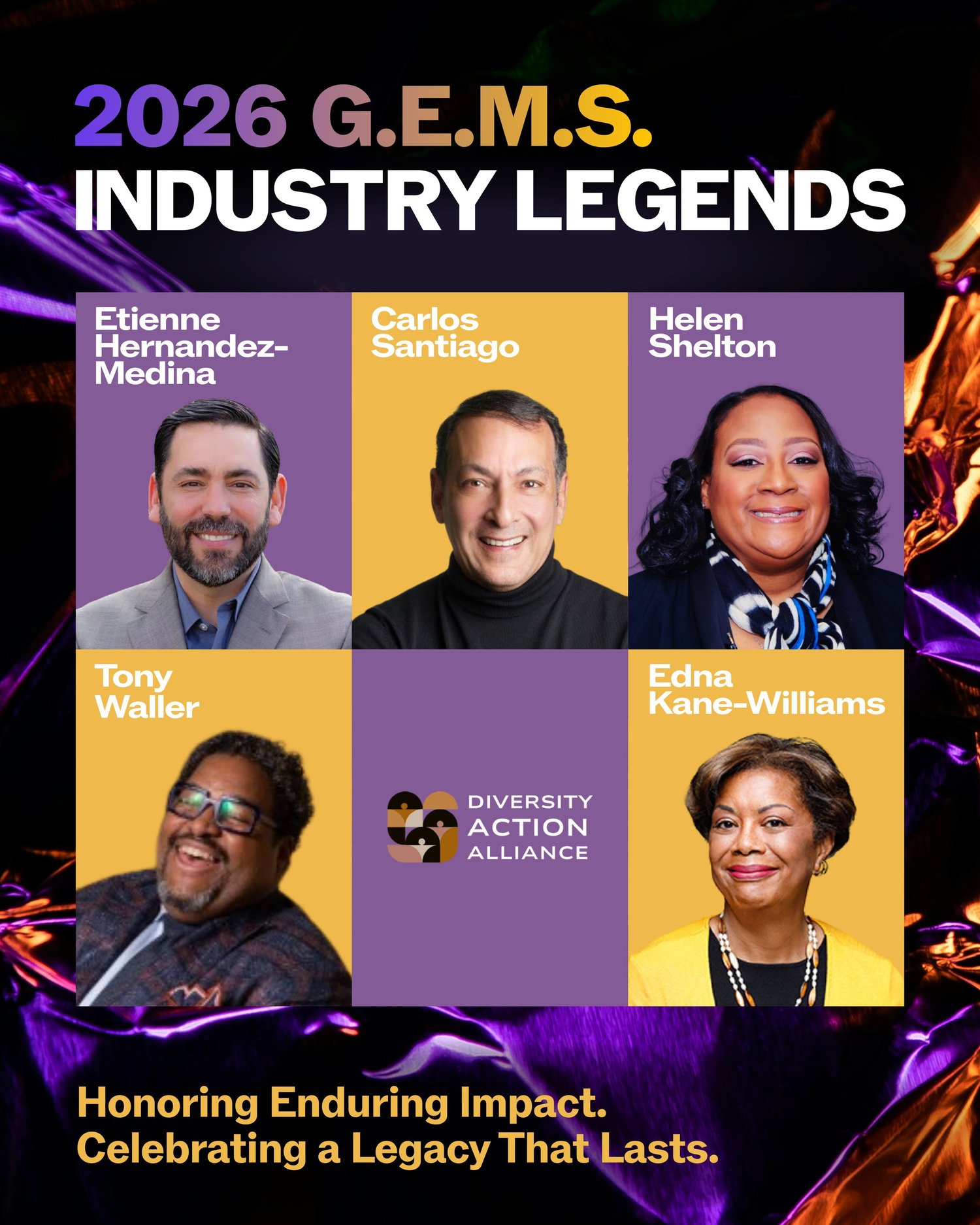
In 2026, the Diversity Action Alliance named Medina one of five G.E.M.S. Industry Legends. The recognition cited a career of service, advocacy for underrepresented professionals, craft and lasting industry impact. The grand word in that title is “legend.” The more interesting word may be “industry,” because Medina's contribution lives in ordinary professional choices: who gets hired, who sits in the room, which audience is studied with care, and whether cultural context arrives before or after the campaign is already fixed.
His story has a pleasing symmetry. He entered agency ownership because he did not always feel visible or valued. He then built a company whose documented work helps audiences feel considered rather than counted. That does not make every campaign virtuous, and it does not turn a percentage into proof of belonging. It does offer a disciplined way to work.
Start with the relationship, not the reach. Give each messenger a reason to be there. Make the gathering worth attending. Then measure what happened without pretending one number contains the whole story.
More than two decades after the garage, the company is larger, the briefs are broader and the media system is noisier. Medina's central idea remains almost stubbornly human: people can tell when an invitation was made with them in mind. In public relations, as at a dinner party, that is often the difference between a crowd and a room that comes alive.