The ideal Redwood Software customer story begins with nothing happening. Nobody is staring at a progress bar. Nobody is reopening a terminal window at 2:13 a.m. Payroll arrives, invoices move, an SAP close advances and a file lands where it belongs. Inside a large company, that absence of drama is an expensive achievement.
Redwood sells the machinery behind it. Its software schedules and orchestrates work across ERP systems, cloud services, databases, applications and old infrastructure that cannot simply be switched off. A job can wait for a file, trigger an SAP process, call an API, check an outcome, alert an operator and recover from a known exception. The buyer is usually an IT operations, SAP, finance, data or DevOps team whose most dangerous workflow has outgrown a collection of cron jobs, scripts and institutional memory.
That description sounds modest beside the current promise of autonomous AI. It is also the point. Redwood lives in the gap between an executive saying, “automate the close,” and the hundreds of dependencies required to make that sentence true every month.
The machine under the machine
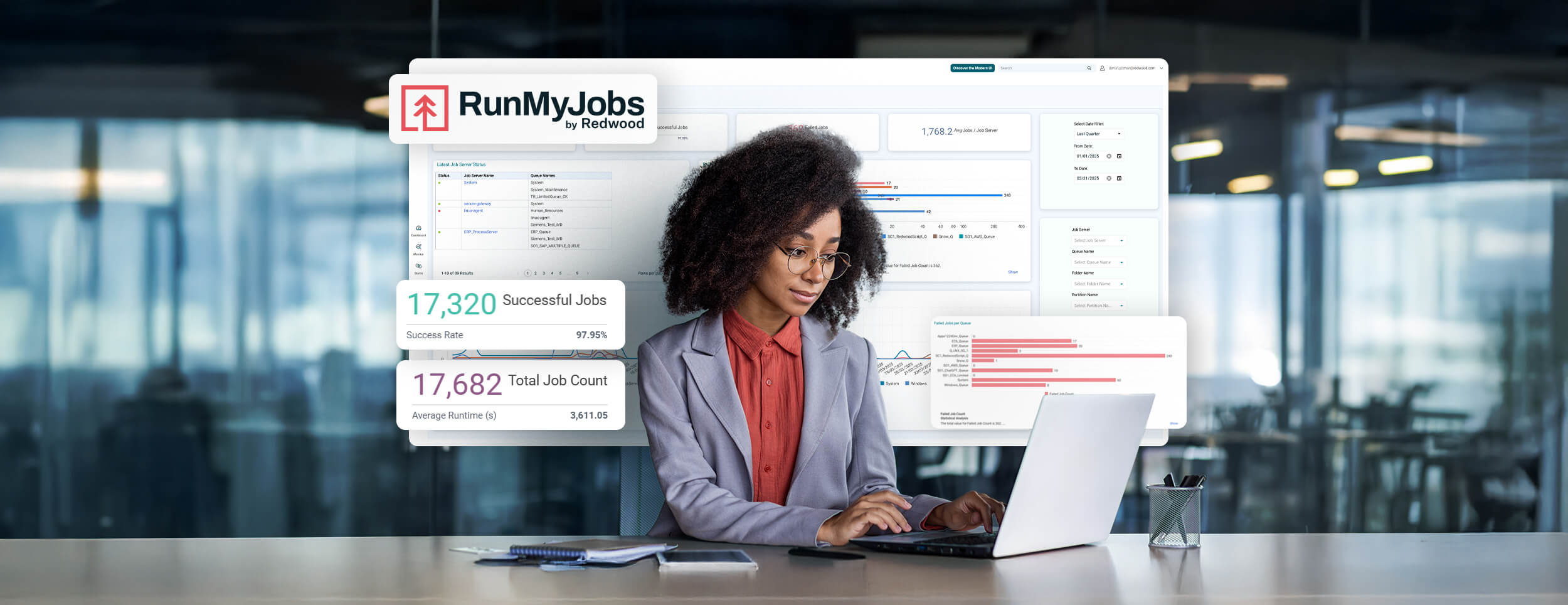
RunMyJobs is Redwood’s flagship. It is a SaaS-first service orchestration and automation platform - the category formerly known, less grandly, as workload automation. It gives an enterprise one place to define dependencies, schedule work, monitor service levels and coordinate jobs across systems. Redwood’s special claim is depth in SAP: RunMyJobs is an SAP Endorsed App, with premium certification across the cloud ERP landscape.
The rest of the shelf fills adjacent needs. Finance Automation handles record-to-report work such as journals, reconciliations, intercompany steps and the close. ActiveBatch and Tidal are workload automation platforms with their own installed bases. JSCAPE and Cerberus move files securely. Redwood Insights puts workflow telemetry and AI-generated analysis over RunMyJobs. RangerAI, announced in late 2025, pushes the pitch toward governed agentic operations.
The work varies by industry, but the pattern repeats. A retailer needs replenishment data ready before stores open. A manufacturer needs production planning to hand cleanly into warehouse activity. A bank needs a chain of controls that an auditor can reconstruct. A data team needs the pipeline to finish before an executive dashboard refreshes. Redwood is useful when each step lives in a different system and “done” means the business outcome arrived, not merely that one script returned a green check.
RunMyJobs, ActiveBatch and Tidal coordinate jobs across applications, data and infrastructure.
Finance Automation turns recurring accounting checklists into controlled workflows.
JSCAPE and Cerberus handle managed and secure file transfer.
Insights adds analytics, role-based views and signals about workflows at risk.
This is not a tidy single-product story. It is a portfolio story. Turn/River Capital invested €315 million in Redwood in May 2021. In February 2022, Redwood combined with Advanced Systems Concepts, bringing ActiveBatch and JSCAPE under one company. Tidal followed in January 2023 and Cerberus one month later. Vista Equity Partners and Warburg Pincus agreed to acquire the enlarged Redwood in 2024; the deal closed that December for an undisclosed price.
What changed? Scale, mostly. A specialist cloud scheduler had become a suite able to meet customers where they already were. That eases sales, but creates a product-management test: buyers need the pieces to feel like an automation fabric, not a cabinet of acquired brands.
The company itself changed with the shelf. Founder Tijl Vuyk had led Redwood through most of its technical evolution. Kevin Greene arrived as chief executive during the 2022 combination, bringing experience from enterprise analytics, venture capital and IBM. The transition marked a familiar software-company handoff: from a founder-shaped specialist to an operator-led platform expected to integrate acquisitions, sell across a larger account and satisfy new financial owners.
The failure that makes the sale
Enterprise automation purchases rarely begin with a blank whiteboard. They begin with something that failed first. A global energy-services company found IBM Tivoli Maestro cumbersome, maintenance-heavy and unfriendly while it was running millions of SAP processes. It moved the workload to Redwood’s cloud in 90 days. The initial problem was not that scheduling was impossible. It was that keeping the old scheduler healthy had itself become a job.
Genentech offers the cleaner reversal. The biotechnology company had begun implementing SAP Financial Closing cockpit. Halfway through, its team concluded the setup was not delivering the automation or benefit it expected. Redwood was given a three-week pilot. The result changed the plan: Genentech later reported 88 percent process automation and a reduction of more than 50 percent in end-to-end close time.
Siemens provides the almost comic before-and-after. It reduced nearly 1,000 manual tasks in its financial close to about 30. Arla Foods cut close cycle time by 30 percent. Daikin shortened overnight processing from 11 hours to six. These are vendor case studies, so treat them as selected victories, not an average. Still, they reveal the unit Redwood actually sells: fewer touches, shorter windows and less time waiting for the person who knows how to restart step 47.
“SAP customers aren’t struggling with vision - they’re struggling with execution.”Charles Crouchman, Redwood chief product officer
What quiet costs
Redwood does not post a universal RunMyJobs price. The model combines a platform subscription with a fixed charge for completed process executions. Connections and platform agents are unlimited; support, SaaS operations and several non-production environments are included in the platform offer. That is more legible than charging separately for every server, but “pay for what runs” is only predictable when a customer knows how much will run.
One public Illinois agreement, reported from procurement records, put a three-year RunMyJobs package at $607,864.86. It covered the enterprise SaaS edition, five million job executions, three environments, automation and migration services. That is a data point, not a menu price. Scope, connectors, services and negotiating leverage change the bill.
The economic argument is not simply labor replacement. A failed close, delayed warehouse feed or missed service-level agreement has a cost; so does the duplicate infrastructure needed during migration. RunMyJobs promises 99.95 percent uptime and 24/7 support. The customer is buying insurance with a workflow editor attached.
A crowded control room
Redwood’s named rivals include BMC Control-M, Stonebranch, Broadcom AutoSys, IBM Workload Automation, Rocket and JAMS. Cloud teams can assemble alternatives from AWS Step Functions, Azure Logic Apps, Airflow and Kubernetes tooling. Finance departments may compare BlackLine or native SAP capabilities. File-transfer administrators have MOVEit, GoAnywhere and IBM Sterling. And every prospect already owns the cheapest competitor: a drawer full of scripts.
Redwood differs most clearly when a process crosses boundaries. Its SAP credentials help when an S/4HANA job must wait on a non-SAP file, trigger a cloud pipeline and preserve an audit trail. SaaS delivery shifts upgrades and infrastructure to Redwood. Consumption pricing removes the penalty for connecting a rarely used system. The portfolio also lets a buyer put scheduling and file movement with one vendor.
That advantage weakens at the edges. A small team with a dozen simple schedules does not need an enterprise control plane. A cloud-native engineering group may prefer code-first orchestration. A company with chaotic, undocumented processes will merely automate its confusion faster. And an organization with enormous numbers of tiny executions should model consumption carefully before celebrating the pricing model.
The part worth copying
Start with one process that hurts and can be measured. Inventory every dependency, owner, exception and manual touch. Establish the current cycle time and failure rate. Run the old and new paths in parallel. Automate known recovery steps, but assign a human owner for the unknown ones. Only then expand to the next workflow.
That sequence sounds obvious. It is also what Genentech’s three-week pilot got right: prove the automation against a living process before asking the organization to believe a platform diagram. It will not work when leadership treats the software purchase as the transformation, when source systems are unreliable, or when nobody owns exceptions after launch.
The agent still needs a scheduler
Redwood’s latest chapter wraps agentic AI around the old discipline. RangerAI and the company’s 2026 messaging frame orchestration as the governed execution layer for AI agents. The logic is credible. A model can propose an action, but a regulated enterprise still needs permissions, dependencies, audit history, observability and a reliable way to execute that action across systems.
The risk is fashionable vocabulary outrunning integration. Redwood’s durable asset is not that it can say “agentic.” It is three decades of encoded business logic and customer trust around processes that must complete. In August 2026, the company announced a third consecutive Leader placement in Gartner’s service orchestration and automation report and said it ranked first in four of five accompanying use cases, tying for first in the fifth. Those distinctions help with enterprise buying committees. The night operator will care more about whether the failed job fixes itself.
Redwood now serves more than 7,500 customers and, as of its 2024 sale announcement, 28 percent of the Fortune 500. Its culture page tells employees to “Work the Problem,” “Make Your Own Weather” and “Own the Outcome.” The phrases are breezy. The product is not. It exists because the tedious, chained, deeply consequential work of a company keeps happening after the strategy deck is closed.
That may be Redwood’s most defensible position. Plenty of software promises to make work feel magical. Redwood is paid to make it feel uneventful.