At 2:07 a.m., nobody wants a philosophy of automation. They want the policy file to arrive, the SAP job to finish, the data pipeline to wake up, and the morning report to contain numbers instead of apologies. This is Stonebranch's territory: the unphotogenic layer of enterprise software that decides what runs next, watches whether it ran, and tells somebody when it did not.
The Alpharetta, Georgia, company calls its flagship product Universal Automation Center, or UAC. Think of it as air-traffic control for computational work. A bank can use it to coordinate a mainframe process with a Linux task and a cloud service. A retailer can trigger inventory work when a file appears. A data team can turn a pipeline into a monitored business service rather than a collection of scripts. An SAP team can schedule jobs without hiding the dependencies from everybody else.
That breadth matters because the average large company did not migrate neatly from old technology to new technology. It accumulated both. Mainframes remained excellent at high-volume transaction processing. SAP acquired decades of business logic. Cloud services multiplied. Containers and APIs arrived. Then each team bought its own scheduler, transfer tool, dashboard, and alerting habit. Stonebranch sits above that sprawl and tries to make it behave like one system.
The founding idea: keep the machines
Stonebranch began in 1999 with Wolfgang Bothe, Gert Adolphsen, and Nathan Hammond. Bothe and Adolphsen had come from Germany to build the American operation of a file-transfer software company. They decided the market had the premise backward. Enterprise vendors often asked customers to discard working infrastructure in order to adopt a supposedly cleaner future. The founders wanted their managed file transfer and job scheduling software to cooperate with what customers already owned.
That line has aged better than most late-1990s technology slogans. The company's present-day promise is still compatibility, only the inventory has expanded from mainframes and distributed servers to public clouds, containers, data tools, infrastructure code, and AI services. Stonebranch's Integration Hub supplies connectors and blueprints; Universal Agent reaches across operating environments; Universal Data Mover handles files; and the Controller gives operators a browser-based place to design and monitor the chain.
What failed first: the seams between tools
Stonebranch's case studies read like a catalog of seams. At KMD in Denmark, rising license costs, scattered job output, and a mixed collection of IBM agents prompted a change. After moving distributed batch processing to Stonebranch, KMD reported 43 percent fewer relevant jobs, 12 percent faster processing, and 36 percent fewer installed agents. The value did not come from making one task magical. It came from removing duplicated machinery around thousands of ordinary tasks.
An anonymized Dutch bank had a different fracture. Its plan-driven IBM TWS/IWS environment had accumulated temporary scheduling systems and operational drag during mainframe modernization. After adopting UAC and moving toward event-driven automation, the bank reported 45 percent fewer jobs and a 60 percent decrease in operating costs. It also reported sharply better transparency. The migration itself was not frictionless - its program manager acknowledged issues and imperfections - but the support relationship kept the project moving.
What consolidation removed
Selected customer-reported results. Different companies, baselines, and projects - useful as examples, not a forecast.
PSCU, a credit-union services organization now known as Velera, gives a clue about what changes a buyer's mind. It ran an intensive proof of concept, judged both the web application and the conversion team, then selected UAC. The migration moved every job, automated finance workflows, and finished six weeks early and on budget. The winning feature was not only software coverage. PSCU described wanting a partner rather than a vendor that treated it like a customer number.
Achmea, the Dutch insurer, chose UAC after comparing three products, citing agent technology. Its data analytics platform has run more than one million task instances in a week. Groupon's published story emphasizes the other side of scale: eliminating unplanned automation downtime and making deployments ten times faster. In both, a scheduler is less a clock than a dependency map with consequences.
The product: a control plane, not another script
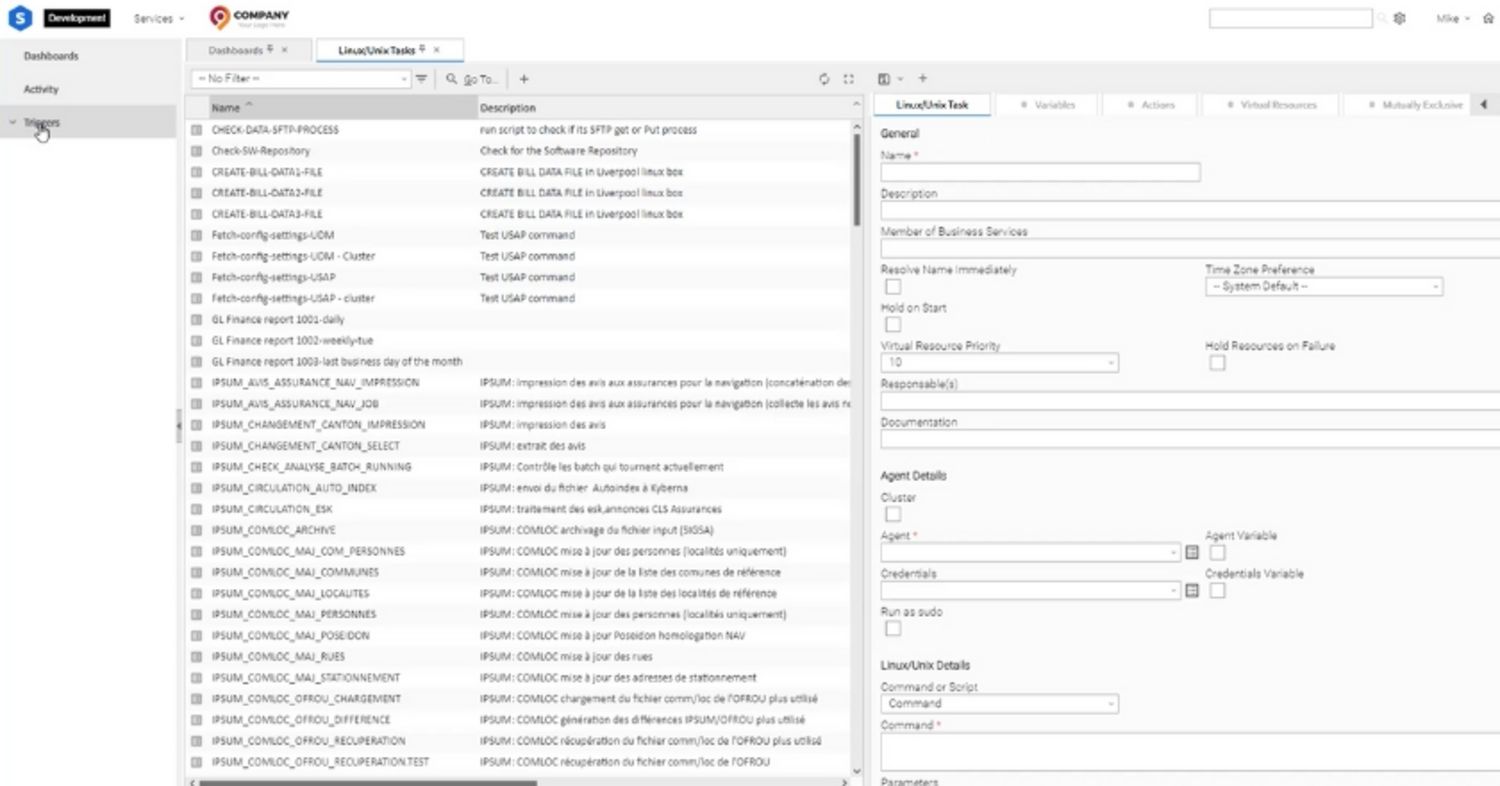
UAC supports time-based schedules, but Stonebranch's more interesting pitch is event-driven work. A file landing in storage, a message arriving, or an application changing state can trigger the next action immediately. Operators can design workflows visually, set service-level expectations, receive predictive alerts, and expose approved actions through a self-service portal. Developers can manage definitions as code and move them through a lifecycle. Business users can launch a governed process without receiving administrator access to the machinery underneath.
The commercial model matches an enterprise control plane. Contracts cover self-managed and SaaS deployments, with custom volume licensing and services around migration, implementation, support, and training. A public AWS Marketplace listing provides one rare anchor: $43,000 for a 12-month, self-managed license covering 25,000 task executions per month, before any additional AWS infrastructure cost. Custom and SaaS offers require a conversation. For a small team, that price can look like ceremony. For a bank retiring duplicate schedulers, the comparison is against outages, licenses, manual checks, and specialists keeping brittle systems alive.
Where it fits: above the specialist tools
Stonebranch competes most directly with BMC Control-M, Redwood RunMyJobs and ActiveBatch, Tidal, Broadcom's Automic and AutoSys, IBM Workload Automation, and JAMS. These products chase the same scarce prize: central authority over work that crosses applications and platforms. Stonebranch differentiates with its compatibility story, event-driven architecture, integrated file transfer, self-service, and an Integration Hub designed to make the platform extensible.
Cron and cloud-native schedulers are inexpensive and sensible when work stays inside one environment.
Airflow and similar tools fit code-centric pipeline teams that do not need broad enterprise operations.
Cross-platform workflows, event triggers, SAP, files, mainframes, cloud, governance, and operational monitoring.
Control-M, Redwood, Tidal, Broadcom, IBM, ActiveBatch, and JAMS compete for the same control-plane role.
The company has pushed further into SAP. Its Universal Connector received certified integration for RISE with SAP S/4HANA Cloud in 2025, and Stonebranch acquired German SAP automation specialist HONICO that September. In 2026 it launched Robi AI, offering natural-language interaction and operational insights inside automation. The useful question will be whether AI shortens diagnosis while preserving the permissions and audit trail that regulated customers require. In this market, a clever suggestion is welcome; an untraceable production action is not.
Stonebranch is also privately held. EMH Partners took a significant minority stake in April 2024 to fund product work, geographic expansion, and organic growth, while Elvaston kept majority ownership. The amount was not disclosed. Stonebranch says it serves more than 350 enterprise clients, with public examples spanning ING, BMW Group, Expedia Group, BP, Seattle Children's Hospital, Wella, Thai Airways, and Achmea. The common trait is not industry. It is an IT estate too consequential and too mixed for one person's spreadsheet.
For a company that sells unattended work, Stonebranch talks a lot about the people attending to it. Its team works across seven global locations and remotely, with company benefits and recruiting material organized around flexibility, health, respect, training, and shared celebrations. Employee feedback produced Metro Atlanta Top Workplaces awards in 2025 and 2026, while Diversio awarded a Bronze certification for inclusion work in 2025. Those signals do not prove that every office feels the same. They do fit the service-heavy sales pitch, though: migration expertise and responsive support repeatedly show up in customer accounts as reasons a technically difficult switch became acceptable.
When the control room is overkill
The Stonebranch approach does not win automatically. A startup with a dozen cloud jobs may be better served by its provider's scheduler. A data team operating entirely in Python may prefer Airflow. An organization unwilling to retire duplicate tools can end up paying for a new layer while preserving every old cost. Event-driven design also fails when upstream systems cannot emit reliable events, ownership is vague, or teams automate a broken process without first agreeing what success means.
But in the environment Stonebranch was built for, the appeal is easy to understand. Tomorrow's revenue file depends on yesterday's mainframe record; the SAP process waits on both; a cloud model needs the output; compliance wants an audit trail; and an operator wants one alarm, not seven. The company's product is the choreography, but the thing customers are really buying is a quieter morning.