The quiet enemy of financial marketing is not a rival campaign. It is the redlined PDF waiting in somebody’s inbox. Before a fund company, broker-dealer or investment adviser can publish an ad, a compliance team has to check the claims, attach the right disclosures, record the revisions, collect approvals and keep evidence that the whole ritual happened. A missing sentence can become a regulatory problem. A slow review can turn a timely market idea into yesterday’s news.
Red Oak built a business in that uncomfortable gap between “ready to publish” and “safe to publish.” The Austin company’s software routes marketing material through configurable reviews, records every decision and stores the result in a format designed for securities rules. The buyer is usually not one person. Compliance wants defensibility. Marketing wants speed. Legal wants consistency. Operations wants the workflow to stop living in email.
This is a wonderfully specific kind of enterprise software: the customer pays to make a mandatory process less painful. Red Oak says its customers typically reach approvals 35 percent faster with 70 percent fewer touches. The rules remain. The waiting shrinks.
The first thing that failed was the handoff
Red Oak’s origin is less garage mythology than workflow archaeology. Stephen Pope and Cathy Vasilev had worked as compliance practitioners. They saw the shortcomings of existing advertising-review tools up close: rigid systems on one side, improvised email and spreadsheets on the other. In 2010 they teamed with software developer Rick Grashel to build the tool they wanted to use.
Their important decision was to treat each firm’s process as genuinely different. Red Oak’s workflow engine lets customers create rules, parallel reviews, questions, routing and approvals without paying for a fresh technical project every time a policy changes. It connects to content tools and reporting systems, and its FINRA AREF integration can file material, retrieve comment letters and save as much as 30 minutes per filing.
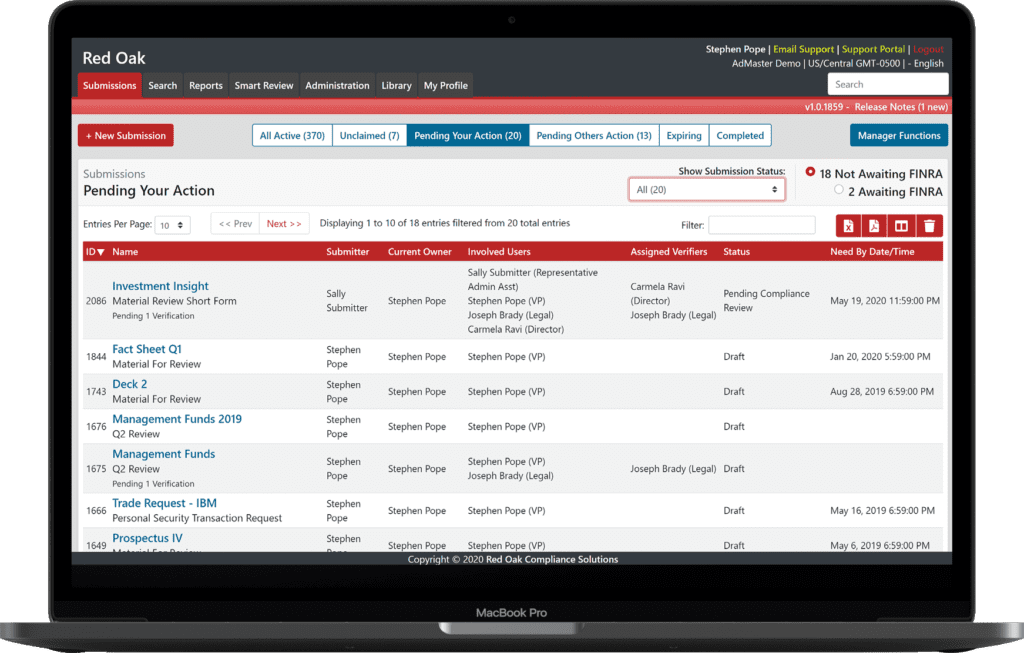
The scale hiding inside this mundane work is startling. In 2022, customers reviewed more than 6.7 million documents in Red Oak, recorded 14.8 million interactions and sent 15,441 submissions to FINRA through its filing module. That year the company shipped more than 200 enhancements across 30 releases, expanded staff by almost 20 percent and grew revenue by 27 percent. Forty-one new software customers represented another $4.5 trillion in assets under management.
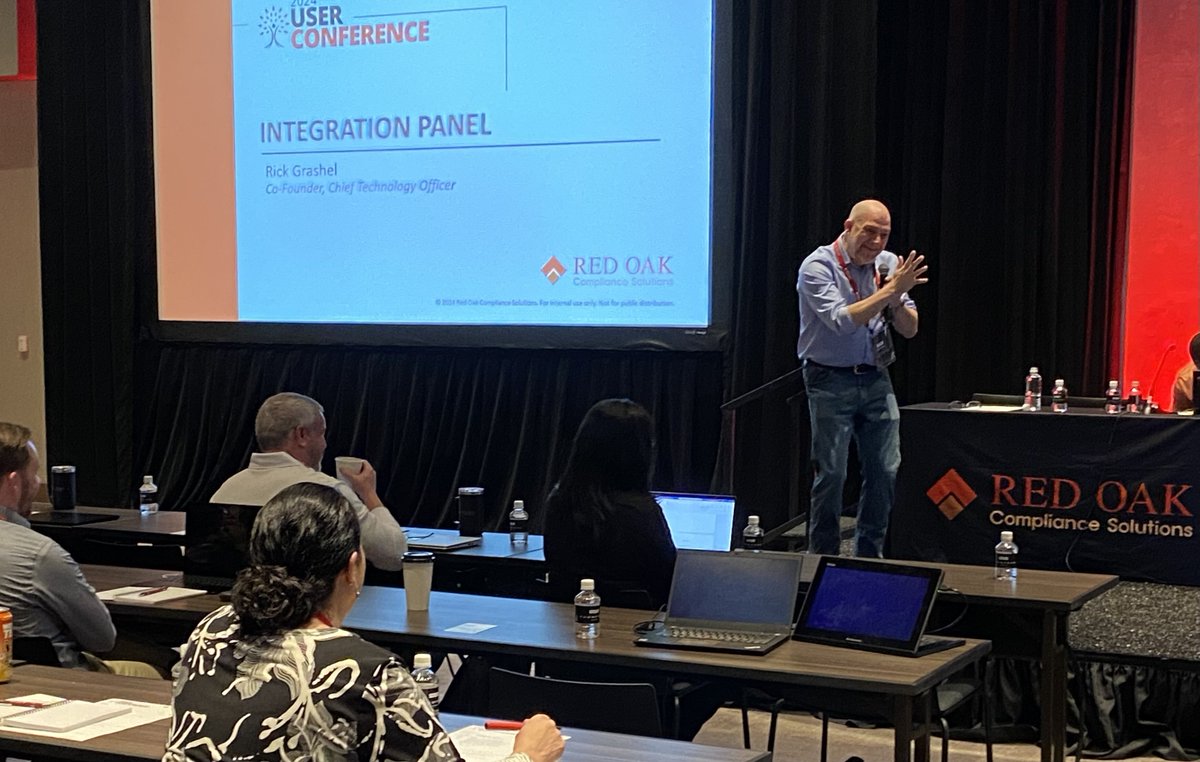
“Our software is the best because our customers predominantly inform its direction.”Rick Grashel, co-founder and chief technology officer
Thirteen bootstrapped years, then the expensive part
For most of its life, Red Oak grew organically. Then came the change of mind. The founders had fielded investor interest before, but in 2023 they began taking Mainsail Partners seriously. Their public account is revealing: they spoke with other companies in Mainsail’s portfolio and focused on whether the growth investor would preserve Red Oak’s culture and customer relationship. Capital was not the scarce resource. Trust was.
The answer cost $51 million, the size of Mainsail’s growth-equity investment announced that June. Red Oak said it would use the money to accelerate development, expand customer service and scale operations. Prices for the acquisitions that followed have not been made public. The sequence, however, shows exactly what the money was meant to buy: the rest of the communication chain.
Check claims, disclosures, versions and approvals before publication.
Move approved content to wealth firms and advisors, then measure engagement.
Monitor sites, social accounts, affiliates and changes after content goes live.
Capture communications across channels and preserve the evidence.
SiteQuest came first in 2024, adding website monitoring, internet supervision and policy management. In 2025 Red Oak bought 4U Platform, a network that connects investment companies with wealth managers for content submission, approval, advisor distribution and engagement analytics. The company stopped describing itself as an advertising-review vendor and started talking about “compliance connectivity.” The phrase is marketing, but the product logic is solid: follow the same piece of regulated content beyond the approval button.
The platform is now chasing the sentence after the brochure
The latest move is the largest conceptual jump. In July 2026, Red Oak and MirrorWeb announced a definitive agreement to combine under the Red Oak name. MirrorWeb’s software supervises and archives email, text, WhatsApp, iMessage, LinkedIn and other channels. Its Mira system uses AI to surface conduct risk. Romir Bosu, MirrorWeb’s CEO, is set to lead the combined company; Red Oak CEO Dave Dutch will remain an adviser.
Red Oak governs what a firm publishes. MirrorWeb governs what its people say around it. Together they intend to create a shared record from content creation through approval, distribution, supervision and archiving. Existing clients are not being forced to migrate immediately, and both products will continue while the systems are connected over time. That detail matters. In regulated enterprise software, an integration roadmap is more believable when it admits that replacing infrastructure cannot happen over a weekend.
The combined group reports more than 1,550 regulated firms, 17 of the top 20 global asset managers and more than $62 trillion in represented client assets. Earlier Red Oak releases used a broader count of more than 2,300 firms worldwide, so the customer number depends on what is being counted. The firmer signal is buyer quality: large asset managers use the system for processes they have to defend in an examination.
AI has to show its work
Red Oak launched its AI Review module in January 2025. The restrained part of the pitch is the useful part. The module sits inside the existing rules engine, uses prompts and a firm’s own policies, and assists reviewers rather than pretending a language model can assume legal accountability. Red Oak’s newer phrase is “compliance-grade AI,” meaning the output must be transparent, auditable and attached to a controlled process.
That is also where Red Oak differs from a generic workflow builder. RegEd competes directly in enterprise advertising review. Saifr emphasizes AI-assisted marketing compliance. Hearsay, Smarsh and Global Relay cover advisor communications, supervision or archiving; StarCompliance covers other employee and firm obligations. A large buyer can assemble a stack from those vendors. Red Oak’s wager is that one editable thread across review, distribution and supervision will beat a collection of handoffs.
The business model follows enterprise software convention: modular SaaS sold through demos and negotiated contracts, with implementation, support and optional compliance consulting. Red Oak advertises greater than 99.9 percent uptime, an average support resolution time below one hour and 99 percent client retention. Its consultants collectively claim more than 120 years in the industry. The service layer is not decoration. A configurable system still needs somebody who knows which configurations will survive contact with a regulator.
What another company can copy - and when not to
Red Oak’s transferable idea is not “add compliance” or “buy three companies.” It is to pick a costly handoff between departments, learn the underlying rules better than a horizontal software vendor, measure the touches and waiting time, then expand only where the same record naturally travels. Review led to distribution because approved content needs an audience. It led to supervision because the published message changes once a human discusses it. It led to archiving because every decision needs evidence.
The Red Oak playbook, in five moves
- Start with the workflow people must complete, not a dashboard they might admire.
- Let customers encode their own rules without calling engineering.
- Measure cycle time, touches, exceptions and evidence captured.
- Expand along the object’s journey, not into a fashionable adjacent market.
- Use AI inside the audit trail, with a named human still responsible.
The approach is a poor fit for an unregulated company with a simple approval chain. It will also disappoint a buyer that has no process owner, no coherent policies to encode or no appetite for implementation. Configurable software can preserve a good process and expose a bad one; it cannot decide who inside a company is allowed to say yes. And a firm looking for autonomous AI to replace accountable reviewers is asking for a different product, and perhaps a future conversation with its regulator.
Red Oak itself now faces the platform version of that warning. Combining SiteQuest, 4U and MirrorWeb will work only if the data, permissions and customer experience actually connect. A suite described on a slide is easy. A shared record that crosses marketing, compliance, distribution and employee communications is hard. The company’s opportunity is that its customers already know the cost of disconnected systems. Its risk is becoming one.
Follow the work
Red Oak publishes product updates, regulatory commentary and event material for financial compliance and marketing teams.