Consider the ordinary employee trade. Someone at an investment firm wants to buy a stock for a personal account. The request looks small, almost domestic. But the firm may be advising the company, holding confidential information about it, or trading the same security for clients. The size of the purchase tells you remarkably little. What matters is the company it keeps.
That is the territory ComplySci chose: the gap between an employee’s private financial life and a firm’s public obligations. Founded in 2003 as Compliance Science, it built software to collect personal trading records, apply firm policies and help compliance officers examine potential conflicts. Today its product is marketed as the Comply Platform. The old name survives in its login address, a small fossil of a larger business.
- Employee trades, disclosures and certifications become records a compliance team can review.
- Direct broker feeds supply evidence; configurable rules help decide what deserves attention.
- Acquisitions widened the offering into consulting, education and political-contribution monitoring.
A trade is only half the story
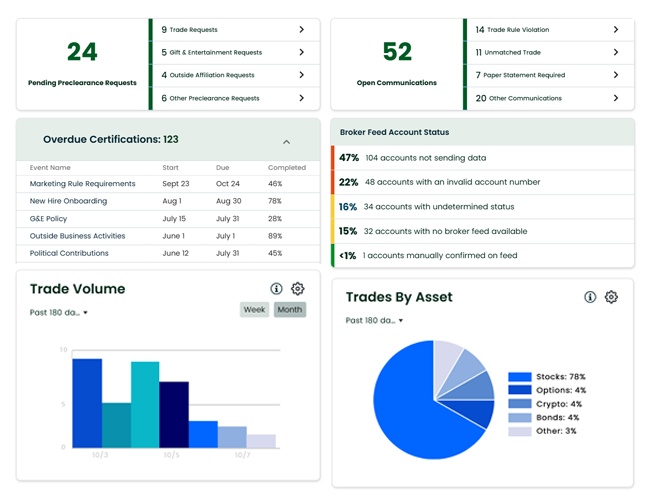
ComplySci’s customers include investment advisers, hedge funds, private equity firms and broker-dealers. Their compliance teams need to know more than whether somebody bought shares. Did the employee request permission? Was the security restricted? Did a holding-period rule apply? The platform brings preclearance, post-trade monitoring and reporting into a shared workflow, so the request and the eventual transaction can be examined together.
The same logic extends to gifts, entertainment, political contributions and outside business activities. An outside directorship might be perfectly reasonable, yet deserve scrutiny alongside a firm’s commercial relationships. A certification records an employee’s acknowledgment of policy. A disclosure gives the reviewer something to investigate. ComplySci’s useful trick is putting these activities within reach of the same compliance function.
The plumbing has opinions
The unglamorous part is collecting the data. In a September 2022 explanation, ComplySci described connections to more than 200 brokerage firms. Brokers send holdings and transaction files directly into the compliance system. That article describes nightly batches, an important distinction for anyone imagining a continuous live market feed. A fast approval workflow and a transaction feed are different clocks.
Incoming records also need translation. Security identifiers, account details and transaction formats must line up before a rule can sensibly compare them. ComplySci describes normalization, a securities reference database and dedicated data operations staff. It also provides a view of feed health. An account that has stopped sending data is a problem the reviewer needs to see, rather than mistake for a beautifully quiet employee.
- 01 Broker recordsHoldings + transactions
- 02 NormalizeMatch the identifiers
- 03 Apply policySurface exceptions
- 04 Review + recordKeep the decision
Coverage has qualifications. COMPLY’s broker directory warns that a broker may decline a feed request because of account minimums, geography or broker-dealer status. Individual authorization may be required; timing is at the broker’s discretion. For a buyer, the sensible question is specific: will this system receive the accounts our employees actually use?
The $120 million widening of the lens
The company’s financing history helps explain the expansion. Edison Ventures announced an $8.25 million Series A investment in January 2014, describing it as the first outside capital. Vista Equity Partners took a major stake in August 2018. Then, in June 2021, ComplySci announced approximately $120 million in growth capital from K1 Investment Management, explicitly linking the investment to product development and acquisitions.
Investment in the business, not its valuation.
In October 2021, ComplySci acquired National Regulatory Services, adding consulting, education and compliance technology. In November it acquired illumis, whose software aggregates political-contribution records from federal, state and local sources. Each purchase filled a different need: understanding obligations, or finding evidence scattered across public databases. The product’s field of view became wider than personal trading.
By 2022, ComplySci, RIA in a Box, NRS and illumis had come together under the COMPLY parent brand. Scale needs careful reading here. ComplySci reported more than 1,400 customers in 2021; later COMPLY materials describe more than 7,000 clients across the portfolio. Those figures concern different business boundaries. Treating them as a tidy organic-growth chart would manufacture a story the numbers do not tell.

Buying the system means building the rules
ComplySci sits in the specialist financial-services RegTech market, alongside alternatives such as ACA Group’s ComplianceAlpha and MyComplianceOffice. Both also offer employee trading oversight. ComplySci’s emphasis on direct feeds, data operations and the surrounding COMPLY services gives buyers a concrete proposition to test. The useful comparison concerns coverage, configuration, review work and support.
The commercial model is business subscription software, with additional services available within the wider portfolio. Its sales path invites a demonstration rather than displaying a checkout price. The time commitment is more visible: COMPLY lists typical onboarding at approximately six to eight weeks, with larger implementations separately scoped. Data loading, integrations, broker outreach and supervisor training are part of that work.
There is a lesson readers can borrow without buying anything. Identify the records that matter. Check whether they arrive. Define the rules explicitly. Test those rules, then preserve the review and decision. ComplySci’s rules library includes holding periods, security-type restrictions and trade-frequency limits, with regression testing to identify transactions outside permitted boundaries. A policy becomes more useful when someone can show how it behaves.
The newest interface still needs the oldest discipline
The wider business continues to change. COMPLY acquired UK-based Trailight in October 2025, adding conduct, competence and accountability tools. In April 2026, it announced a ComplyAI MCP Server intended to let authorized users connect AI agents to compliance workflows, including trade preclearance, while retaining platform audit logs.
“We built the compliance data infrastructure before we built the AI.”Michael Stanton, COMPLY CEO · April 2026
That sequence is the most interesting part. A new interface can make a request easier to submit. It cannot make an absent account visible by wishing. ComplySci’s enduring proposition rests on connecting records, policies and reviewers closely enough that an ordinary transaction can be understood in context. Financial drama makes headlines. This business earns its place in the quieter work that comes before them.