The most consequential button in insurance may be one most consumers never see: Clear to Sell. Before an agent can place a policy, a pile of facts must agree. Is the license active? Has the carrier appointed the agent? Did the training get finished? Is the registration current? RegEd turns those questions into a signal. Three plain words replace a small archaeology dig through regulator portals, inboxes and spreadsheets.
That is the company in miniature. RegEd does not make a banking app or move money. It builds the machinery that lets regulated financial institutions prove their people, products and processes obey the rules. Insurers use it to onboard and license producers. Broker-dealers use it to manage registrations, branch audits and employee conflicts. Banks use it to review marketing. Compliance teams use it to catch regulatory changes, assign work and show an examiner what happened afterward.
Founded in 2000 by former regulators and led today by CEO Frank Brienzi, the Morrisville, North Carolina company says it serves more than 1,000 clients, including over 200 enterprise firms and 80 percent of the top 25 U.S. financial-services companies. It is privately held and backed by Gryphon Investors. This is a mature, modular SaaS business in a category where a clean audit trail can matter more than a charming interface.
The spreadsheet is usually the first thing to fail
Manual compliance looks reasonable at small scale. A licensing specialist tracks expirations in a workbook. A marketing reviewer sends edits by email. A regulatory team copies a new rule into a shared folder. Then the firm adds states, products, representatives and acquisitions. Rows multiply. Ownership becomes fuzzy. One employee knows why a cell is yellow, and that employee goes on vacation.
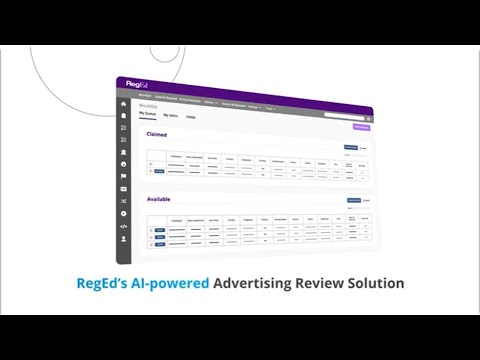
RegEd’s answer is not simply digitization. Its platform attaches rules, roles, evidence and exceptions to a workflow. Xchange synchronizes producer and representative data with sources such as NIPR and FINRA, triggers transactions, flags credential gaps and gives distribution teams a current status. Advertising Review routes submissions according to firm rules, manages versions and disclosures, supports video and audio annotation, and retains the history regulators expect. Regulatory Change Management filters a torrent of public notices into obligations and action items.
The distinction matters. A generic task manager can assign “review this ad.” RegEd can also know who submitted it, which licenses that person holds, what disclosure language the firm approved and which version reached the public. The product is context arranged around a regulated decision.
A platform sold one headache at a time
RegEd groups its products into four broad jobs: producer management; compliance management; education and training; and regulatory change management. Underneath sit more than 20 modules, including onboarding, licensing and registration, continuing education, advertising review, gifts and gratuities, outside business activities, personal securities accounts, complaints, questionnaires, branch audits and policy management.
The business model is enterprise SaaS, sold on a quote rather than a public price card. A contract can include software subscriptions, implementation, integrations, training volume and managed services. The customer is buying less re-keying, fewer disconnected vendors, shorter review cycles and more defensible records. RegEd says its 25 largest customers use an average of 14 solutions, which neatly explains the commercial engine: enter through an urgent workflow, connect the data, then expand across adjacent obligations.
| Job | Old operating system | RegEd’s version |
|---|---|---|
| Producer readiness | Portals, email and license spreadsheets | Synced records, automated transactions and Clear to Sell |
| Marketing review | Attachments, redlines and tribal memory | Routing, annotations, disclosures, versions and retention |
| Regulatory change | Newsletters copied into trackers | Curated obligations, ownership, action and evidence |
| Training | Separate catalogs and certificate files | Assigned courses, completion data and credential tracking |
The cost is not only the invoice. Enterprise compliance software requires process mapping, clean data, integrations and people willing to retire their unofficial side systems. A large insurer can justify that work because one workflow may touch tens of thousands of producers. A small adviser with a simple footprint may be better served by a narrower product or outside consultant. RegEd’s breadth is an advantage when complexity is real; without that complexity, it can become overhead.
“The best compliance automation does not remove judgment. It removes the scavenger hunt before judgment.”A practical reading of RegEd’s product strategy
AI arrives after the plumbing
RegEd’s recent AI push is interesting because it sits on top of an existing workflow rather than floating beside it. The company’s advertising product has handled more than eight million submissions. It says four of the five largest U.S. banks and six of the ten largest broker-dealers use the system. In 2025, RegEd released the third generation of its proprietary advertising model, reporting greater than 90 percent accuracy at identifying problematic content.
Then came Eddie, a virtual compliance assistant whose cheerfully ordinary name softens a serious assignment. Eddie now represents embedded intelligence across advertising review, licensing, regulatory change and branch examinations. In 2026, RegEd extended its advertising support to the SEC’s Marketing Rule for investment advisers and introduced a branch-exam assistant that places regulatory guidance and a firm’s own policies beside inspection questions.
This suggests an evolution, not a sudden change of faith. RegEd began with rules engines, automated validation and directed workflows. Machine learning improves which item gets flagged and what context appears. The company still emphasizes governed deployment and human judgment. In compliance, a plausible answer without lineage is not a shortcut. It is a new kind of risk.

The expert layer is the product, too
Software alone cannot keep pace with financial regulation. RegEd says more than 30 regulatory specialists, carrying over 300 years of combined experience, vet more than 40,000 items a year. In 2025, that funnel produced more than 4,600 actionable regulations across securities, federal insurance and state insurance. The value is not forwarding every bulletin. It is deciding which changes deserve a customer’s attention, then attaching them to work.
That human layer also appears in training, templates, conferences and managed services. RegEd updates annual compliance questionnaires around FINRA and SEC priorities. It runs RegEd Engage for clients and industry experts. It delivers more than one million courses and insurance certificates annually. The content creates recurring reasons to use the system; the system produces evidence that the content reached the right people.
Partnerships make the platform less isolated. NIPR and FINRA connections anchor licensing and registration. RegEd lists technology and ecosystem relationships with DTCC, Guidewire, FIS, Varicent, CaptivateIQ, MessageWatcher and applicant-screening specialist Business Information Group. Its developer portal exposes APIs for onboarding, Clear-to-Sell validation, licensing orders, gifts and advertising reviews. The more RegEd can sit at the center of customer data, the harder it is to replace with a prettier point solution.
What builders can steal
Completing a task is useful. Showing who did it, under which rule, with which evidence is what regulated buyers fund.
The richest workflow products live between systems and teams, where copying, chasing and reconciling consume the day.
Encode specialist knowledge, but keep an escalation path for exceptions. Judgment is part of the product boundary.
One module earns trust. Common data and identity make the next module cheaper to adopt and more valuable.
There are conditions where this playbook fails. The process must recur often enough to justify software. The rules must be structured enough to encode. The buyer must face meaningful downside from mistakes. Data sources must be accessible, and the institution must be prepared to change its process. If the work is rare, bespoke or politically ownerless, a platform can merely put a glossy surface on confusion.
Competition is fragmented. AgentSync and Vertafore overlap in insurance distribution; COMPLY, ACA Group, MyComplianceOffice and StarCompliance cover parts of employee and securities compliance; Smarsh is strong in communications; Wolters Kluwer and Ncontracts compete in adjacent risk and regulatory work. The stubborn competitor is the internal stack - spreadsheets, email, regulator portals and people who know the shortcuts.
RegEd’s defense is accumulated specificity. It has spent a quarter-century learning that a license is not merely active or inactive, an ad is not merely approved or rejected, and a regulatory notice is not automatically an obligation. Each answer depends on a chain of context. RegEd packages that chain as software. Boring? Certainly. But when an examiner asks for the receipt, boring becomes a compliment.