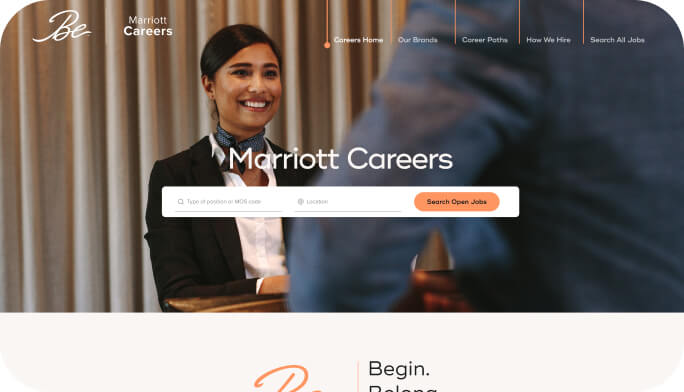
Pilot Flying J had a very particular problem. It needed commercial drivers, a group of candidates that a generic corporate careers page could easily underserve. Recruiting.com describes the response: a new career site with landing pages designed for specific audiences. Six months after launch, driver applications had risen 30 percent. The interesting part is where the intervention happened. Before the interview. Before the screening call. At the place where a stranger decides whether an employer deserves another minute.
That is the territory Recruiting.com chose: the distance between being interested in a company and actually applying. Its work combines employer branding, career-site design and recruiting software. The buyer is an employer; the person who must find the result useful is a job seeker. Both need more than a photograph and an Apply button.
- Recruiting.com made employer career sites its specialty.
- Its domain now leads to Paradox’s Career Site Studio.
- The lesson to borrow: remove obstacles between interest and application.
The doorway was the product
The business has roots in Aaron Matos’s recruiting ventures. A 2014 company announcement dates the Recruiting.com software division’s launch to 2012, within the Jobing.com business. It was an expansion from helping people discover jobs toward helping employers present themselves and handle candidate interest. Recruiting.com later described itself as a Recruiting Ventures portfolio company, based in Scottsdale.
Its expertise lived at the intersection of marketing and human resources: explain the employer, organize the opportunities, make the site work on a phone, and connect it to the applicant tracking system. A historical company fact sheet reported more than 500 career sites and integrations with over 100 applicant tracking systems. Those historical claims reveal a business built around repeated implementation work.
The customers crossed industry lines. Recruiting.com showcased Pilot Flying J, Extra Space Storage, Taylor Morrison and Grand Canyon University. Healthcare, hospitality, retail, education and nonprofits appeared among its customer sectors. Their common problem was translating an organization into something a prospective employee could understand and act on.
Now the website answers back
Today, Recruiting.com’s domain redirects to Paradox’s Career Site Studio. That distinction matters: the old company identity and the current product should not be casually collapsed into one. Paradox’s product combines branded sites with conversational AI, job recommendations and an assistant that can answer questions while someone explores opportunities. Workday completed its acquisition of Paradox on October 1, 2025.
The small features explain the idea better than the AI label. A military skills translator connects an occupational specialty code with relevant civilian jobs. A commute calculator lets candidates investigate travel before applying. Resume matching helps visitors identify openings related to their experience. Each addresses a different translation problem: what you did, where you can get to, and which job title might actually fit.
Content can respond to the conversation, too. Ask about benefits or culture and the experience can surface relevant material. Someone who finds no suitable opening can join a talent community or receive job alerts. For employers with multiple brands or regions, separate career experiences can preserve the appropriate identity. Internal career sites extend the same logic to existing employees looking for their next role.
A website still needs people behind it
There is a second customer in this story: the recruiter who has accidentally become a website administrator. Paradox’s managed service covers design, building, hosting and ongoing maintenance. Its argument is a labor-allocation argument. Time spent fixing a career page is time unavailable for conversations with applicants and hiring managers.
The current product also acknowledges the appeal of direct control. Career Site Studio is the new name for Conversational Career Sites, with tools allowing teams to manage content directly while retaining service support. The practical shift is from treating service and control as a binary choice to offering both. For a buyer, that operating arrangement belongs in the decision alongside the site’s features.
Recruiting.com’s earlier HiringThing partnership makes the division of labor clear. Announced in January 2019, it paired career-site and employer-brand expertise with applicant tracking software. Then-CEO David Harden described reaching candidates at the “point of interest.” BountyJobs was another announced partner. The strategy was to connect recruiting tools around the candidate journey, giving the career site a defined job within a larger system.
“point of interest”
David Harden, then Recruiting.com CEO, on where the career-site experience begins. January 2019.
Count the people who get through
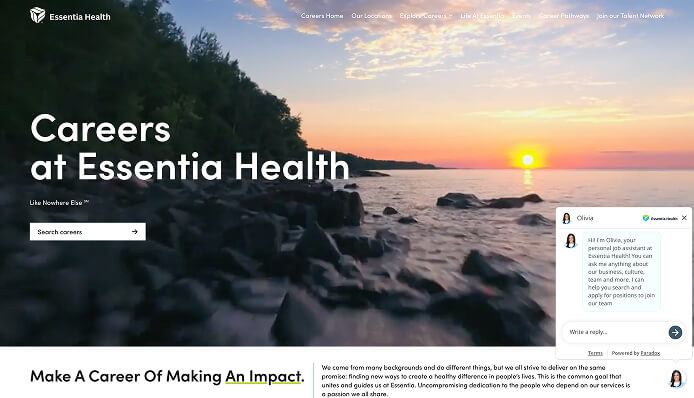
Consider Essentia Health, a current Paradox customer using several products, including Career Site Studio, Conversational Apply and scheduling. Its published case study describes recruiters burdened with manual administration. Olivia, the conversational assistant, worked alongside its Workday applicant tracking system to capture and schedule candidates around the clock. Essentia reported a 100 percent increase in interviews scheduled.
That result belongs to a combined implementation. It does not establish that redesigning a homepage doubles interviews. Likewise, Pilot Flying J’s application increase is a reported customer outcome, not a promise that every employer gets the same lift. The useful distinction is between attracting attention, completing an application and arranging an interview. They are different events, with different obstacles.
The commercial model combines recruiting technology with site delivery and support. Historically, Recruiting.com reported that nearly half its customers held multiyear contracts. For a buyer, the useful cost comparison includes the vendor agreement, integration work and staff time spent maintaining the experience. A sensible evaluation follows one real vacancy from mobile search through application and checks whether candidate details reach the hiring system correctly.
- 01Find a roleCareer site
- 02ApplyApplication flow
- 03MeetScheduling
Copy the question before buying the answer
This sits in a competitive market alongside Phenom, Radancy and iCIMS career-site offerings. Personalization alone is not a defensible explanation of the difference; other vendors offer it. Paradox’s proposition puts conversational interaction, custom design, managed service and recruiting-system connections together. The fit depends on which of those an employer actually needs.
The portable lesson is pleasantly ordinary. Ask what a particular candidate needs to know next, then make that answer easy to reach. Try a role-specific landing page. Test on a phone. Measure completed applications alongside visits. Check the handoff to scheduling. These are experiments an employer can run without first agreeing that every hiring problem needs AI.
The limits follow from the same logic. Faster navigation cannot improve unattractive pay, invent a suitable vacancy or repair inaccurate job data. A complex implementation also needs an owner who can keep policies and openings current. Recruiting.com’s most useful idea survives those conditions: hiring starts before the recruiter arrives. The first conversation is often with the website.