Reagan Attle arrived at Clio in 2017 with a question she later admitted out loud: could legal technology really be a place for creative marketing? The answer came quickly. On her first day, she watched customers react to the company’s work, its reasons for doing it, and the ideas it was trying to teach. The response surprised her. Legal professionals were not merely buying software. They were looking for a clearer way through a changing profession.
That observation became a useful organizing principle. If the customer is trying to navigate change, marketing cannot stop at a list of features. It has to explain the change, give it a vocabulary, and bring people together to compare notes. Attle’s work at Clio has stretched across brand, demand, product and customer marketing, insights, partnerships, digital strategy, and communications. The connective tissue is trust.
Trust is a slow asset in a fast business. It is hard to attribute neatly, easy to neglect, and valuable precisely when a market becomes noisy. Attle calls it a competitive moat. Her version is built through education, useful research, credible customer stories, and repeated opportunities for legal professionals to learn from one another.
A brand learns to speak industry
Before Clio, Attle led global marketing and strategy at ACTIVE Network, helping the company through multiple acquisitions and its public offering. That is useful preparation for corporate motion: new owners, new products, new audiences, and the recurring problem of explaining what changed without losing the plot.
At Clio, the motion kept coming. Attle led announcement and go-to-market work around the Series D and E funding rounds, the acquisitions of Lexicata, CalendarRules, and Lawyaw, and the launch of Clio Payments. She also helped introduce a new mission and brand. In 2021, when Clio expanded its executive team, she became Chief Marketing Officer.
The striking part is what did not change. Attle has noted that Clio’s logo stayed the same while the look, feel, voice, and expression of the customer problem changed substantially. Brand consistency, in this telling, is not visual stillness. It is the ability to preserve a promise while making it legible to a company and market that have both grown up.
“We truly have an opportunity to reshape how lawyers manage and grow their firms.”Reagan Attle, on becoming Clio’s CMO
The promise is larger than software. Clio’s mission is to transform the legal experience for all. Attle’s job is to make that sentence show up in practical places: how the company hires, what its customers hear at all-hands meetings, which stories receive attention, and how a product announcement connects to the work of a law firm.
Autonomy with a wider frame
Attle’s operating style matters because the brief is too broad for one executive to hold personally. When Clio announced her promotion to CMO, colleague Nefra-Ann MacDonald described a leader who asks teams to consider three layers at once: the metric, the company-wide consequence, and the industry-wide consequence. MacDonald also credited Attle with balancing direction and autonomy, leaving room for people to bring their own judgment to the work.
That combination sounds simple until a company is moving quickly. A narrow performance target can make a team efficient at the wrong task. A grand mission without measures can make it vague. Attle’s frame connects them. The campaign still needs to perform, but the team must also ask what expectation it sets for the company and whether it helps the industry move toward a useful outcome.
The method showed up when Clio’s distributed marketing team gathered in Vancouver for its first global onsite. Attle wrote that colleagues came from Canada, the United States, Ireland, and Australia to study how customers use the product, practice giving and receiving feedback, and decide how to increase their impact during the next growth phase. The agenda tells its own story. Customer understanding and team mechanics were treated as parts of the same system.
It also clarifies what “customer obsession” means in her vocabulary. It is not simply responsiveness. It is an organizational habit of returning to the customer’s work before choosing the language, the channel, or the creative treatment. The better the team understands the lived problem, the more freedom it can use responsibly.
The trust-compounding loop
The conference as a piece of infrastructure
ClioCon is the most visible expression of this approach. Attle describes community as “everything” to the company. The annual gathering is its large public square, but the system also includes an online community, smaller city events, sessions at industry conferences, customer case studies, and videos. Each format answers the same pair of questions: how can Clio talk with customers, and how can customers find one another?
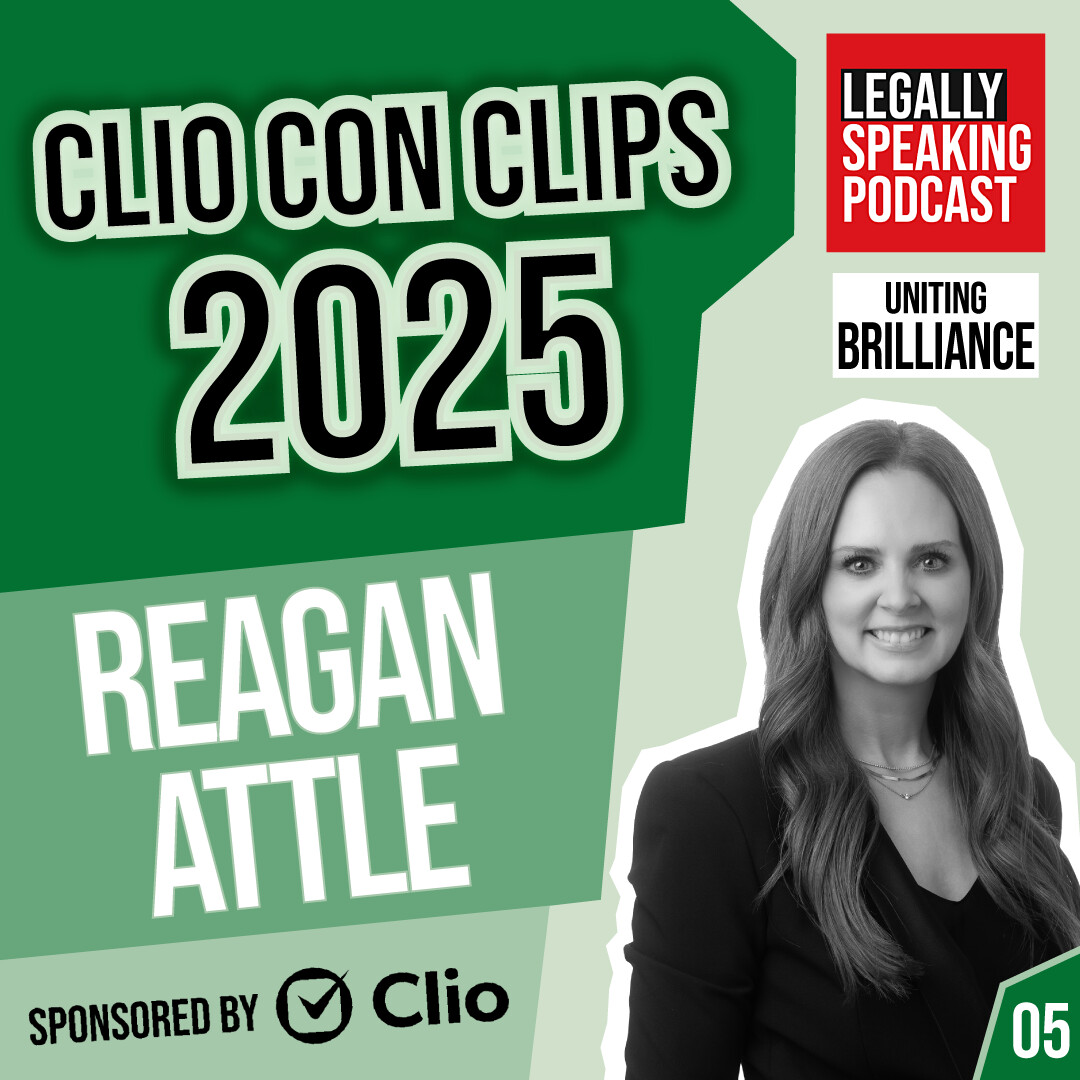
Her standard for the event is deliberately personal. People should leave having learned something, met someone useful, or felt included in a memorable moment. They have surrendered two, three, or four days depending on the journey. The obligation is to make that commitment worthwhile.
That framing offers a better event metric than spectacle alone. A conference is temporary; a relationship between two customers can keep producing value. The warm feeling Attle wants attendees to carry home is not decorative. It is evidence that information, hospitality, and identity landed together.
Did the customer learn something, meet someone, or feel more capable than when they arrived?
AI speed, human source material
The latest test of the philosophy is AI. At ClioCon 2025, the marketing team created the opening video with AI and made that fact intentionally obvious. The medium became part of the message: legal work and the tools around it are changing.
Attle is comfortable with AI as a creative accelerator. Her team uses it to explore new ways of working and to get stories into the market faster. But she keeps returning to a constraint: the work has to remain rooted in real customer conversations and human stories. Speed is useful after somebody has done the noticing.
That distinction matters in legal technology, where enthusiasm for capability meets a profession built on judgment, confidentiality, and trust. Attle’s public comments about ClioCon’s 2026 speakers place the emphasis on thoughtful use. She wants legal professionals to move beyond curiosity or concern and use AI with confidence and strategic intent. She has also argued that adding more technology is no longer the hardest problem. The work is to fix what is already broken.
“Legal marketing should be rooted in thought leadership.”Reagan Attle at ClioCon 2025
For Attle, education earns its place because legal professionals are learners. Thought leadership works when it helps them interpret the market, not when it merely dresses a sales pitch in charts. Customer obsession, in the same spirit, is not a slogan about proximity. It is the discipline of understanding the difficulty well enough to produce something genuinely useful.
The 100-year horizon
In a 2025 conversation about building a brand that lasts 100 years, Attle contrasted product-market fit with narrative-market fit. A product needs to work, but a company also needs a story customers can locate themselves inside. Clio’s narrative asks the legal industry to imagine more than a better administrative tool. It presents technology, data, and now AI as parts of a broader change in how legal services are managed and delivered.
A century is not a forecast. It is a prioritization device. It forces a different question about today’s decision: does this deepen the company’s relevance and its relationship with the people it serves, or merely decorate the quarter? The long horizon makes room for research, community, and patient education because their returns compound.
This is where narrative-market fit becomes more than a memorable phrase. A narrative earns fit when customers recognize their own tension in it and can use it to make a decision. For Clio, the tension has shifted over time. The early argument concerned moving legal practice into the cloud. The current argument includes connected operations, legal intelligence, and AI. The job of the brand is to help customers cross that distance without pretending the uncertainty has disappeared.
Attle’s approach offers no shortcut. It asks marketers to build the evidence behind the narrative, repeat the useful parts, retire language the customer has outgrown, and maintain enough contact with the market to know the difference. A launch creates a moment. A category requires memory. Research, conferences, customer education, and consistent language are how that memory gets made.
Attle’s own horizon widened in February 2026, when she joined the board of the BC Tech Association. The appointment connects her experience scaling a global technology brand to the local ecosystem where Clio began. She has described the role in terms of advancing technology, entrepreneurship, and talent across British Columbia.
There is also an unexpectedly tidy biographical detail. Attle used to play competitive rugby at scrum-half, number nine. The position sits at the hinge of the team, collecting the ball from one group and deciding how to move play toward the next. Marketing leadership is not rugby, but the picture fits: listen at the point of pressure, read the field, connect specialized teams, and send the story where it can travel.
Off the field, Clio’s biography supplies one more human note: she plays classic Nintendo games with her son. It is a modest detail in a career marked by acquisitions, financing, international growth, and increasingly sophisticated technology. Perhaps that is why it sticks. The most durable brands, like the most memorable games, make a complex system feel clear enough to enter and rich enough to stay.