A courtroom terminal costs 36,000 yuan. That is the price attached to a Huayu device in a 2022 upgrade contract for the People’s Court of Ejina Banner, in Inner Mongolia. Twelve terminals accounted for 432,000 yuan. Systems integration had its own line: another 25,000. The complete contract came to 1,046,300 yuan. For all the talk of intelligent justice, someone still has to specify the equipment, connect it and make it work.
This is a useful place to meet Beijing Huayu Information Technology. Start with the invoice, and the company becomes easier to understand. Its business reaches from planning and software development to courtroom systems and continuing support. Artificial intelligence now belongs in that mix, but the mix was there first.
- The customer is an institution: courts, prosecutors, government agencies and other legal organisations.
- The sale includes the seams: development, installation, integration and maintenance.
- Legal AI sits within a larger system: the Thunisoft group’s Wanxiang platform supplies specialised capabilities.
- Keep the accounts straight: this operating subsidiary and its listed parent are different legal entities.
The court buys a system, not a promise
The subsidiary was established on September 9, 2009. Its parent, Beijing Thunisoft, is the Shenzhen-listed company behind stock code 300271. The distinction matters. A group announcement can describe a technology shared across businesses; a subsidiary’s accounts describe one company. Treating them as interchangeable makes both the products and the financial performance harder to judge.
Huayu Information’s home territory is legal technology and digital government. Its customers include courts, procuratorates, judicial administration bodies and police, alongside other public institutions and commercial legal organisations. These buyers have procedures, installed equipment and people who must keep working while systems change. Their shopping list is longer than a login screen.
The company’s published service offering covers an information system’s life: planning and consultation, application development, integration, maintenance and operation. A buyer can therefore procure help with the architecture before the software arrives, and support after it has arrived. That breadth explains why a courtroom tender can contain terminals, switching equipment and an integration charge in the same document.
Consider what integration means from the user’s side. A hearing produces material that must remain useful after the hearing. Records need to be accessible to the people authorised to use them. Equipment and applications have to cooperate. A good-looking interface does little for an employee if the next step requires re-entering the same information somewhere else. The practical question is whether the system carries the work forward.
Huayu’s service credentials belong to this less theatrical part of the story. The ITSS standards organisation’s 2022 profile records level-one maturity certification for operations and maintenance and participation in more than ten standards. Such credentials concern delivery discipline. They give a procurement team something to assess beyond a polished demonstration.
The intelligence arrives inside the workflow
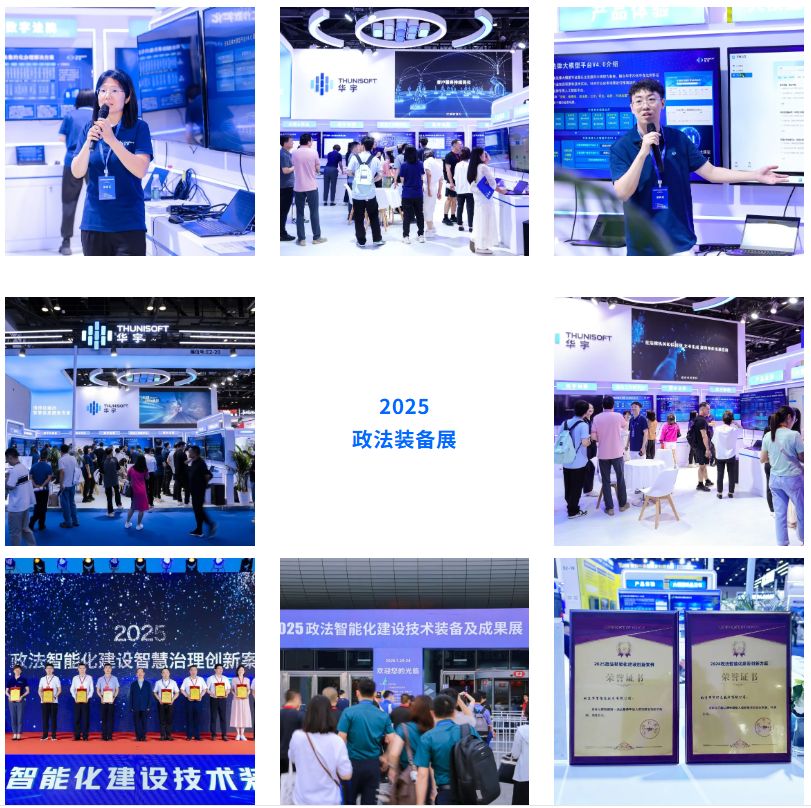
At the Thunisoft group’s 2025 Beijing exhibition appearance, Wanxiang legal large-model platform 4.0 was presented alongside digital court and prosecution tools. The company described a platform built on general foundation models, supplemented with legal knowledge and training for particular work scenarios. Its reported reach at the time was more than 100 customer organisations across seven institutional sectors.
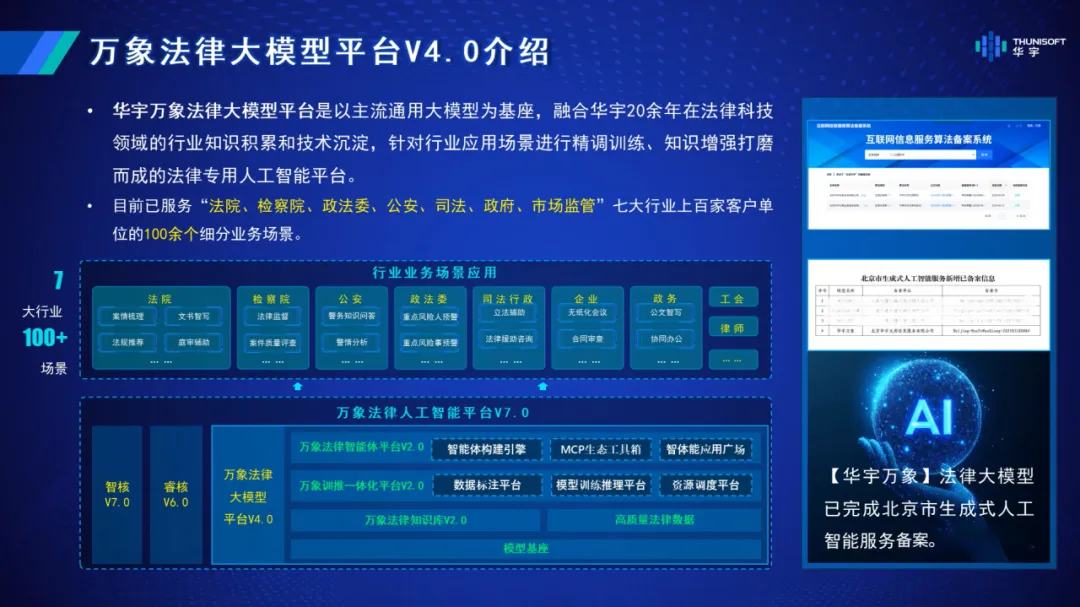
The interesting part is the placement. Court applications presented at the exhibition included case-file management, digital archives, documents, enforcement and hearing support. For prosecutors, the display included case-quality checks and an AI-assisted way to query information. These are specific tasks with an existing place in someone’s working day.
The group’s investor materials date Wanxiang’s launch to July 2023 and its legal AI platform work to 2016. That chronology suggests an incremental route into generative AI: start with domain work and data, then adapt new model capabilities to it. It is an inference about the product path, rather than proof that every earlier investment paid off.
For a legal professional, potential usefulness starts with a narrower question than whether a model knows the law. Can it help organise material for review? Can it make retrieval less laborious? Can a draft enter an established document process? Those questions make it possible to test a product against a task. They also make responsibility visible: the person handling the matter must be able to inspect what the software produces.
“Continuous innovation, enabling customers’ success.”
Huayu’s published mission, translated from Chinese
That mission sounds broad. The product catalogue makes it more concrete. Huayu Information’s association listing also names e破通, a bankruptcy legal-services platform. Bankruptcy brings several participants into one procedure; software has value when it helps them coordinate. Here again, the attractive market is a knot of records, roles and handoffs.
Sometimes the competitor is on the invoice
Court technology has rivals, but the rivalry can be wonderfully untidy. Nanjing Tongdahai competes in court workflow and enforcement systems. In its IPO responses, it also described supplying software to Thunisoft for integration into broader projects. One documented example concerned the Supreme People’s Court’s second-phase enforcement information platform.
Thunisoft won the project; Tongdahai supplied components such as enforcement workflow and judicial inquiry systems. Thunisoft integrated and further developed them. The explanation was ordinary commercial logic: a court wanted a complete solution, and a specialist could supply part of it. Even rivals sometimes have excellent reasons to appear on the same invoice.
This is a more revealing comparison than a list of AI features. A buyer selecting an integrated institutional system is judging how the pieces fit, who delivers the whole and who supports it. A specialist application supplier can compete for one tender and contribute to another. Market position depends partly on the boundaries of the job being purchased.
The contract is won. The economics remain.
The subsidiary’s 2025 revenue was approximately RMB 963.64 million; its net loss was about RMB 113.27 million. For the first half of 2026, it reported revenue of RMB 406.90 million and a net loss of RMB 10.53 million. Those are subsidiary figures. They do not make a half-year result directly comparable with a full year, but they do establish that substantial sales had yet to produce a profit.
RMB. Subsidiary results, not consolidated group results.
The wider group’s accounts provide context. Thunisoft reported 2025 revenue of roughly RMB 1.62 billion and a shareholder-attributable loss of RMB 195.09 million. In the first half of 2026, group revenue grew 7.67% to RMB 637.90 million, while operating cash flow was negative RMB 440.09 million. An improving income statement and a strained cash account can coexist.
Group management has described greater concentration on core business, operational efficiency and AI applications. Its 2024 reporting also linked revenue weakness to the opening order book and the seasonal pace of orders. The evidence supports a change in operating priorities. It does not justify inventing a private moment when management suddenly changed its mind.
Nor should the contract price at the beginning become a universal tariff. It was one historical courtroom upgrade with a specified mix of goods and services. A different institution, scope or installed system changes the job. The useful lesson is how the price was assembled: equipment and integration were identifiable obligations, rather than one mysterious number labelled technology.
Copy the sequence, not the scenery
For another software business, the transferable idea is to study the whole task before choosing where to put intelligence. Find the records, the repeated work and the points where information changes hands. Decide who needs help and who remains accountable. Then define an outcome that the buyer can inspect when the installation is complete.
For a buyer, that means asking for a demonstration built around representative work, followed by clear acceptance and support terms. For a developer, it means recognising that a useful specialised application may rely on components from another supplier. For an operator, it means allowing for the distance between signing a contract, finishing the work and receiving payment.
This approach needs conditions that software cannot supply by itself: usable information, authority to connect systems, people able to review results and a budget for continued operation. Without them, an AI layer can become another place to move paperwork. Huayu’s business is interesting because it addresses several of those practical layers together. The court may admire the demonstration. Eventually, it has to hold the hearing.