Benefits administration is the kind of business that can make a clear sentence feel like contraband. The work sits at the intersection of software, rules, employers, carriers and decisions people would prefer to make without a glossary. Ana Perez has built her career inside that thicket. Her particular skill is not pretending the complexity has vanished. It is deciding how much of it the customer should have to carry.
Since October 2024, Perez has been chief marketing officer at PlanSource, the Orlando-based benefits administration technology company. Her remit is unusually broad even by CMO standards: brand awareness, pipeline, partnerships, retention, engagement and expansion. Read together, those responsibilities describe marketing less as a department than as connective tissue. The job begins before a prospect arrives and continues long after the contract is signed.
That suits Perez. In a recorded conversation about revenue marketing during her years at Aon, she argued that marketers must understand the numbers behind the business, how it makes money and how its operations work. The phrase is striking because it contains no fashionable ornament. Before marketing can ask the business for influence, her logic goes, it should learn to speak the business's language.
“They're looking for clarity, for confidence, and for a resolution they can trust.”Ana Perez at PlanSource Eclipse 2026
A career built in the difficult middle
Perez's path began in marketing and communications roles at GE Healthcare and AIM Specialty Health. A former colleague from GE recalled her work during the merger with IDX Systems: building a message platform, arranging access to important audiences, organizing strategic communications events in Washington, D.C., and preparing executives for press conversations. Corporate combinations are where tidy language goes to be tested. Every sentence has constituencies, consequences and a deadline. It was useful training for a career spent explaining systems whose inner workings rarely fit on a billboard.
At Aon, where she spent six years and became vice president of marketing for the Health and Benefits business, Perez established a strategic marketing function for the portfolio. Her public comments from that period show the lens widening. Communications still mattered, but so did attribution, commercial outcomes and the move from a traditional marketing operation toward a revenue marketing organization.
She then joined League as vice president of product marketing and sales enablement. The title itself is a small map: understand the product, give sales a useful story, and make sure the two agree. In August 2021, Benefitfocus appointed her chief marketing officer, putting her in charge of brand value, growth and customer engagement. She held the role for three years, moved to the CMO position at talent technology company Radancy, and then joined PlanSource.
The widening lens: communications to enterprise growth
The sequence matters. Perez did not arrive at the C-suite by polishing one narrow specialty until it shone. Her roles kept adding interfaces: executive communications, portfolio strategy, product, sales enablement, customer engagement and revenue. By the time she reached PlanSource, “marketing” meant holding a complicated set of promises together.
The rebrand as a receipt
In early 2026, PlanSource introduced a new visual identity. There were the familiar components of corporate renewal: a new mark, a friendlier typeface and a palette that traded the old look for burgundy, charcoal, poppy, clementine, blue and soft whites. Perez's explanation, however, began elsewhere. Over the preceding year, she wrote, the company had accelerated its use of AI, sped up implementations, strengthened electronic data interchange performance and invested in service delivery. The brand had fallen behind the business it was meant to describe.
Her argument was that the redesign should make operating change legible. The flowing “P” was intended to suggest flexibility and forward movement. Rounded letters brought approachability. Warmer colors signaled that enterprise software need not dress like a filing cabinet to be taken seriously. Four principles anchored the design language: ease, innovation, empathy and expertise.
Reduce visual and verbal friction around a complicated process.
Let the identity reflect a product and service model in motion.
Remember the person who meets the system at a consequential moment.
Pair warmth with the credibility required of enterprise infrastructure.
This is an exacting view of brand. If the visual identity is a receipt for work already underway, marketing cannot merely announce transformation. Product, engineering, service and customer success must supply the evidence. The reward is coherence. The risk is useful too: a promise stated clearly becomes easier for customers to test.
What the customer should not have to carry
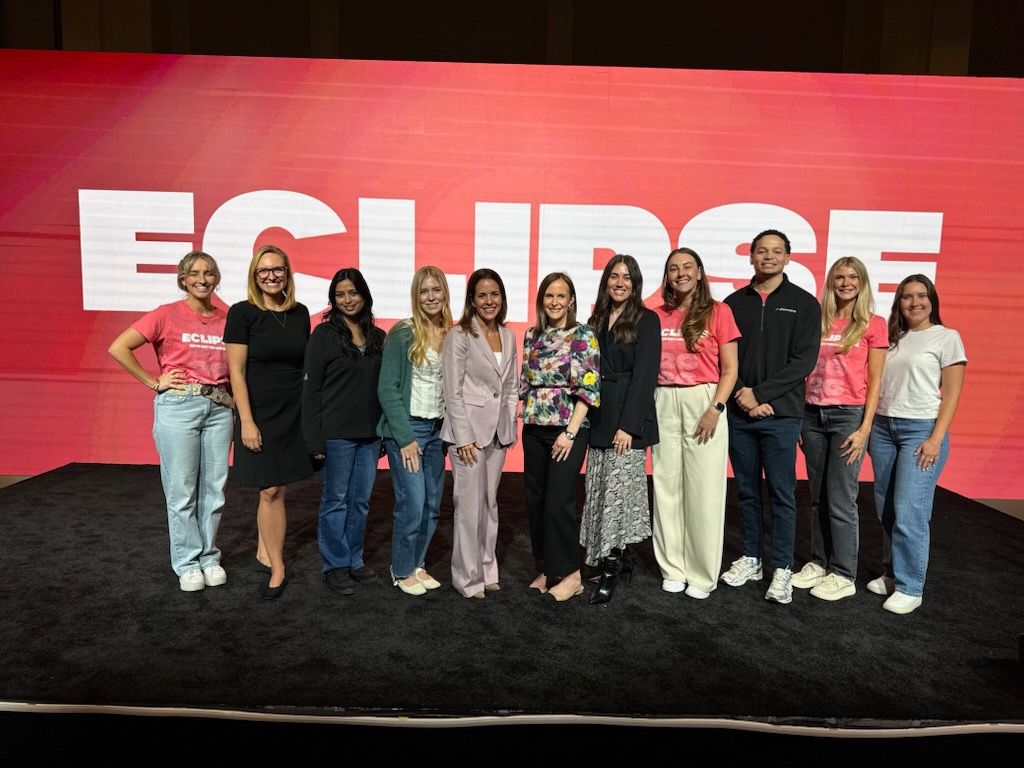
At PlanSource's Eclipse 2026 gathering, Perez and chief growth officer Greg Mercer described three stubborn problems in benefits administration. The underlying issue was fragmentation: complexity travels through the ecosystem until someone has to absorb it. Too often, that someone is an administrator or employee who never volunteered for the assignment.
Perez offered the human test. When a person is making a coverage decision or trying to resolve a problem, speed is not the whole standard. The person wants clarity, confidence and an outcome they can trust. It is a notably restrained claim for a technology executive. Faster is measurable, but trust is what gives speed its value. A quick wrong answer remains wrong with enviable efficiency.
The PlanSource story now puts AI beside human expertise rather than opposite it. At Eclipse, the company described technology intended to take on error-prone work, help teams make decisions and free people for the judgments that require context. The important verb is absorb. Useful systems swallow complexity. Unhelpful ones convert it into another task for the user.
Perez's role is to keep that distinction visible across the market. In January 2025, only a few months after joining, she described her team as a “force multiplier” for go-to-market work through brand, thought leadership, product marketing and growth. She also emphasized partnership among marketing, sales, product and customer success. It is a phrase that can sound ceremonial until one considers the alternative: each function making a different promise to the same customer.
“This redesign wasn't about aesthetics. It was about creating a clearer, more cohesive system that reflects who we are now.”Ana Perez on PlanSource's new identity
The culture behind the clean line
There is another consistent note in Perez's public leadership: she names the team. After Eclipse 2026, her recap did not dwell on the stage or claim the event as an executive triumph. She thanked colleagues individually and praised the quality and grace with which they handled details, deadlines and last-minute changes. The telling word was “grace.” Plenty of managers value work that looks effortless to the audience. Fewer remember to notice what the effort felt like backstage.
Colleagues have described Perez as creative, analytical, clear with senior leaders and comfortable working across a team. PlanSource CEO Mike Morini highlighted her energy, drive and culture-focused philosophy when announcing her appointment. Those descriptions match the pattern in her own writing: performance and warmth are not rivals. A high bar works better when people help one another reach it.
The civic version of that idea appears in Chicago, where Perez has served on the board of Step Up. The nonprofit works with girls in under-resourced communities, helping them become confident, career-focused and prepared for college. Her public profile records the board service beginning in 2018. She also lists native or bilingual proficiency in English and Spanish and studied in Kellogg's Women's Business Association while earning her MBA from 2008 to 2010. Her undergraduate degree in communications and public relations came from Boston University.
None of these facts turns a complex industry into a simple one. That would be a suspicious magic trick. They do reveal the shape of Perez's ambition. She wants marketing close enough to revenue to be accountable, close enough to operations to be credible, and close enough to people to recognize when the machinery has become the burden.
This may be why her career reads less like a collection of campaigns than a long practice of translation. At GE, the problem was a merger with many audiences. At Aon, it was moving marketing toward revenue. At League, product knowledge had to become sales usefulness. At Benefitfocus and Radancy, the brief widened to the whole company. At PlanSource, the assignment is almost architectural: align what the business builds, what the brand promises and what the user feels.
The final measure is not whether customers admire the architecture. It is whether they can walk through it without getting lost. Perez has chosen an unglamorous and therefore interesting standard: make the hard thing clear, make the clear thing trustworthy, and make the numbers answer to the experience.