Raven Gao has an unusually literal answer to the question of why anyone starts a company: there is somewhere he wants to go. In 2022, talking with other young founders, he described a virtual place that did not yet exist. Waiting another decade seemed an unsatisfactory travel arrangement. A company was a way of getting there.
That answer gives his career a useful starting point. Gao is the founder of PixAI and CEO of Mewtant, working on anime-style generative AI. The business makes pictures, but his earlier ambitions concerned whole worlds. Read his progress through that lens and the characters, communities and creative tools begin to look like parts of the same long journey.
There is a pleasing inconvenience in this ambition. A picture can be finished. A world keeps asking for things: another character, a conversation, somewhere to meet. Gao has chosen a destination with a remarkably long packing list.
A place without a winning score
In that 2022 conversation, Gao made a distinction between a virtual world and a role-playing game. A game normally supplies an objective. His imagined internet could accommodate many activities without imposing a single story or purpose. He compared it with an iPhone: the device itself does not tell its owner what victory should look like.
“I prefer virtual world, or more broadly, virtual internet.”
Raven Gao · translated from Chinese
He also offered a rather practical definition of success. Making a previously unreachable place reachable would count. When the discussion turned to failure, he said he could continue in the same direction. This was commitment expressed as geography: the company could change, while the destination remained.
His appetite for travel extended beyond software. Asked what he might buy after becoming financially free, Gao wanted a SpaceX ticket. It is an agreeable detail in a conversation about imaginary worlds. Even someone determined to build a different reality can appreciate the merits of a window seat.
Philosophy, friends and a computer science degree
Gao’s interests once pointed toward philosophy. He has discussed his attraction to utilitarianism and his eventual decision to leave philosophy behind. He went on to study computer science at Columbia University, graduating magna cum laude. His education included a focus on artificial intelligence. Abstract questions and working software occupy different timetables, but both leave room for asking what people actually want.
During his formative years, video games connected him with international friends. Those experiences later informed his interest in building virtual spaces where people could form relationships. The appeal of the screen included the people on the other side of it.
By December 2024, he was explaining how anime fans used PixAI to visualize imagined characters, while also discussing an ambition to serve professional artists. The platform then had more than five million users, principally in the United States and Japan. His field of interest had widened from meeting people in an existing game to helping people supply the inhabitants of worlds they imagined themselves.
Another side of Gao appears in his 2023 AACYF Top 30 Under 30 profile. It names him as Raven Yifan Gao, records his leadership of Troph, and describes a team that had grown from two people to more than 30. It also lists an extracurricular interest that would be difficult to confuse with model training: bartending.
Gao’s credentials included bartending through Columbia’s Bartending Agency and sake advising. There is no need to turn a cocktail shaker into a theory of entrepreneurship. The detail is enjoyable on its own. Someone who spends his working life thinking about virtual experiences also took the trouble to learn how to serve an actual drink.
Shibuya asks a better question
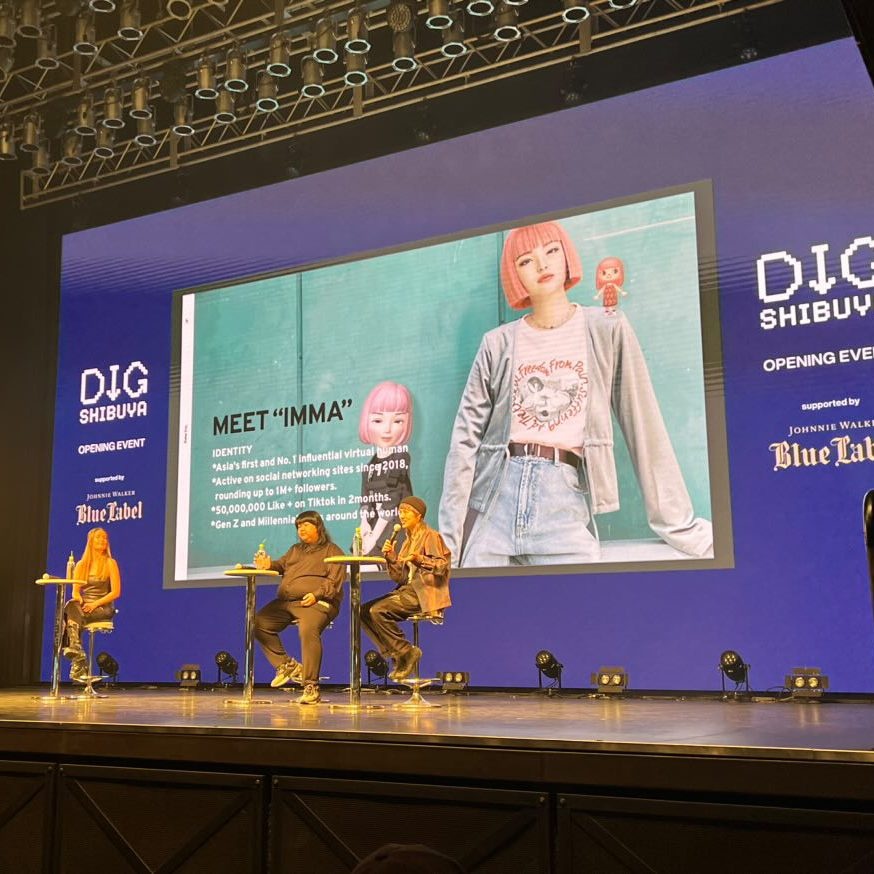
In January 2024, Gao appeared at DIG SHIBUYA for a session about whether AI would change self-expression. Alongside him were Oshi founder Leni Andronicos and Aww producer Sara Giusto. The subjects around that stage included virtual characters and digital identities. It was a fitting setting for a founder whose work concerned what people could make of themselves online.
By March 2026, he was taking part in a more practical Shibuya conversation. At Creative Tech Shibuya, Gao joined Yoshiro Tasaka in a workshop for overseas startups exploring Japan. The discussion covered business culture, decision-making and the difficulties of entering the market. Mewtant was introduced as a Shibuya-based startup.
These appearances capture two different jobs. One involves discussing what a technology might let people express. The other involves explaining how a business operates among unfamiliar institutions, expectations and habits. A founder working across markets needs both vocabularies. The imagined world still has to pass through a real meeting room.
The invitation gets easier to accept
PixAI began service in October 2022. By 2026, the work around Gao included reducing the effort between having an idea and making a usable image. Mio.2, made available to all users in April, approached that problem through conversation. Users could describe a character, then ask for changes to an outfit or composition without constructing the conventional prompt themselves.
The assistant supported Japanese, English, Korean and Traditional Chinese. An idea mode helped develop a direction; a standard mode generated images to compare. The design gave a newcomer somewhere to begin before they had learned the technical vocabulary. You could arrive with an idea still wearing its slippers.
- DescribeStart with a character or scene.
- ReviseDiscuss clothing, pose or composition.
- ChooseCompare the resulting images.
For Gao’s broader interest in self-expression, that is a consequential choice of interface. The user can spend more attention describing the thing they want. Whether the result satisfies them remains a matter of taste and judgment. A conversational tool can accept a request; the person still decides whether the character has arrived.
Let the guests organize something
In June 2026, PixAI opened up community contests. Previously, competitions had been official platform events. Eligible creators could now propose their own themes, entry requirements, prizes and schedules, subject to review. The shift gave users another role inside the platform: they could help decide what other people might make together.
That is a small but revealing addition to Gao’s story. A gallery gives someone a place to show a picture. A contest gives several people a reason to return, compare interpretations and discover each other. The same theme can produce a roomful of different answers. The social activity grows out of the creative task.
The accompanying updates were less theatrical: eight additional payment methods and a volunteer program to improve wording across more than 15 languages. These are the chores that international software acquires as it grows. An invitation can sound welcoming and still fail if the payment screen refuses the guest’s wallet.
From a character to a production
Gao had expressed an interest in helping professional artists as well as fans. PixAI Creator Lab supplied a concrete program in that direction. Applications opened in May 2026 for projects including games, comics, visual novels and original characters. Selected participants were offered production funding support, memberships and credits, early model access, individual assistance and promotion.
Its first season brought together six projects. Among them were My Android Boyfriend: Genesis, a romance visual novel with a human-written story, and Pocket Dice Hero, an independent game exploring a workflow assisted by AI. The variety matters. A character illustration, a branching narrative and a game do not ask identical things of a tool.
This is also where an ambition becomes more demanding. A single image can suggest an entire fictional life. A production needs the next scene, the next background, the next recognizable appearance. Helping someone finish a project entails more obligations than helping them begin one.
Imagination meets the rights holder
Gao has also spoken about the less visible work of entering the anime business. In a testimonial for AniBiz, a service connecting businesses with anime rights holders, he praised its founder Kun as a sounding board for thinking about anime intellectual property. The wording describes advice and a relationship, rather than announcing a particular licensing deal.
“Kun has been an invaluable sounding board in how we should think about working with Anime IP.”
Raven Gao · AniBiz testimonial
That detail adds another dimension to his position. Fans arrive with affection for characters and stories. Companies encounter the people and organizations responsible for them. Gao’s work sits near that meeting point, where enthusiasm has to acquire a business vocabulary. The virtual world comes with some thoroughly terrestrial conversations.
A world acquires a soundtrack
September brought Tsubaki.3, designed to support character development, images, manga layouts and video within the same creative engine. For a founder interested in virtual worlds, continuity is a useful technical problem to work on. A character becomes much easier to follow when a change of scene does not turn them into a stranger.
PixAI’s fourth-anniversary Project Genesis added music and original storytelling. Its theme song, UnLocking World, featured Rina, known for Girls Band Cry, with production led by Kenji Tamai of agehasprings. The mascot Mio also received a new story. The company was putting characters to work across more than one format.
Gao’s public appearances had expanded too. In June 2026, he joined Shiho Watabe and Makers Fund’s Yoyo Yang at Stanford for a discussion of AI and media startups in Japan, moderated by Richard Dasher. The subject placed him among people thinking about creators, investment and the movement of ideas between markets.
The most useful way to read this career is still through the destination Gao described years earlier. Pictures, conversations, contests and longer productions offer different ways into a shared imaginary space. His old question persists beneath the newer tools: how do you make somewhere that people want to go? It is a question with room for engineers, artists, friends and, occasionally, a bartender.