The most important moment in a Pocket FM story may be the moment it stops. A secret is about to surface. A fortune is about to change hands. The listener has heard enough to care, but not enough to leave satisfied. On this audio platform, that small gap has a price.
The story in three beats
- Serialized fiction gives listeners a reason to return.
- Coins let them buy the next episodes instead of waiting.
- AI reduces production work; audience taste still decides what sells.
Pocket FM occupies an interesting corner of entertainment: stories with television’s continuing plots, audio’s freedom from the screen, and a payment mechanism familiar from mobile games. Romance, fantasy, thrillers and family drama supply the fuel. The product is available on phones and the web. Its ambition depends on a remarkably ordinary impulse: wanting another chapter.
The first problem was five minutes
Co-founder Rohan Nayak traced the idea to a long metro commute between Gurugram and Noida. He wanted something better to listen to. In 2018, he started Pocket FM with Prateek Dixit and Nishanth KS. Having an empty stretch of someone’s day, however, did not mean having their attention.
The early proposition included podcasts. The founders found that these did not produce the daily pull they wanted. They experimented with episodic fiction instead. Nayak later described two years and ten pivots. His account of the financing was equally uncomfortable: a Series A investment arrived with roughly one week of runway left.
Lightspeed’s retrospective supplies a useful sequence. Average daily engagement began around five minutes, reached 40 by Series A, and 120 by Series B. The team worked on engagement, then retention, then monetization and recovery of customer-acquisition spending. That ordering matters. Buying more attention before learning how to hold it can make a weak product expensive very quickly.
The habit came before the scale
Historical milestones in Lightspeed’s March 2024 account; not a current user forecast.
A cliffhanger with a checkout
Consider the listener’s decision. A subscription asks whether a whole service deserves a recurring place in the household budget. An episode purchase asks whether this particular story deserves another few minutes. Pocket FM makes the second question easy to encounter.
Listeners begin with free access. They can wait for further unlocks or buy coins to continue sooner. Paid plans also exist; the precise offer varies by market. The defining feature is the connection between a specific desire and a specific purchase. You do not have to imagine enjoying an entire catalogue. You already want to know what happens.
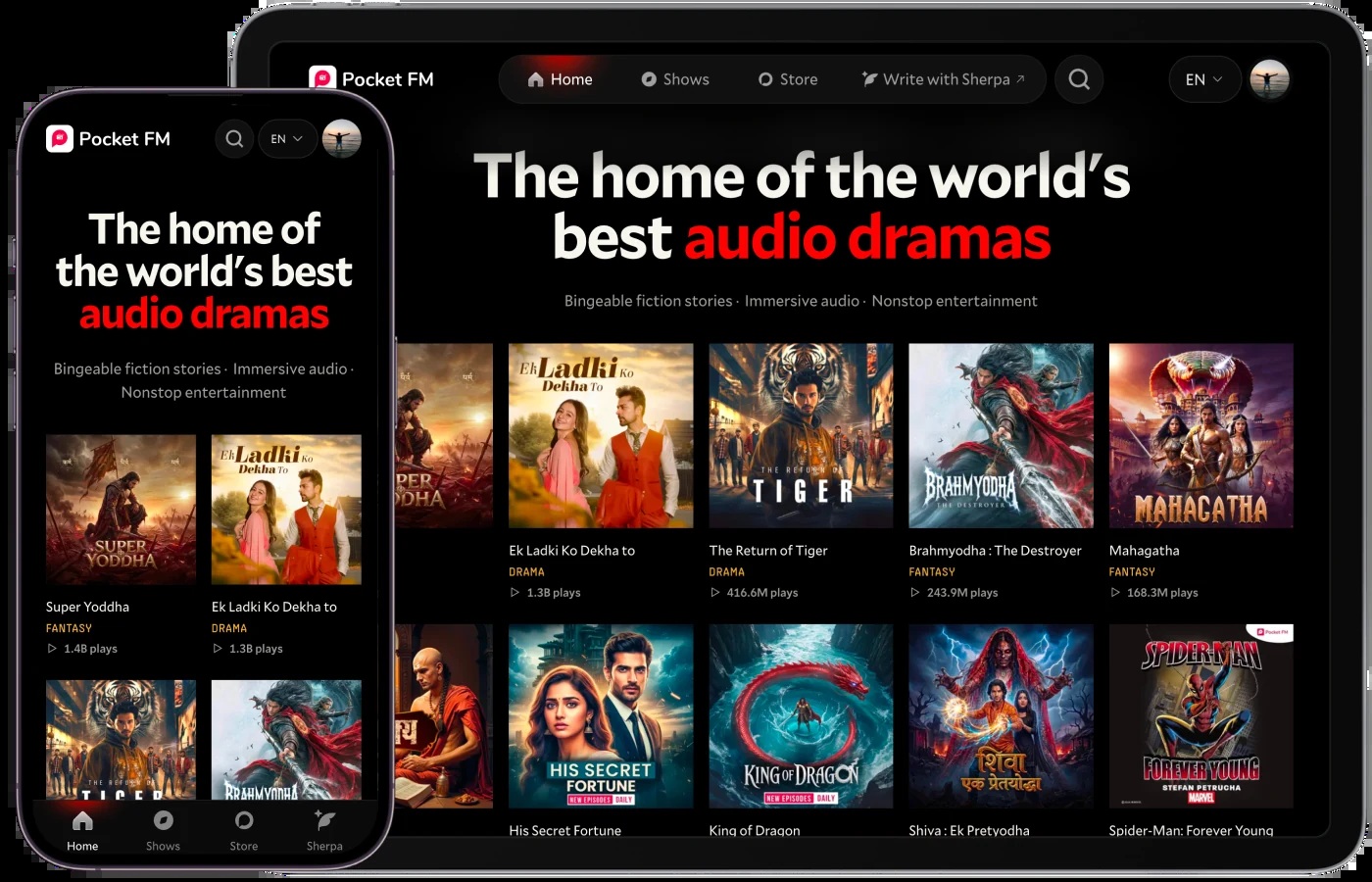
For someone cooking, commuting or doing household chores, audio offers entertainment without demanding continuous visual attention. Writers get a route from a manuscript to listeners, with production and distribution handled through a platform. Neither relationship guarantees a hit. Both make more sense when a story can become a habit.
Kuku FM and Pratilipi FM are nearby alternatives in Indian audio storytelling. Audible and Spotify compete for listening time. Pocket FM’s distinction lies in the combination of continuing fiction, episode-level access and a creator pipeline. Calling all of them “audio apps” obscures what a customer actually buys.
“Monetisation of a platform is a product problem.”
Harsha Kumar, Lightspeed
In conversation with Business Standard, June 2024
The bill behind the binge
Small purchases are still purchases. A coin wallet lowers the size of the first decision, but a long series can produce many decisions. Listeners who want a predictable total should examine the offer before settling in. The convenience of continuing immediately and the discipline of waiting point in different directions.
The business has also required substantial capital. In March 2024, Pocket FM announced a $103 million Series D led by Lightspeed, with StepStone participating. Its announced funding total reached $196.5 million. Those dollars funded a company, including expansion, content and technology; they do not reveal the cost of creating one successful series.
Reported FY24 net loss, alongside approximately ₹1,052 crore in global revenue. Growth and profit are separate measurements.
The production bill explains the interest in AI. In June 2024, ElevenLabs announced its narration partnership with Pocket FM, reporting experimental cost reductions of up to 90% and more than 30,000 hours of AI audio series produced. These were partner-reported results from that phase. They describe cheaper production, not proof that every generated hour earns its keep.
More recently, the financial labels have become especially important. Mint reported parent Pocket Entertainment’s FY25 revenue at ₹1,768 crore. In September 2026, the parent announced a revenue run rate above $500 million. A run rate extrapolates current trading into a year. It is not a completed year’s revenue, and a microtransaction business should not be mistaken for a book of contracted subscriptions.
The creation workflow has changed too. In the 2024 ElevenLabs launch, writers could choose a series in the app’s Write tab, submit enough text, then select a voice and background music to turn it into audio. That gives a writer a way to test work without first organizing a recording production. The useful question becomes whether the time saved brings a good story to listeners sooner.
A process that can travel
The attractive part of Pocket FM’s expansion is the distinction between repeating a process and repeating a story. Testing content, measuring return visits and checking payment behavior can travel. A joke, a family conflict or a character’s ambition needs to belong to the audience hearing it.
By September 2026, the parent company said 96 titles had each generated more than $1 million, including 13 above $10 million. These are reported hit counts, not average creator earnings. They explain the appeal of owning and adapting a successful story: a familiar character can be a reason to return across episodes and markets. They also leave a hard editorial job untouched. Someone still has to decide which stories deserve the next investment.

The company now links to Sherpa, its AI writing partner, and Pocket Saga, a sibling microdrama product. Its stated culture emphasizes candor, ownership, customer focus and AI use. Those are declarations of intent. The practical test is whether the tools and working habits help creators make something listeners choose again.
For another founder, the useful thing to copy is the sequence of questions. Do people stay? Do they return? Will they pay? Can the business recover what it spent finding them? Expansion becomes more defensible after those answers hold together.
The same approach becomes fragile when stories cannot sustain interest, acquisition gets too expensive or localization misses the audience. Cheaper narration helps with one bill. It cannot settle all the others. Pocket FM’s next episode still has to earn the listener’s curiosity.