Hamster King has company. On Cantina’s public character roster, a fortune teller shares space with Diva Shark and a brutally honest friend. These are personalities you can chat with and put to work in a video. The joke is easy to grasp: give an imaginary creature something to say, then send the result to someone who will appreciate it.
Behind that small act of nonsense is Cantina Labs, the social AI company led by Sean Parker and Daniel Klaus. Its flagship app lets people design characters, gather with friends and bots, and make media featuring the resulting cast. The company’s wager is that a character can become something people return to, develop, and recognize outside the app where it began.
That makes Cantina an entertainment business with an unusually technical workshop. Personality, appearance, speech, live conversation, and video all have to cooperate. A funny premise gets someone through the door. The harder part is making that premise useful twice.

The room needed a reason to fill
Cantina grew out of Airtime, Parker’s earlier social-video venture. The financial history stretches back well before the current AI identity: Airtime launched in 2012 with $33.5 million in reported funding. That number belongs to the predecessor’s financing, not a bill for Cantina’s reinvention.
The most revealing explanation of the pivot comes from former design leader Matt Regan. His public case study says Airtime’s engagement had plateaued. Research identified problems around onboarding and engagement; the response was a redesign across mobile and web, with user-created AI characters at the center. The aim was to let several people participate with AI, both live and at different times.
Designer Jenni Hoang describes the next bottleneck: once bots became the main attraction, the character builder needed to be simpler and more people needed to finish it. Her work covered personality building, avatar creation, and bot discovery. A company could have sophisticated AI and still lose a prospective creator somewhere between an idea and a completed character.
Read together, the accounts suggest a useful product lesson. Give people an activity they can begin before everyone else arrives. Then make the first finished thing easy to reach. An imaginary cast supplies conversational material; an unfinished setup form supplies very little.
A personality with production controls
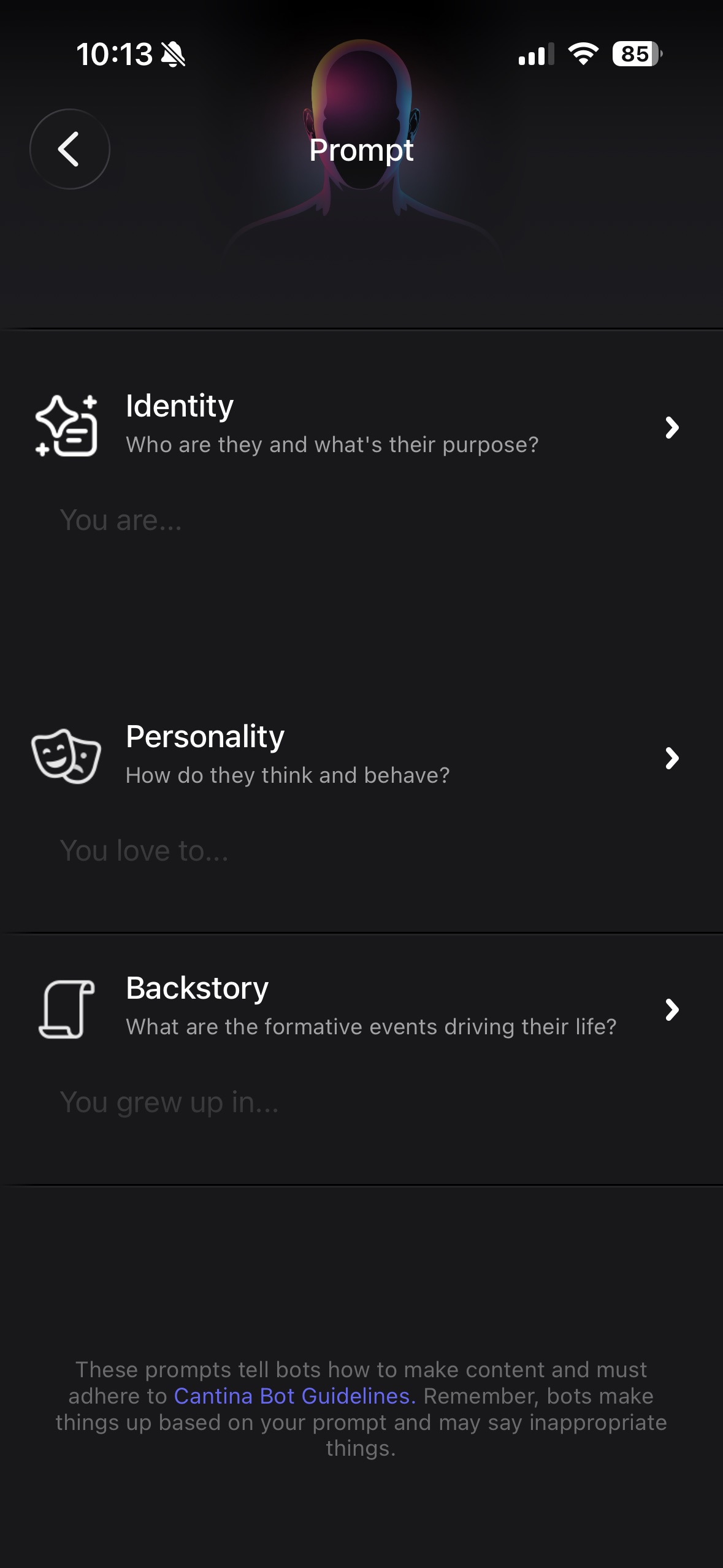
The current product makes the character an object you can keep working on. Cantina separates appearance, identity, and voice. Its character interface asks about personality and backstory: the ingredients that distinguish a recurring performer from an attractive image with a name underneath.
The company’s August 2026 help guide explains continuity through three connected references: who the bot is, what it looks like, and the base videos on its profile. Those references give subsequent videos a starting point. Storylines, meanwhile, collect videos on a profile, providing a home for an ongoing series.
Imagine adds a production layer. The March 2026 guide documents scenes with up to six characters. Creators choose a topic or supply their own, then adjust dialogue, action prompts, and clips. A reusable Topic/Plot setting lets them change the cast while preserving the premise and request a rewritten script.
The editor offers further control over backgrounds, scripts, and captions. It can also turn selected bot messages from a room into a video. That creates a route from a social exchange to a finished clip: something amusing happens in conversation, and the creator gives it a second life on screen.
Voice is another editable ingredient. Cantina documents both voices generated from text descriptions and cloning of voices the user has permission to use. Its June guide asks for clear audio, including at least eight seconds when recording. Creators can preview the result and store generated voices in a library. Delivery becomes part of the character’s design.
The group chat has a writers’ room
Rooms preserve the social roots of the product. People can share a space with bots, while Room Lore gives the cast a common setting, roles, or background. The published examples include a murder mystery and a reality show. It is a pleasingly literal version of getting everyone on the same page.
A group could, for example, establish a detective agency, assign characters conflicting motives, and use the conversation to develop a scene. That is an illustrative use of the documented tools, rather than a claim about a particular customer. The benefit is shared creative context: participants have something to react to besides an empty message box.
Room Lore also has permissions and privacy controls. The guide specifies iOS for setting it, a reminder that access to the app does not automatically mean identical controls on every device. For someone organizing a group project, checking the actual workflow matters more than admiring the demo.
Make it here. Let it travel.
Cantina’s homepage compresses its pitch into eight words: “Create characters. Make videos. Go viral.” The first two are product functions. The third is an ambition, and the company has built creator programs around pursuing it.
“Create characters. Make videos. Go viral.”
Cantina’s homepage pitch
The campus program targets full-time U.S. students and asks for short videos built around recognizable campus situations. Its suggested formats include rivalries, confessionals, and inside jokes. The creative advice is deliberately local: make something that people at a particular school will understand. Participants are encouraged to publish to Instagram, TikTok, and YouTube Shorts.
The commercial logic is straightforward. A clip can introduce a character, demonstrate the software, and reach people who have never opened Cantina. A creator can test a premise where an audience already exists. For the company, each exported performance is a possible invitation back to the workshop.
That approach has drawn scrutiny. In August 2025, Gazetteer SF reported on Cantina-made videos circulating on TikTok and questioned the visibility of paid-promotion disclosures. The report also described an ambassador listing advertising compensation of up to $5,000 a month. Those were reported recruitment terms, not evidence of what every participant earned.
The later creator brief is especially concrete. For an August 2026 event in Los Angeles, Cantina asked participants to develop an original character and a 30-second pilot in four hours, with $2,500 and consideration for its paid creator residency at stake. It sounds like a miniature television-development exercise because, in practical terms, it is.
One original character, a short performance, and a chance to enter the creator residency.
Free admission, crowded competition
The consumer entry price is simple: Cantina’s U.S. iPhone listing is free, and its campus site describes the app as free. The visible business is organized around attracting creators and audiences. Free entry lowers the cost of trying an unfamiliar format; making something worth sharing still takes judgment and revision.
The continuing Android listing displays more than a million downloads. It also contains reviews from the Airtime years. Treat that as a cumulative distribution marker for the listing, not a count of newly acquired AI users. Downloads, regular audiences, and paying customers answer different business questions.
Cantina sits between AI companionship, social networking, and video creation. Replika emphasizes a personal AI companion. Character.AI is a closer competitor for character-driven entertainment, and its move into Stories and studio-made microdramas shows how quickly the categories overlap. Video alone cannot serve as Cantina’s distinction.
Its pitch rests on the combination: build a character, interact with it socially, direct it, and carry its performances into other feeds. Whether that combination becomes a habit depends on how well the pieces work together. A creator who mostly wants private companionship has different priorities from one trying to publish a weekly comedy series.
The humans still have jobs

Cantina’s work extends beyond generation. The company’s public culture page describes collaboration across AI modalities and across training, inference, and evaluation. It also records staff volunteering with the SF-Marin Food Bank. These are glimpses of a workplace whose output may be imaginary, but whose research and community work are performed by people.
Human oversight matters inside the product too. Cantina describes automated harm detection alongside human moderators, reporting tools, and content-provenance efforts. Its May 2026 age-verification guide states that the service is 18+, with Cinder powering an age-assurance workflow using FaceTec technology. A cute character does not make the platform a children’s product.
The boundaries also affect creative control. Cantina’s terms warn that “bots can act unpredictably.” Its voice instructions require permission for cloning. A person expecting perfectly obedient performances, or planning to use someone else’s identity without consent, is bringing the wrong assumptions to the set.
Give the character one good scene
There is a practical way to borrow the useful part of Cantina’s approach. Start with a character who wants something specific. Give it a recognizable voice and one setting. Write a short scene that exposes its personality, then decide whether the result deserves another episode.
Cantina’s prompting guide supports that discipline: specify the subject, action, setting, and visual treatment; keep an Imagine prompt focused on one continuous action; revise the missing detail when the output goes astray. That is closer to directing than wishing. An overstuffed prompt asks the system to solve too many creative decisions at once.
The most interesting test comes after the first laugh. Do people recognize the character? Do they want it back? Cantina has assembled tools for answering those questions in public. The imaginary star still needs a human with a reason to cast it.