Nearly half a billion dollars can disappear without a single transistor failing. Ramin Farjadrad learned that at Velio Communications, the startup he co-founded in 1999. Years later, he recalled a combination of purchase orders and letters of intent approaching $500 million from customers including Nortel and Lucent. Then the optical market collapsed. The customers pulled back. The switches still existed. The future attached to them had gone missing.
It is a useful place to begin the story of an engineer now running a company valued at $1 billion. Farjadrad, co-founder and CEO of Santa Clara-based Eliyan, has seen how little a promising technical position can guarantee. He has also kept returning to a related engineering question: how do you get information from one piece of silicon to another, quickly enough and cheaply enough that someone can build a business around it?
Today that question sits inside the discussion about AI infrastructure. A processor needs data from memory and cooperation from other processors. Getting those bits across a package, a board, or a rack takes time, power, and physical space. Farjadrad’s career has followed those journeys through several generations of hardware. Along the way, he has acquired a rather practical education in the distance between a working circuit and a working company.
Before the boom, a bronze medal
Long before the financing rounds, there was Warsaw. In 1989, Farjadrad represented Iran at the International Physics Olympiad and won a bronze medal. He had been born in Tehran and went on to earn his electrical engineering bachelor’s degree at Sharif University of Technology in 1993. Stanford followed, with master’s and doctoral work in electrical engineering.
His early professional work already concerned the movement of signals. During a summer at Sun Microsystems Laboratories, he worked on a serial transceiver. At LSI Logic, another summer brought multigigabit transceiver architectures. These were the circuits responsible for turning data into signals that could survive a journey and arrive intelligibly at the other end. Computing’s couriers have always needed a decent sense of timing.
At Stanford, Farjadrad explored high-speed communication in CMOS, the semiconductor technology also used for large digital circuits. His co-authors included Chih-Kong Ken Yang, Mark Horowitz, and Thomas Lee. A 1999 journal paper described a 10-gigabit-per-second, four-level transmitter; a 2000 paper described an eight-gigabit-per-second transceiver. The distinction matters: a transmitter sends; a transceiver also receives. The numbers describe different designs.
The attraction extended beyond speed. Bringing high-speed communication into CMOS opened possibilities for integrating links with larger logic circuits. Fewer awkward boundaries between technologies could mean more useful systems. This habit of thinking about the surrounding system, alongside the circuit itself, would reappear in his companies.
Getting more from the cable
Velio tried to turn high-speed communications expertise into switches for the optical market. Its subsequent sale brought Farjadrad to Rambus, where he served as a senior principal architect. Aquantia came next. Co-founded in 2005, it gave him another setting in which bandwidth, cost, and customers’ existing equipment had to agree with one another.
Ethernet has an unglamorous advantage: people have already installed a great deal of it. A better networking chip becomes more useful when customers can fit it into the infrastructure around them. Aquantia worked on physical-layer technology, the circuitry that makes communication over a real connection possible. Its territory included multigigabit enterprise links and automotive Ethernet. The packet eventually has to meet the cable.
For a founder, that is a different kind of opportunity from selling speed in isolation. An enterprise network has wiring, connectors, equipment cycles, and people who would prefer to avoid replacing the ceiling. Improvements that respect those arrangements can travel further commercially. Farjadrad’s work helped develop connectivity technologies adopted in industry standards, where an individual company’s engineering must become something other companies can build around.
Aquantia went public in 2017. Marvell completed its acquisition in September 2019, adding the company’s multigigabit technology to a broader networking portfolio. Farjadrad took a technology leadership role at Marvell covering networking and automotive physical-layer products. By then, he had experienced a startup market collapse, an acquisition, an IPO, and the work of selling into established networking markets. The career had accumulated more than circuit diagrams.
A smaller distance, a familiar problem
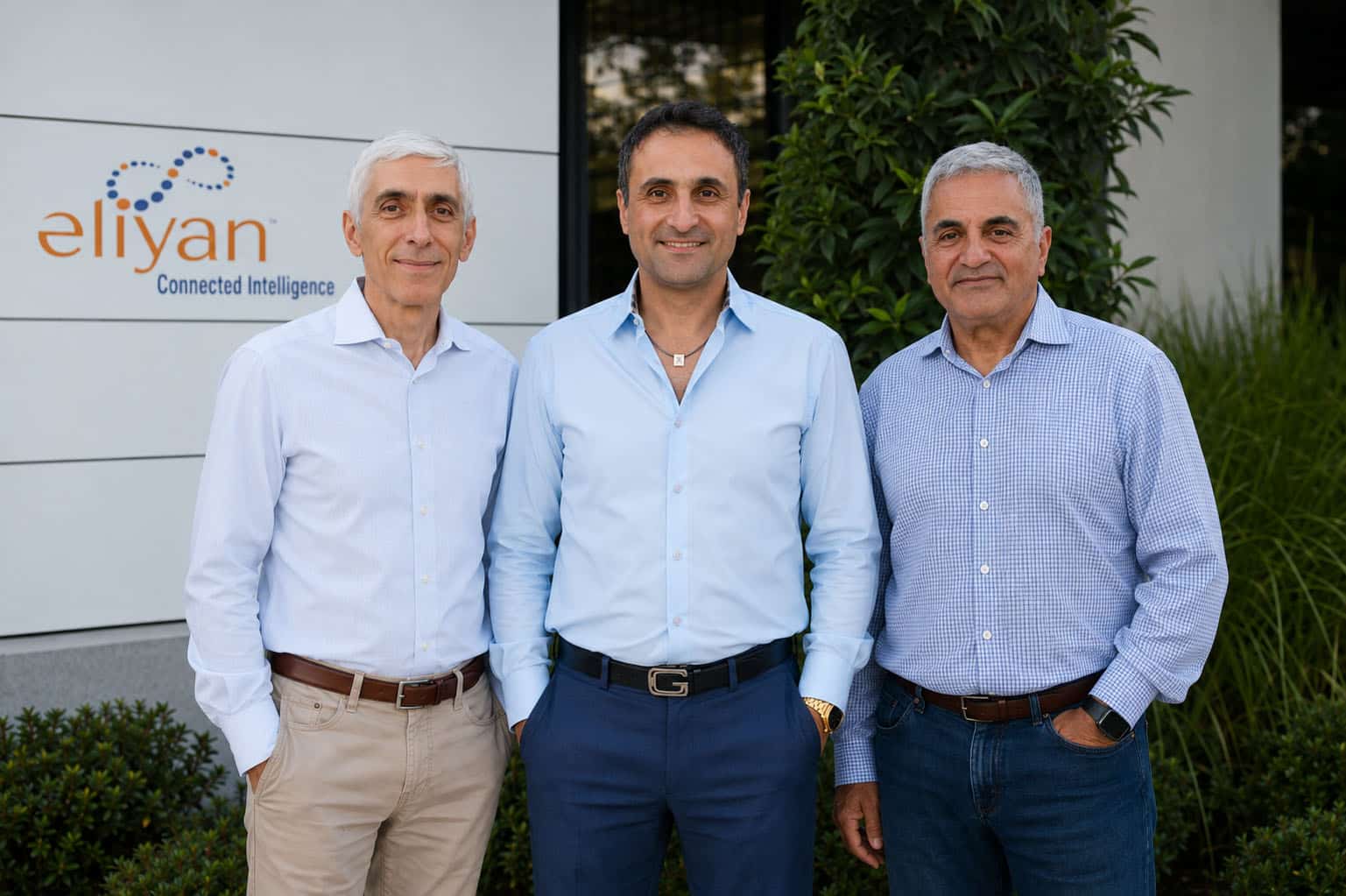
In 2021, he co-founded Eliyan with Patrick Soheili and Syrus Ziai. Their subject was the communication between chiplets: separate pieces of silicon assembled into a larger system. Each piece can perform a particular job. Making the collection behave like a useful whole requires connections with enough bandwidth and sufficiently low power consumption.
The distance can be millimeters, yet the constraints are substantial. A die has a finite edge. Connections occupy room. Package materials affect how signals travel. Memory must supply data fast enough for the compute beside it. A designer who adds more arithmetic capacity can still end up waiting for information. A very fast kitchen remains dependent on the doorway.
Eliyan’s NuLink technology addresses these links in both advanced packaging and standard organic substrates. That latter option brings a familiar concern back into view: how much performance can be achieved using a manufacturing approach customers can obtain and afford? Packaging is part of the architecture, with consequences for cost, available space, and how many components can be brought together.
One technique Farjadrad has explained in his technical writing is simultaneous bidirectional signaling. Data travels in both directions over the same connection at the same time. In suitable designs, this can increase aggregate bandwidth for a given number of connections, or reduce the connections required for a given bandwidth. The receiver has to cancel the nearby transmitter’s signal and deal with reflections. The extra circuitry earns its place by making scarce routing resources do more work.
The colleague behind the circuitry
The public descriptions of Farjadrad include a detail more revealing than another title. Max Soriano, who worked with him from Aquantia’s early days, recalled learning from Farjadrad’s suggestions about Ethernet magnetics. He also remembered him as approachable despite the demands of his position. Expertise can make a person busy; it need not make them inaccessible.
“Always available in spite of his busy schedule”
Max Soriano, former Aquantia colleague
His professional connections also operate through standards work. Farhad Tabrizi has described being drawn back from retirement after Farjadrad, a longtime friend, asked him to help lead an industry effort. Tabrizi went on to chair the JEDEC SPHBM working group. Farjadrad publicly thanked him for helping bring Eliyan’s memory-interconnect approach into that standards conversation. A technical idea needs allies who can carry it through committees as well as laboratories.
Standards introduce a different rhythm to invention. A connection has to make sense beyond the team that designed it. Other companies need an agreed interface before they commit their own products to it. For an engineer working between compute and memory, that shared agreement becomes another part of the system: a way for separate businesses to build compatible pieces.
Farjadrad’s own advice to founders contains a similar check on solitary conviction. He argues for belief in a vision while repeatedly testing it against customers’ actual needs. His history gives that advice some weight. A purchase intention can vanish. A strong architecture can arrive before a buyer is ready. Persistence still needs information from the other end of the line.
The next connection travels by light
Eliyan’s 2026 announcements widened the setting. In January, it disclosed $50 million in strategic investment, including participation from AMD, Arm, Coherent, and Meta. In July came a $145 million Series C led by Seligman Ventures, valuing the company at $1 billion. Cisco Investments and Lumentum joined as new strategic investors. That roster spans several of the businesses whose products need to communicate inside AI infrastructure.
Then, on October 14, Eliyan introduced Nexus and Oscar, the first chiplets in its NuLight platform. Farjadrad unveiled the technology at the OCP Summit. The approach uses arrays of tiny vertical-cavity surface-emitting lasers, or microVCSELs, to carry data optically. The company said both chiplets were sampling. Its initial optical-reach target is approximately 50 meters, a design objective for connecting resources beyond a single rack.
The architecture spreads bandwidth across more optical lanes running at lower rates. Nexus bridges high-speed electrical interfaces to that wider set of lanes; Oscar provides the electrical interface to the optical arrays. Spare lanes are intended to let traffic move around a failing lane without interrupting the link. Reliability joins bandwidth and power in the list of things a customer has to consider.
NuLight’s initial optical-reach target, announced October 2026. A design target, rather than a measured result presented here.
The ambition behind these products extends beyond a single interface. Farjadrad has pointed to Broadcom’s history of building a wider business on differentiated connectivity. In a 2024 interview, he described a similar direction for Eliyan: establish the interconnect foundation, then expand the product portfolio that can benefit from it.
“We plan to be the Broadcom of tomorrow.”
Ramin Farjadrad, February 2024
That is a large commercial ambition from someone whose engineering has often concerned very small distances. It also puts the company’s valuation in perspective. The money finances a next stage; adoption will require products, manufacturing, partners, and customers who keep buying. Farjadrad has already lived through the difference between anticipated demand and orders that endure.
His subject keeps changing scale: optical networks, enterprise cables, the edge of a die, the span between racks. The recurring work is patient and physical. Signals must arrive. Receivers must distinguish them. Power must stay within a budget. For an industry preoccupied with what a processor can do, Farjadrad keeps attending to the arrangements that let it get on with the job.