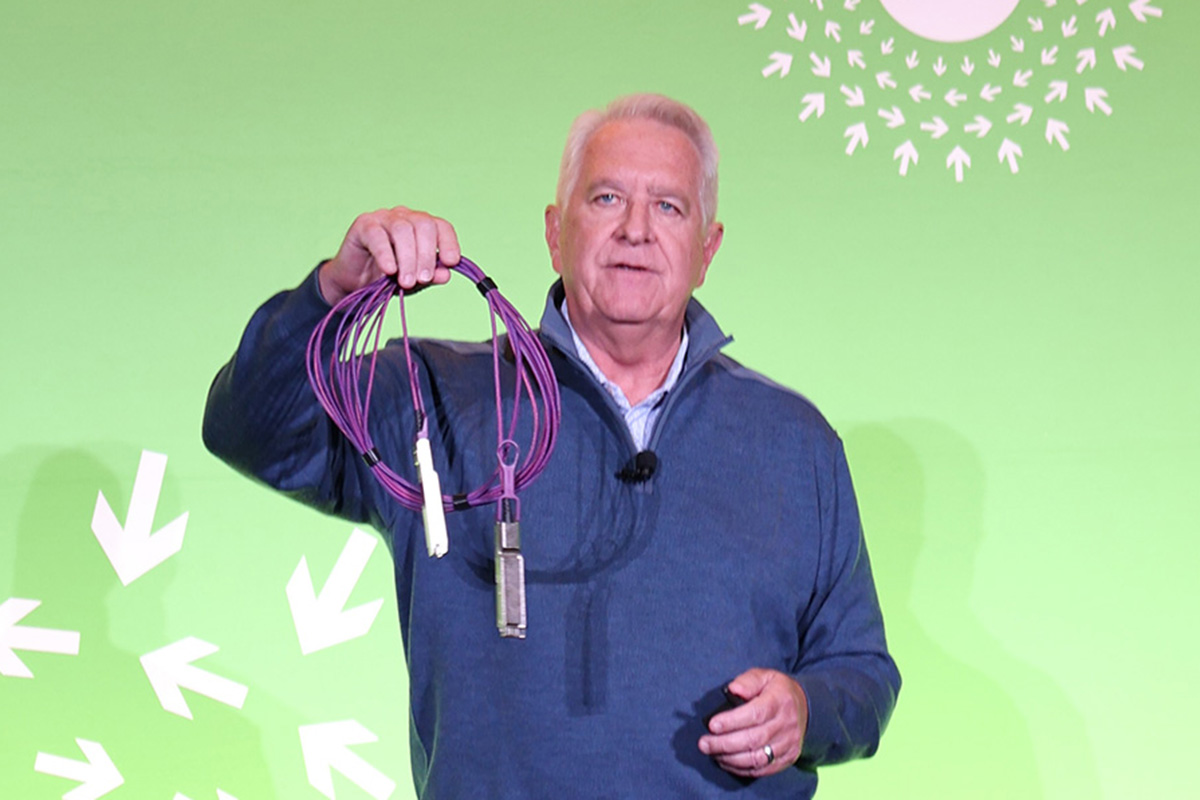
Bill Brennan holds up a coil of purple cable. It is October 2026, he is speaking at the Open Compute Project Global Summit in San Jose, and his proposed route to faster AI infrastructure includes a curious instruction: slow down. Spread the traffic across more optical channels. Give each channel a less punishing job. Leave room for something to go wrong without bringing the connection down with it.
His talk is called “Wider. Slower. Better: Optics That Can Beat Copper.” For a semiconductor executive, it is an agreeably awkward title. An industry accustomed to selling speed has to make room for the virtues of restraint. Brennan has brought a physical exhibit. You can spend a great deal of money explaining the future of computing; sometimes it helps to hold the thing up.
The cable is the latest chapter in a career that began at Texas Instruments in 1986 and brought Brennan to Credo in December 2013. He joined a business with 15 employees. By 2024, it had more than 400. Along the way, the work of getting information from one chip to another became a much more conspicuous part of the computing business.
The long apprenticeship before the purple cable
Brennan’s education was in electrical engineering at the University of Colorado. His early professional education also happened on the customer side of the table. He worked as an account manager at Texas Instruments from June 1986 until January 1993, then spent more than seven years as a vice president at Exis, an NEC Electronics partner.
In May 2000, he joined Marvell, where he became a vice president in the storage business. He stayed until August 2011. These were substantial stretches of time, long enough to see several generations of products, customers and expectations come and go. His résumé has the rhythm of an industry apprenticeship rather than a collection of brief executive visits.
The connection to Marvell matters to Credo’s story. Lawrence Cheng and Job Lam, Credo’s technology and operations leaders, also worked there before co-founding Credo in 2008. They had started the company five years before Brennan arrived. His place in the story is the executive brought in to help turn an existing technical enterprise into a larger business.
Account manager
Storage business
Chief executive
CRDO begins trading
A business hiding between the chips
Credo’s technical foundation is SerDes, short for serializer/deserializer. The name sounds like a filing system designed to discourage visitors. Its job is more useful: prepare data for high-speed transmission and reconstruct it at the receiving end. The practical questions are how much information can travel, how far it can go, and how much power the journey requires.
That foundation can be sold in several forms. Another chipmaker can license the intellectual property. A customer can buy a component. Or it can buy a complete connection, including the electronics needed to keep a signal usable. Brennan’s Credo has pursued all three, with products spanning electrical cables, optical processing and other interconnect components.
An active electrical cable, or AEC, puts electronics to work on the connection itself. Copper remains the medium, while the electronics help the signal survive a demanding trip. For the customer, the relevant unit is the working link. A semiconductor company that supplies that link takes on questions extending beyond the silicon, into cable design, firmware, testing and deployment.
This is where Brennan’s commercial background becomes useful context. The customer needs the parts to function together. In a 2022 discussion of Credo’s AEC business, he described an internal organization responsible for designing, developing and delivering the system. The ambition was to carry the responsibility far enough that a customer could actually use the result.
The market catches up
On January 27, 2022, Credo began trading on Nasdaq under CRDO. Its offering had been priced at $10 a share. Brennan had been at the company for eight years by then. Going public gave a visible date to a process that had mostly taken place away from public attention: building products, hiring people and persuading customers to adopt a different connection.
Later that year, he appeared with Jill Malandrino on Nasdaq TradeTalks to discuss Credo’s role in data centers. He also spoke about the continued expansion of data creation and consumption amid a weakening economy. The broad proposition was already in place. More computing activity would require more data to move, and moving it efficiently would become a business in its own right.
AI sharpened that proposition. A cluster of accelerators needs to exchange information as it works. Buying more processors brings additional demand for connections between them. The processor receives the attention, but the network helps determine how productively the collection can operate. Imagine assembling an orchestra and economizing on the musicians’ ability to hear one another.
By the quarter ending August 1, 2026, Credo reported revenue of $479 million, up 114.7% from a year earlier. GAAP net income was $129.4 million. These are company results, produced by a growing organization, and they give a sense of the scale Brennan now manages. The executive who joined a 15-person team was running a business with nearly half a billion dollars in quarterly sales.
“Our portfolio now spans connectivity from millimeters to kilometers”
Bill Brennan, September 2026
When a small interruption becomes a large problem
Brennan’s public argument increasingly turns on reliability. A link flap is a connection that drops and returns. It sounds almost cheerful, like a bird briefly adjusting its wings. In a computing cluster, it can interrupt useful work and send operators looking for the cause. The larger the collection of links, the more consequential that troubleshooting becomes.
In a presentation titled The Interconnect Wall, Brennan illustrated how component reliability changes character at scale. A failure rate that seems comfortable for one device can produce frequent interruptions across a very large installation. His slides made the argument through hypothetical cluster sizes and explicit assumptions. The lesson is arithmetic: multiply a small problem by enough equipment and it deserves its own budget.
Credo’s ZeroFlap optical products address that operational problem with link monitoring, diagnostics and mechanisms to manage instability. Their name is a commercial promise with an unusually easy test to understand. The engineering underneath is less tidy: operators need to locate faults, distinguish the cable from the module or host, and decide what to fix.
That emphasis makes Brennan’s account of AI infrastructure fairly earthbound. The subject keeps returning to power, interruptions, distance and maintenance. There is little room for a grand theory when a customer needs to know why a particular connection keeps disappearing. A reliable link is valuable partly because it lets people stop having conversations about the link.
Slower channels, a wider ambition
The October 2026 cable announcement extends this thinking into optics. Credo’s proposed 1.6-terabit-per-second active light cable uses arrays of micro-emitters and photodetectors. Rather than force a small number of optical channels to work at extreme rates, the design divides the load among many lower-rate channels. Redundant channels provide a way to keep traffic moving if one falters.
The announced targets are specific: reach of up to 50 meters and power of 12 watts per cable end. Credo says the cable is intended to ship in 2027. Those are design targets and a delivery plan, with the work of production and deployment still ahead. Brennan’s presentation places a concrete product on the table while asking customers to consider a broader architecture.
More speed per channel
Less speed per channel
He is also asking other companies to help define how that architecture fits together. Credo announced a Short-Reach Micro-Emitter Optics workstream within the Open Compute Project, joined by companies including AFL, ams OSRAM, BizLink, Foxlink, Heraeus Covantics, SENKO and YOFC. The proposed specification covers matters such as signaling, power and physical form factors, with OCP approval targeted for 2027.
That is the less photogenic half of the demonstration. A cable can be held up in one hand. A compatible ecosystem requires agreement among suppliers whose products must meet at the same physical and electrical interfaces. Brennan’s latest pitch therefore has two audiences: customers deciding what to deploy, and partners deciding what to build together.
The person in the room
Brennan’s professional circle now extends beyond Credo. He joined the Global Semiconductor Alliance board in July 2025 and Axiado’s board that November. The first appointment places him among people concerned with the semiconductor industry as a whole. The second connects his data-center experience to a company working on hardware-based security and system management.
There are glimpses of a less formal Brennan, too. In a Credo discussion with Amber Huffman and Sylvia Acevedo ahead of International Women’s Day in 2025, the conversation included parenting daughters and encouraging leadership. Acevedo recalled Brennan sharing lessons from experiences with his daughter. The executive discussing networks was also participating as a father, with something to learn and something personal to contribute.
His public enthusiasm for his team can be distinctly unbuttoned. After OFC 2026, he praised a company banner and described the culture as “being bold and pioneering new connectivity categories.” The trade-show joke was built around ZeroFlap. Engineers may be responsible for civilization’s communications systems, but they remain susceptible to a decent pun on a booth wall.
Back on the OCP stage, the purple coil gives Brennan’s work a useful scale. The argument reaches across AI infrastructure, industry standards and years of development; the object fits in his hand. His next task is familiar from a career spent moving between technology and customers: explain the engineering, get the pieces working together, and make the connection dependable enough for someone else to build on it.
Follow the connections
Talks, profiles and further reading.