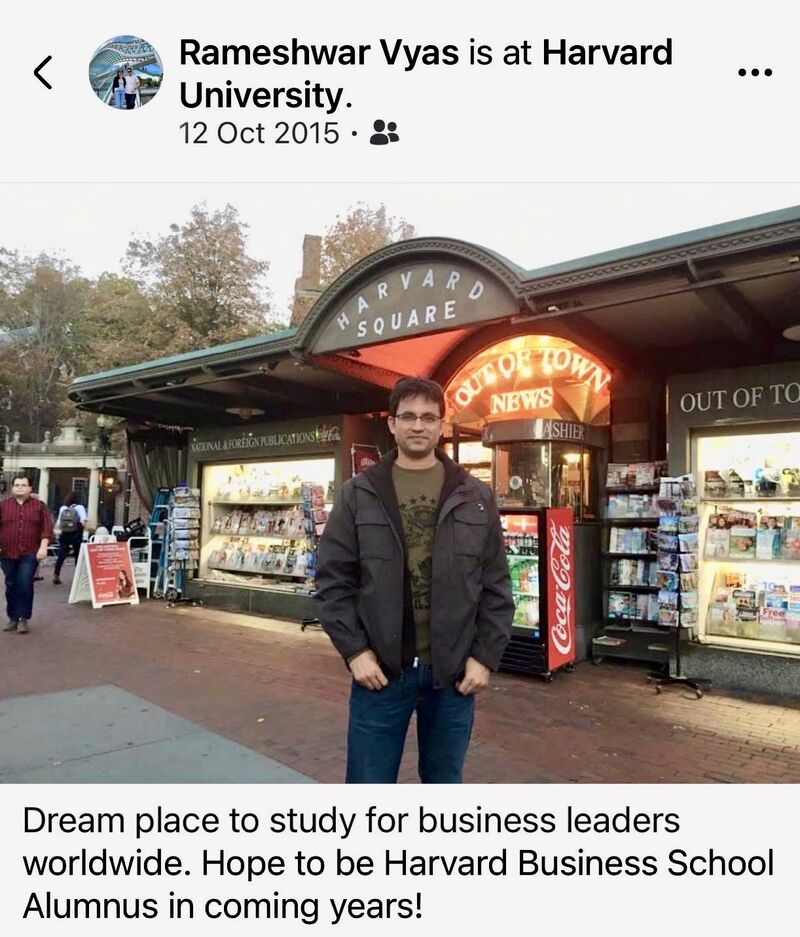
At Harvard Square in October 2015, Rameshwar Vyas posed for a photograph outside a newsstand. Behind him were newspapers, drinks and the familiar business of a place where people come and go. His accompanying message looked further ahead: he hoped to become a Harvard Business School alumnus. A photograph usually records where somebody has been. This one also recorded where he intended to go.
On 11 April 2026, Vyas announced that he had completed Harvard Business School’s Owner/President Management program, or OPM. The wish had survived eleven years of other appointments. For the founder and chief executive of Ranosys, it was a return to a promise made while his technology business was already under way. Running a company had apparently failed to cure him of wanting homework.
The photograph makes a useful entrance to his story because it catches ambition before the congratulatory comments arrive. Elsewhere in that story are a software engineering classroom in Singapore, a coach in Atlanta, a college reunion in Jodhpur and a high tea in Bikaner where 42 people received job offers. Education keeps appearing, sometimes as something he seeks, sometimes as something his business helps others obtain.
A company begins; the studying continues
Ranosys began in September 2008. In an anniversary reflection, Vyas described a modest, bootstrapped start during the global financial crisis, accompanied by large ambitions. The timing supplied enough uncertainty without any help from the founders. By September 2020, he was reporting a team of more than 350 across eight offices in five countries. Those are figures from that anniversary, a marker of the distance covered by then.
His earlier career included work as a principal engineer at GlobalFoundries. Engineering gives his professional history a starting point in technical work, before the broader duties of leading a consulting business. Ranosys would develop around digital commerce, digital transformation and product engineering, working with platforms including Adobe, Salesforce, OutSystems and Shopify Plus. The founder’s job grew to include the relationships and organisational decisions around the software.
Vyas also pursued a Master of Technology in Software Engineering at the National University of Singapore after starting his IT business. That sequence matters. The business did not wait politely for education to finish; education had to find a place beside it. His later Harvard studies continued that habit, with the demands of leadership and the demands of learning sharing the same calendar.
There is a pleasing inconvenience in this arrangement. A founder can become accustomed to being the person expected to know. A classroom restores the possibility of being wrong in front of other people. For somebody making decisions about technology and clients, that possibility has practical value. It leaves room for an old answer to be improved before it hardens into company policy.
Forty-two reasons to hold a high tea
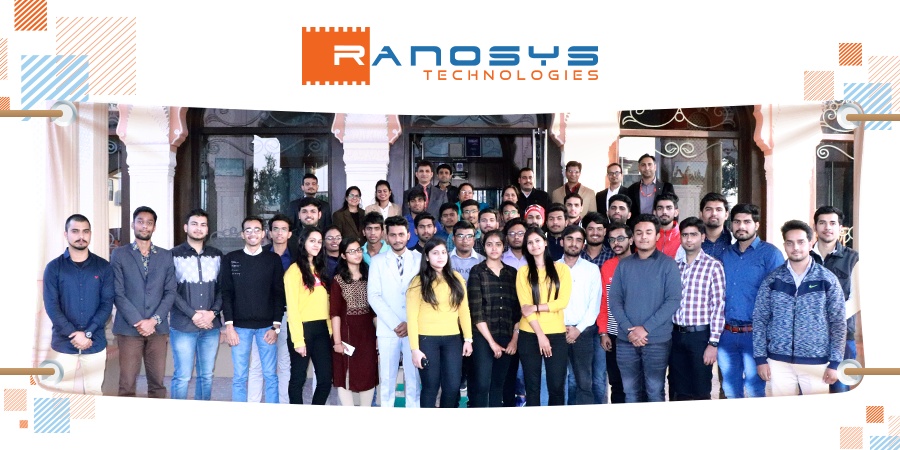
On 5 February 2019, Ranosys gathered new recruits at Hotel Basant Vihar Palace in Bikaner. Vyas met the candidates and handed over 42 offer letters for the Bikaner development centre. It was a hiring ceremony with the social grace of a high tea: a formal beginning made a little more welcoming by the occasion.
“Knowledge and skills are the driving forces of social development and economic growth of any country,” he said. He linked the company’s recruitment to training infrastructure and quality employment for young people. An offer letter is an unusually legible expression of business growth. Somebody can take it home, read it again and begin planning around it.
The following year, Ranosys signed an OutSystems education protocol with Bikaner Technical University. The partnership was intended to train students in the low-code development platform and offer mentorship for professional opportunities. Vyas’s argument was that access to suitable knowledge, materials and guidance could open careers. Here, his company’s interest in a software platform met the university’s responsibility to prepare graduates for work.
The connection to Bikaner is personal. In August 2022, announcing that he had received the Bikaner Gaurav Award, Vyas called it his hometown and expressed gratitude for what it had given him. He hoped to continue creating quality jobs there. That gives the recruitment ceremony a wider setting: a founder’s attachment to a city expressed through employment as well as affectionate words.
Ranosys had also taken basic computer education into a government school in Chokhunti, Bikaner. Its Digital India Corporate Pledge initiative began with pupils in grades nine and ten. The declared aim was greater digital awareness and independence. The school workshop and the university partnership sat at different points along a learning journey, from initial familiarity with computers to skills intended for professional use.
It would be easy to let the international itinerary dominate a technology founder’s biography. Bikaner gives this one a place to pause. Recruitment, school instruction and university training are specific activities, each with a different audience. Together they make his hometown commitment something a reader can examine in the details.
The adviser he hired for the questions he missed
In 2019, Vyas hired a coach in Atlanta. He later described the experience as a turning point: the coach helped identify blind spots and gave him courage to act on necessary changes. In his February 2025 essay on leadership, he connected that experience with a lesson from Harvard professor Deepak Malhotra about learning beyond the needs a person already recognises.
“The greatest lessons are often the ones we don’t realize we need.”
Rameshwar Vyas, writing on coaching, 2025
There is some wit in paying somebody to point out what you have overlooked. Most of us prefer the service when it comes with compliments. Vyas’s account instead puts value on an outside view that can challenge a leader’s assumptions. His description is personal enough to be useful: a decision to seek help, followed by changes in how he approached leadership.
A month earlier, he had written about another lesson from OPM: the relationship between insight and influence. In his telling, understanding a problem and earning enough trust to move people towards a solution belong together. For an IT services company, technical skill has to reach across the table. A client needs to understand the recommendation; a team needs to be able to carry it out.
Understanding the problem. Earning trust to act.
A demonstration with the company’s own working day inside
At Ranosys, one expression of that argument was its internal adoption of Salesforce. Vyas wanted the business to use a platform it was also helping customers implement. The team built recruitment, workforce and payroll applications, with information brought together through Ranosys Pulse. A prospective customer could see an example drawn from the consultant’s own operations.
The appeal of this approach is easy to understand. Software advice becomes more concrete when the people giving it can discuss their own working experience. A demonstration invites questions about how the system behaves and what it asks of employees. The founder has something more useful than a collection of possibilities to bring into the conversation.
That willingness to use its own proposed tools appeared again in December 2021, when Ranosys announced plans to move its corporate website to Adobe Experience Manager. Vyas linked the decision to the company’s existing Adobe work and its growing practice. The website itself would become another place to apply the technology around which the business was advising clients.
External recognition followed in 2023, when Ranosys announced two Salesforce Partner of the Year awards: Innovation & Impact and Growth. Vyas connected the former with its work for Rituals Cosmetics, a Valiram Group franchisee. These were company awards, and the distinction matters in a founder’s profile. Delivery requires colleagues whose names rarely fit into a headline.
Old classmates, new classrooms
In December 2022, Vyas posted about his batch’s silver jubilee reunion at MBM Engineering College in Jodhpur. Meeting friends after 25 years in the same surroundings had been recharging, he wrote. It is a quieter scene than an international conference, and an appealing one: a chief executive returning to a place where people knew him before the title.
When he announced his OPM completion in April 2026, he again emphasised relationships. The three-year experience had included business cases, discipline and sacrifice; the connections, he said, would remain with him. He thanked his professors, his wife Sushma Vyas and his family. Sushma also appears alongside him in Ranosys’s leadership, bringing the personal and professional parts of the story into the same frame.
The business continues to supply new assignments. In March 2026, Ranosys announced a ServiceNow partnership, with Vyas discussing more connected and efficient operations. In August, he highlighted its work for Ben Bridge Jeweler using Salesforce Marketing Cloud Next and Data Cloud. His comments focused on helping retail associates make better use of customer relationships. The platforms change; the need to connect technical work with people remains familiar.
Back at Harvard Square, the younger Vyas had allowed himself a public wish. It was specific enough to be remembered and distant enough to require patience. By 2026, he could put a completion date beside it. Bikaner’s recruits, the engineering classmates and the people met in later classrooms give the journey its company. The old photograph has earned its place in the album. One hopes he left room on the next page.