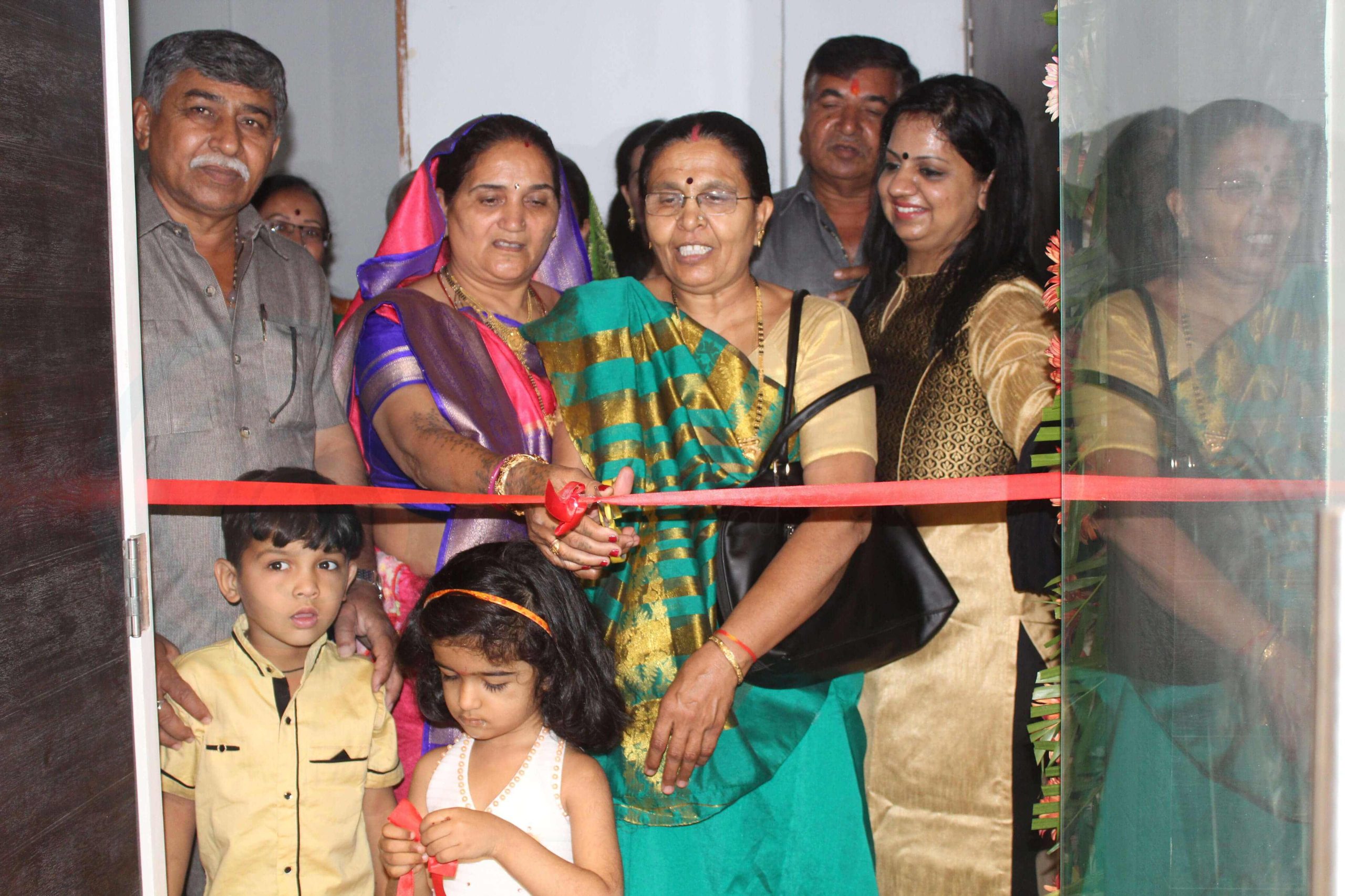
The ribbon was red. The occasion was a new office in Ahmedabad. The people given the honour of opening it were the directors’ mothers. On 1 April 2018, Rajnikant Joshi and his fellow directors at 9series chose a family inauguration for a business milestone. A company can hire almost anything for an opening ceremony. The people who remember you before your first job are rather harder to procure.
Joshi is the co-founder and CEO of 9series, working from Ahmedabad with a business that serves clients internationally. His career runs through programming, engineering management, mobile software and enterprise AI. The opening ceremony supplies a more intimate entrance to that story. It shows who was invited to share a moment of progress, before the conversation moves on to the technology that helped make it possible.
A ribbon with a family history
The three directors involved were Joshi, Dharmesh Rupadiya and Ashwin Vairu. Their mothers inaugurated the premises; employees’ families were invited too. The team had helped decorate the new workplace. Guests arrived through the morning, and clients sent congratulations from elsewhere in the world. Some attended in person.
There is something pleasingly concrete about this celebration. An office has doors, desks and people who need somewhere to sit. A ribbon has to be cut by somebody. The directors chose people whose contribution preceded the company itself. For a day, the business and the families around it occupied the same room.
The engineer before the title
Before the executive role came a sequence of engineering jobs. Joshi worked as a programmer analyst at Argusoft India in 2007–2008, then moved to Infostretch. His roles there included senior software engineer, technical lead and engineering manager. By 2014, he was a director at 9series.
His education also overlapped with that period of employment. He studied at BITS Pilani from 2009 to 2011, with his postgraduate qualification recorded as an M.S. in Computer Software Engineering. The dates put further study alongside an already active professional life.
Those job titles describe several different distances from a piece of software. A programmer works on the implementation. A technical lead helps coordinate the decisions around it. Engineering management adds responsibility for the people and process carrying the work forward. Joshi’s route into company leadership passed through each of those roles. The CEO title came with an engineering history attached.
Programmer analyst
Engineering roles
Director
The questions beneath the interface
On 4 July 2015, Joshi published an essay about multi-tenancy, the arrangement in which one software instance serves several customers. Each customer, or tenant, may need some scope to customise the experience. Behind that plain description sits a collection of decisions about what can be shared and what needs to remain separate.
His discussion considered degrees of sharing across the application and its infrastructure. He connected the choice to workflows, security requirements and the amount of customisation a customer needs. The practical issue was selecting an architecture suited to the use case.
The subject has little decorative value. Nobody opens a booking portal hoping to admire its tenancy model. Yet the arrangement underneath determines how the service accommodates different customers. Joshi was writing about those hidden decisions while helping run a software company. His essay gives the reader something firmer than a list of technologies: a particular problem he had taken the trouble to explain.
Machines translate. People check the meaning.
A week earlier, on 27 June 2015, he had published an essay on content translation for travel software. Hotel-booking and related systems had to serve customers across languages. His discussion separated interface labels, automated translation and work by language specialists.
He proposed combining them. Build the application to support multiple languages. Use translation tools to produce content. Create a workflow in which a language expert can check and improve the result. The arrangement sought to balance cost with the accuracy of what a traveller would read.
The piece belongs to an earlier generation of translation tools, but the problem is easy to recognise. A computer can supply words quickly. Someone still has to care whether they say what was intended. A hotel description acquires considerable authority when a guest has already paid for the room.
Read beside the architecture essay, this is a specific account of Joshi’s technical interests in 2015: software design, customer requirements and the work needed between a generated result and a usable service.
“We are passionate about software and its ecosystem.”
Rajnikant Joshi
A second audience: students
That August, Joshi took related interests into a university auditorium. On 8 August 2015, he and Ashwin Vairu were the invited experts for a seminar on mobility and wearables at Uka Tarsadia University in Bardoli. Joshi led the first session.
He covered the smartphone ecosystem, mobile applications, wearable technology and the Internet of Things. The programme moved through the history and direction of the field, with videos used to demonstrate technologies. Students asked about projects, Android development and the implications of connected devices for network traffic.
The questions are a useful detail. An emerging technology acquires a different character when a student asks what can actually be built with it, or what happens to the network when everything connects. The discussion had reached the engineering beneath the enthusiasm.
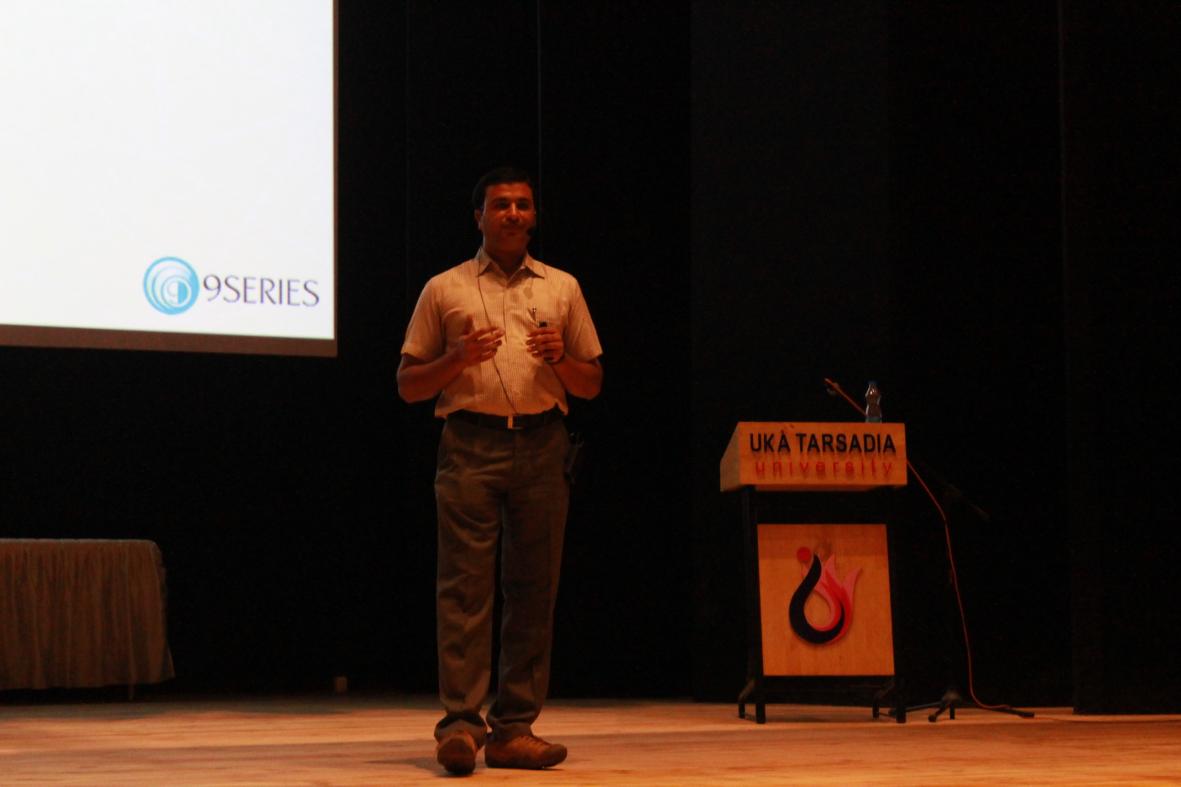
There were further appearances. On 26 July 2019, he conducted a workshop on IoT with AWS Cloud Services at Marwadi University. Sixty participants attended. The combination brought connected devices and cloud services into one practical teaching setting.
IoT with AWS Cloud Services workshop at Marwadi University.
In October 2020, his name appeared among the industry jury members for hackinUTU, a national virtual hackathon organised by Uka Tarsadia University. Its evaluation framework considered implementation, technical work, innovation, feasibility and market adaptability. Those criteria place an idea under several kinds of scrutiny at once. An attractive proposal still has to survive questions about whether it works and where it might be useful.
The company beyond its walls
The business around Joshi extends beyond Gujarat. 9series lists operations in Ahmedabad and the Seattle area, and its client work reaches across countries. There is an unglamorous companion to that reach: the corporate, accounting and administrative arrangements needed to operate internationally.
In a testimonial for Altobooks, Joshi credited Jigar and Tejas with advice on corporate structure, incorporating a company in the United States and managing global accounting and finances. It is a small glimpse of the supporting work behind a technology business. Software may travel through a network; a company still needs its books kept.
A later project provides a different view of those connections. Synkriom described partnering with 9series on Omnihub, an AI platform for bringing together information from multiple data sources. Joshi was named as the contact for the 9series reference. The project concerned data synthesis, contextual analysis and retrieval on cloud infrastructure.
He also shared 9series’ account of work on Solvit, an on-demand inspection platform associated with asset and vehicle assessment. These examples give the international business a practical shape. Its work includes helping organisations collect, organise and use information in particular operating environments.
Making room in the celebration
When 9series celebrated reaching 100 people, Joshi thanked current and former employees, clients, contractors and partners. The inclusion of former colleagues deserves its place in the sentence. A company’s history contains work by people who no longer appear on its current team list.
That was a milestone at a particular moment, rather than a permanent measure of the organisation. Joshi described it as a journey from zero to one, and closed with a brief expression of ambition: “Best is yet to come.” The acknowledgement made the celebration larger than the people still on the payroll.
His stated business priorities have also included delivery quality, lasting client trust and sustainable growth. In discussing 9series’ direction, he placed those concerns ahead of valuation milestones. They are ambitions with a recurring test: the next piece of work has to be delivered, and the relationship has to continue after the celebration ends.
New tools, familiar questions
Today, 9series presents enterprise AI and agentic systems as central parts of its work, alongside product engineering, data and cloud services. Its delivery offering includes business alignment, architecture, model development, integration and ongoing optimisation. The vocabulary has changed considerably since the university talk about smartphones and wearables.
Joshi’s recent public activity includes an invitation to a small group of design partners for an early prototype. He described looking for people who had built an audience or business through social platforms and wanted help turning that attention into conversations and outcomes. The invitation offered early access and direct involvement with the team.
That places another concrete problem on the table: what happens after someone has attracted attention? The answer will depend on the product and the people trying it. For now, the invitation puts prospective users into the development process.
The photographs and milestones give this career its human scale. A university auditorium. A workshop with sixty participants. A new office with families at the door. Joshi’s story moves through changing technologies, but it also has these quite ordinary places where the work becomes visible. At the Ahmedabad opening, the directors had somewhere new to work and people to thank. They handed over the scissors.
Follow the work
More from Joshi, his company and his technical writing.
9series website Rajnikant Joshi on LinkedIn What is your Multi-tenancy approach! Content Translation Strategies in Travel Domain The Ahmedabad office opening