Marketing has acquired a peculiar modern problem: it can do almost everything faster, except decide what deserves doing. Raji Behniwal has spent her career inside that gap. She began when knowing a little HTML could open a professional door. She later helped explain creator marketing before boardrooms had settled on what to call it, then carried the same instinct into food intelligence, where a viral flavor and a viable product are emphatically different creatures. Her work keeps returning to a deceptively plain question: why do some ideas move?
The question now sits at the center of The Executive Standard, the advisory firm Behniwal founded for B2B SaaS, AI, growth-stage, and private-equity-backed companies. Its promise is executive marketing leadership without the reflex to add another agency, campaign, or permanent title to the org chart. The assignment is more surgical: sharpen the company's position, connect marketing to the commercial system, and help leaders decide where the next dollar and the next hour actually belong.
It is a sensible destination for a career spent in emerging categories. Behniwal has worked across digital advertising, insurance, healthcare technology, the creator economy, and food and beverage intelligence. The nouns changed. The job beneath them remained translation - taking a technical product, a changing behavior, or an unfamiliar market and making it legible enough to trust.
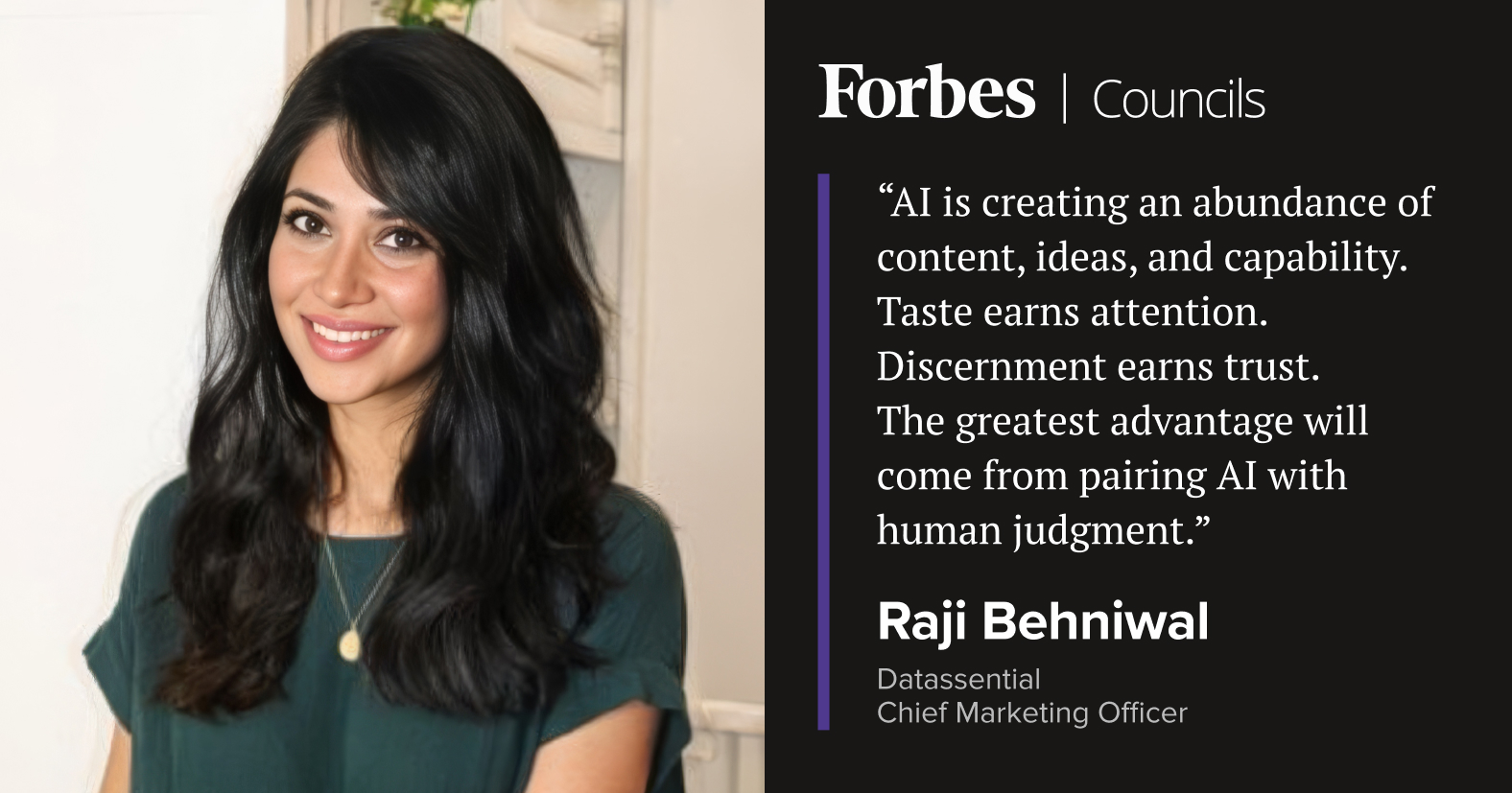
“AI is creating an abundance of content, ideas, and capability. Taste earns attention. Discernment earns trust.”
The first client arrived through a charity website
Behniwal's origin story is refreshingly short on destiny. During the early internet era, she wanted a career that could be technical and creative at once. Website design looked like the seam between those worlds, so she took a class, learned HTML, and volunteered to manage a charity's site. The practice produced her first paying client. A small decision became a professional direction.
That early willingness to do the next job before anyone formally awarded it to her became a principle. She has advised younger professionals to “do the job you want” from the position they already occupy. The point is not unpaid ambition theater. It is to develop the judgment and prioritization that the next role will demand while the stakes are still manageable.
After a marketing coordinator role at BlueLithium, her path ran through Farmers Insurance and Wincere before Captiv8. The sequence matters because it built both range and pattern recognition. Consumer messaging, partnerships, brand strategy, and technical products each offer a different answer to the same commercial question: what makes someone care enough to act?
Teaching the boardroom to take creators seriously
Behniwal joined Captiv8 in 2016 and moved through creative development, brand strategy, and marketing leadership as influencer marketing grew from an experimental channel into enterprise infrastructure. The category carried a credibility problem. Attention was obvious; accountability was not. Brands needed to know whether creators could deliver business results, how risk could be managed, and where influence belonged in a wider media plan.
Her rise at Captiv8 mirrors the category's own maturation. Creative work became brand strategy; brand strategy expanded into marketing and communications. By the time she led the function, thought leadership, demand generation, public relations, and brand awareness had to operate as one story. Captiv8 was not merely selling software. It was asking established companies to recognize a new kind of commercial relationship between audiences, creators, and brands.
The creator economy taught a durable lesson: reach and trust are not synonyms. A million impressions can be a weather report rather than a business result. Influence becomes valuable when it changes perception or behavior, and when the company can explain the connection without resorting to fog machines and adjectives.
When the signal is a sandwich
In March 2025, Behniwal became Chief Marketing Officer at Datassential. The move sounds like a sharp turn from creator culture to menu databases, but it follows her deeper fascination with why ideas spread. Food offers an unusually visible adoption curve. A flavor appears on a few inventive menus, earns social attention, moves into regional chains, and sometimes reaches ubiquity. Many others expire somewhere between photogenic and profitable.
Datassential's proposition rests on structured menu, consumer, sales, and operator intelligence. Behniwal's task covered brand strategy, demand generation, and go-to-market work while the company expanded its AI-powered platform. She was again translating a category at an inflection point, only now the audience needed to understand why an answer grounded in proprietary food data differed from a fluent answer assembled from the open internet.
How a trend becomes a decision
Her argument is precise: access to AI will become ordinary; access to reliable, industry-specific data will not. General tools can help generate and synthesize ideas. Decisions about a menu rollout, product investment, or sales strategy require provenance, consistency, and a model of how the industry actually behaves. In foodservice, being early can help. Being right pays the invoice.
The useful boredom of consistency
Behniwal pairs enthusiasm for change with a fondness for fundamentals. Her advice to executives begins with getting comfortable with discomfort. AI will alter every function, and another platform or market force will follow it. Curiosity and adaptation are survival skills. Then comes the less glamorous half: stay “boringly consistent.” Build trust. Deliver results. Focus on outcomes.
This combination explains the texture of her public advice. She favors clear ownership over ceremonial alignment. She tells marketers to add checkpoints during campaigns rather than reserving every lesson for the postmortem. She says good networkers listen, take notes, and create value in the follow-up. She once over-invested in perfection before a launch; experience taught her to treat marketing as an optimization loop where action creates the information needed for the next adjustment.
Context before content
Nuance, audience knowledge, and the small details turn generated words into a story worth remembering.
Action before polish
Launch, learn how the idea lands, and improve it. Momentum produces evidence that perfection cannot.
Ownership before alignment
Shared goals need explicit definitions, deadlines, measures, and a person responsible for the result.
Judgment before volume
AI lowers the cost of execution. Leaders still decide what deserves to exist and what creates value.
Marketing grows up when it joins the business
The Executive Standard turns those principles into an operating model. Behniwal works with founders, CEOs, and leadership teams on category strategy, fractional CMO leadership, communications, creator strategy, go-to-market systems, AI adoption, executive visibility, and events. The menu is broad because the failure modes are connected. A positioning problem can masquerade as a demand problem. A sales handoff can make good marketing look wasteful. A busy content calendar can hide a company that has not chosen what it wants to be known for.
Her marketing effectiveness review asks leaders to inspect three lenses. Strategic focus tests whether resources support the work most likely to create business value. Commercial impact connects investment to pipeline quality, sales velocity, acquisition efficiency, and market position. Revenue motion examines whether the whole organization can convert interest into revenue. Marketing, sales, finance, product, and customer success enter the same conversation, bringing their definitions with them and, ideally, leaving with fewer.
Behniwal has described walking into organizations where paid search absorbed most of the marketing budget even though the customer journey failed before a meaningful sales conversation. She has also seen demand generation paused because pipeline appeared weak, only for leaders to discover that qualified opportunities were getting lost in an inconsistent sales-development handoff. Both cases punish the department whose activity is easiest to measure while leaving the system that wastes the activity untouched. Her review changes the unit of analysis from the campaign to the commercial engine.
That shift also makes the CMO a convener of useful arguments. Finance can define acceptable acquisition cost and payback. Customer success can expose the difference between retention and genuine loyalty. Product can clarify the buyer and the problems future releases should solve. Sales can report what happens after interest becomes a conversation. The value is not universal agreement; it is shared evidence, explicit ownership, and enough clarity to make a choice. A dashboard may display each team's numbers beautifully while the business still disagrees about what they mean.
This is Behniwal's sharpest departure from the decorative idea of marketing. She treats brand as a commercial asset, storytelling as a form of clarity, and culture as something to understand rather than borrow for an afternoon. Creativity survives the scrutiny. In fact, it gains a purpose sturdier than applause.
“There is tremendous value in being boringly consistent.”
A founder's second question
Behniwal has said she is drawn to companies at pivotal moments of growth and transformation. Founding The Executive Standard places her inside one of those moments herself. The practice is designed for businesses that have outgrown founder-led marketing, need CMO judgment before a permanent appointment makes sense, or have accumulated more tools and activity than conviction.
There is an appealing symmetry to the move. Her career began by making herself useful before the title arrived. Now she offers companies senior leadership without insisting that the title arrive first. The work is bounded by a problem and accountable to an outcome. If a company cannot see what marketing is changing, it needs a clearer system before it needs more output.
The question that carried Behniwal through creators, menus, algorithms, and executive rooms was why ideas move. Her founder chapter adds a second: once an idea moves, does the business know what to do with the attention? The answer requires data and narrative, speed and consistency, technical fluency and cultural instinct. Most of all, it requires someone willing to decide. The machines can produce options. Taste still has to choose.