At Nuun Hydration, the trouble arrived disguised as success. The electrolyte-tablet brand ran influencer campaigns in-house. As those campaigns grew, so did the screenshots, impression checks and calculations required to explain them. Finding creators was only part of the job. Keeping evidence of what they had done was becoming another job altogether.
- The product: software for finding, vetting, managing and measuring influencers.
- The buyer: brands and agencies running repeatable creator programs.
- The useful distinction: followers, estimated reach and sales answer different questions.
That is a revealing place to begin with Klear. Influencer marketing looks wonderfully informal from the outside: a person, a phone, a recommendation. Inside the company paying for that recommendation, there are briefs, approvals, invoices and somebody wondering whether the audience is in the right country. Klear sells order to the people behind the apparent spontaneity.
The number beneath the number
The obvious way to choose an influencer is to start with followers. It is also an invitation to confuse potential with performance. Klear’s profiles place an influence score, engagement and True Reach alongside that familiar total. True Reach is an estimate of content exposure. It gives marketers another question to ask before accepting a large number as proof of a useful audience.
Consider location. A creator can live in one country while attracting viewers in another. Klear’s audience filters let a team search for the people it wants to reach, rather than merely the people it wants to hire. Its vetting tools add demographics, previous partnerships and content review. The algorithm makes the shortlist; the marketer still needs to read the room.
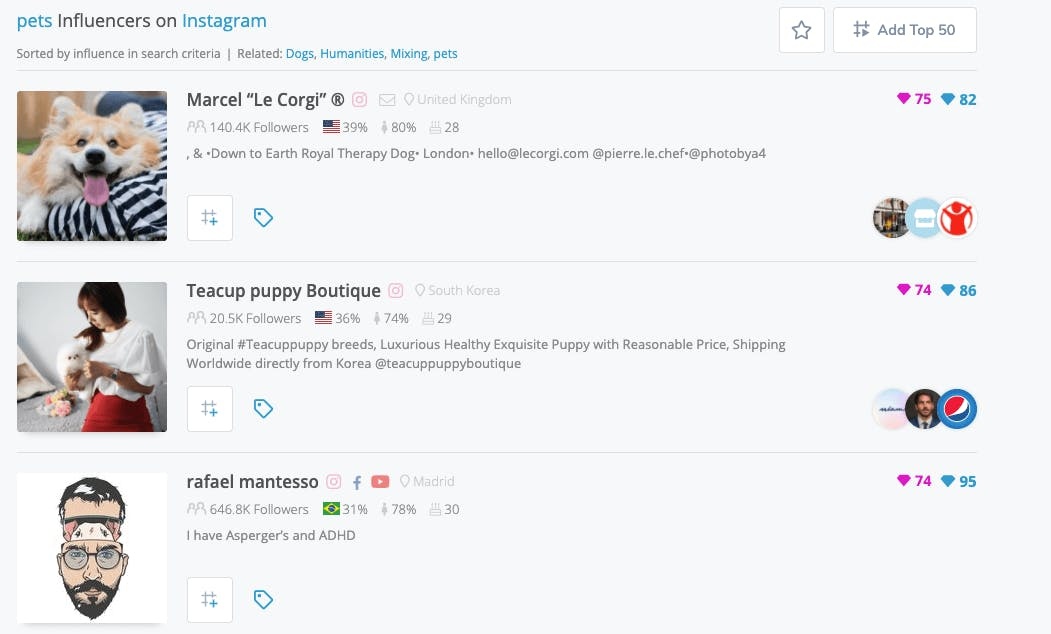
There is something pleasingly concrete about that proposition. A campaign does not need “influence” in the abstract. It needs particular people to notice a particular thing. The more precisely a team can describe those people, the more useful the search becomes. Without that description, even a very large database is an expensive way to browse.
When Twitter became too small a name
Klear began in 2012 with three brothers: Eytan, Noam and Guy Avigdor. Its earlier name, Twtrland, advertised its starting territory. By 2015, the platform also analyzed Facebook and Instagram, and the business became Klear. A name tied to one network had become an awkward fit for a product crossing several.
Contemporary reporting put its new financing at $1.5 million, with AltaIR, GIG and TMT participating. The money was intended for sales and marketing, particularly in the United States and United Kingdom. The company’s early argument was that social analytics could be more understandable and accessible. Its eventual place in enterprise marketing shows how far that argument travelled.
Meltwater became a commercial partner in 2017. In April 2021, it announced an agreement to acquire Klear for $17.8 million in cash and earn-out. Klear had recorded $7.6 million in 2020 revenue. Those figures describe a business with paying customers, rather than a collection of fashionable social-media vocabulary.
The screenshot department gets its afternoon back
Nuun’s experience supplies the practical test. Instead of examining prospective creators one by one, the team used search criteria to produce relevant groups, then vetted them with audience and performance data. Campaign-content collection and reporting became automated. For its #PlopChallenge, niche discovery helped identify roughly 200 creators with trick-performing talents, including backflips and yo-yo skills.
“work that once took us 8-hours now takes 2-hours”
Mason French, Nuun Hydration
Steller, the travel storytelling platform, encountered a different obstruction. It already used influencer software. International creator payments still demanded banking details, tax forms and time from accountants. As that work became more burdensome, the team decided its previous platform was not meeting its needs. Klear’s integrated payment workflow was the reason to reconsider.
Klear Pay brought creator payment information and paperwork into the process. Steller’s case study says paying a single influencer had previously involved around six hours of manual work. The attractive feature here is almost comically unphotogenic: fewer incomplete forms. For the person waiting to be paid, however, it is rather more compelling than another dashboard.
A campaign with fewer loose ends
The wider product connects discovery with collaboration and measurement. Connect handles communications, briefs and content approvals. Recruit brings potential ambassadors into a program through application forms. Campaign reporting makes creator activity comparable, while ecommerce integrations connect links and discount codes with attributed orders. These pieces matter because each handoff is a chance to lose information.
Meltwater added a further connection in May 2024: Klear workflows and analytics inside Engage, its social media management product. Teams could discover and amplify influencer posts on owned channels and use an influencer dashboard in their social reporting. By September 2026, Klear’s updates included a Funnel view for campaign stages and a View Only permission for stakeholders.
CreatorIQ and Traackr compete for enterprise creator programs; Modash offers another route through discovery and campaign operations. Klear’s strongest positioning is its place inside Meltwater’s broader media and social intelligence suite. That is a practical advantage for teams already working there. It is not a claim that rival platforms lack discovery, AI or reporting.
The quote comes before the contract
Klear is sold through customized Meltwater agreements. The current pricing page publishes no standalone Klear fee; most Meltwater contracts run annually with a twelve-month minimum. A buyer therefore needs to price its actual users, workflows and integrations. Creator compensation belongs in the campaign budget too. Saving time and buying inexpensive software are separate calculations.
The lesson readers can copy starts before a sales call: identify the task consuming the hours, define the audience, and agree on the outcome to measure. Estimated media value is not cash revenue. Last-click sales attribution cannot settle every question about how a customer was persuaded. A small, occasional program may have little administrative work to recover. Klear becomes more persuasive when the campaign is already working and the machinery behind it needs help keeping up.