The awkward part of dinner came with the bill. Raghunandan G was visiting friends in New York, people who had built businesses and earned the sort of reputations that usually opened doors. They reached for cash. Their financial standing in India had made the journey less successfully than they had. In America, without a local credit history, they were strangers.
For someone else, this might have remained an irritating travel story. For Raghu, as he is commonly known, it became a reason to return to running a company. He had already co-founded TaxiForSure, sold it to Ola, and spent years investing in other founders. Now he was looking at another peculiar queue: people waiting for a service they seemed perfectly qualified to use.
Zolve grew out of that question. Why should a border make a responsible borrower appear to be an unknown quantity? There is a pleasing inconvenience in Raghu's career. Twice, he has noticed that people and the services they need are sitting surprisingly close together, while an intermediary makes the introduction difficult.
A passenger before he was a founder
Raghu grew up in a middle-class Indian family where academic achievement mattered. His parents expected their children to succeed, and engineering was one familiar route. He did well at school and enjoyed sports. The early outline of his career was conventional enough: computer science at NIT Karnataka in Surathkal, a job at Texas Instruments, then management studies at IIM Ahmedabad.
Consulting at Feedback Ventures supplied the next ingredient: travel. In unfamiliar cities, getting a taxi could become an exercise in listening to a busy call centre. Outside, empty cars were waiting for passengers. Inside the telephone system, passengers were waiting for cars. The people doing the matching had become an obstacle to the match.
Smartphones offered a different arrangement. If a device could locate a customer and a car, why should both wait for an operator to discover the same information? Raghu's engineering background gave the question a practical shape. The irritation was common; the equipment to address it was becoming common too.
His eventual co-founder, Aprameya Radhakrishna, was already a friend. Their connection ran through South Bengaluru, cricket, engineering college and IIM Ahmedabad. They had known each other outside the flattering conditions of a pitch meeting. That history mattered: a business partnership would ask rather more of them than a shared enthusiasm for an idea.
The napkin still needed homework
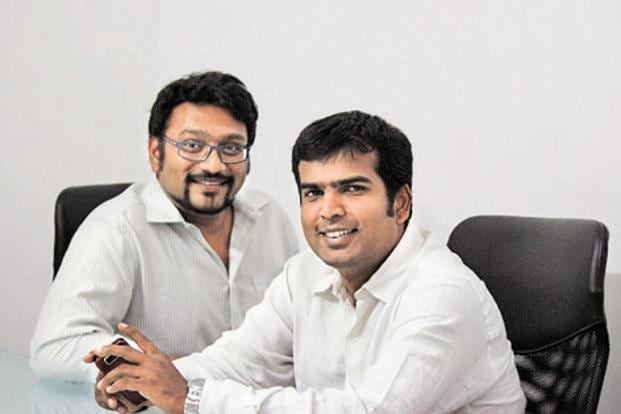
The TaxiForSure origin has the necessary furniture of a startup anecdote: two friends, a pub, a frustrating wait and a paper napkin. Raghu has told the story with some amusement. But the useful part happened after the napkin. They set about finding out whether other people shared their annoyance.
They surveyed friends, questioned travellers outside airports in Delhi and Bengaluru, and hired college students to approach shoppers at malls. In Raghu's later telling, roughly 3,000 people responded and about 90 percent recognised the problem. The founders also described their proposed service to potential customers. Agreement about an irritation was encouraging; willingness to use a solution was more useful.
TaxiForSure launched in 2011, working with taxi operators rather than buying a fleet. Its job was to make existing supply easier to book. In an early interview, Raghu described an app that showed nearby taxis and let a passenger request one without calling an operator. The premise was modest enough to explain in a breath. Making it reliable required a company.
There were other experiments, including luxury-car bookings. Raghu observed that customers in Delhi were more interested in making an impression with large cars than customers in Bengaluru. Even inside one country, people bought the same category of service for different reasons. A map could locate a passenger; understanding that passenger took more work.
“Ideas originate from discussions, not during idea generation sessions or agenda meetings.”
Raghunandan G, speaking about TaxiForSure
Sixteen copies, one difficult goodbye
In March 2015, Ola acquired TaxiForSure for $200 million. The figure is an efficient biography in miniature. It is also a poor description of the day itself.
Raghu went back to the company's first office, a room of about 100 square feet on a Bengaluru terrace, to sign the transaction documents. His wife, Shilpa, accompanied him. At her request, he waited until the auspicious hour of nine before signing. There were sixteen copies of the shareholder agreements. An entrepreneurial chapter, apparently, could end with quite a lot of stationery.
Later, addressing employees, he struggled with the speech he had rehearsed. The sale was financially significant and personally difficult. Those two facts could occupy the same afternoon. A company built with a friend, in a small room, had become something much harder to leave than a line on a résumé.
By May, he was already discussing what he would do differently. TaxiForSure had grown so quickly that the founders had paid too little attention to the world outside it. He also regretted being dazzled by fundraising amounts and valuation while giving insufficient attention to investment terms. A valuation could change; clauses could travel into the next round.
The next venture would need wider vision and closer reading. His impatience with retirement was already plain. He told an interviewer that getting involved directly was more enjoyable than dispensing advice. The apparent endpoint of a founder's story had left him thinking about another beginning.
- 2011Find the carTaxiForSure launches
- 2015Leave the companyOla acquisition
- 2021Carry the historyZolve's public debut
What information needs to reach the other side?
An investor who missed the starting line
He stayed close to the work through angel investing and mentoring. Companies associated with that period include Vedantu, Bounce and Ninjacart. He also became a limited partner in venture funds. Watching other founders widened the range of businesses he could study without having to pretend he could operate them all.
Travel to the United States and China became part of that education. He wanted to understand what was working elsewhere and where comparable opportunities might exist in India. But proximity to company building did not entirely replace doing it. In a later public account, he described missing the work of assembling a team and pursuing his own idea.
His personal interests suggest someone comfortable with longer assignments. He is a reader and an endurance athlete who has taken part in Ironman and triathlon events. A 2023 conversation explored the connections he drew between sport, hiring and team building. At the time, he was also preparing to climb Mount Kilimanjaro. The preparation, rather than an assumed summit, is the telling detail.
There is a less ceremonial glimpse of him in a 2015 account of his gadgets: a Kindle, an Xbox 360 with Kinect, and Evernote for ideas that might otherwise escape between phones. On his Wellfound profile, his reading ranges from The Hard Thing About Hard Things to Jonathan Livingston Seagull and To Sir, with Love. Asked what he would do if money were irrelevant, he chose travelling the world.
A reputation that could make the flight
The New York dinner gave that interest in crossing borders a more specific purpose. The puzzle was particularly sharp because his friends were financially established. Their ability to repay had not evaporated during the flight. The system they had entered simply lacked a usable account of it.
Zolve, founded in 2020 and publicly introduced in 2021, set out to make home-country financial information useful when people moved to the United States. The early proposition involved access to accounts and credit through banking partners. For international students and working professionals, the timing mattered: financial arrangements were needed at arrival, while a new local history took time to build.
The business asked Raghu to stretch beyond a consumer company operating inside India. In his explanations of Zolve, he has repeatedly returned to the ambition of building for international customers from India. TaxiForSure had made a city easier to navigate. Zolve would have to work across institutions, countries and different ways of assessing a person's finances.
A change of country need not mean starting from a blank page.
The second company has its own homework
In March 2025, Zolve announced $251 million in equity and debt financing, with Creaegis leading the round and investors including HSBC and SBI Investment participating. The distinction between those forms of funding matters. Equity backs the business; lending capacity serves a different purpose. Adding them produces a headline, but they remain different tools.
At that point, the company reported more than 750,000 customers. Raghu said expansion into Canada, the United Kingdom and Australia was being prepared, alongside a broader lending offering. Those were plans attached to the funding announcement, rather than a completed itinerary. His ambition had acquired a larger budget and a longer list of practical obligations.
His advice to other founders is correspondingly workmanlike. Build a capable team. Study customer information. Pay attention to compliance. Make the business sustainable. These are the less photogenic parts of a founding story, particularly compared with a dinner revelation or an acquisition cheque. They are also the parts that decide whether either anecdote has a second act.
Raghu has described learning to give capable people room to succeed rather than expecting them to become copies of their leader. That is an appealingly practical ambition for someone whose companies begin with bottlenecks. A founder can recognise an obstruction in a call centre or a credit system. The harder test is making sure he does not become one himself.
The dinner bill has long since been settled. The question it raised keeps him occupied: when a person moves, how much of the life they have already built should be allowed to come along?