Amit Kumar Agarwal wanted to help people find a home. In September 2015, his own company suddenly needed somewhere else to work. Brokers had attacked NoBroker’s Bengaluru office, and the team had to move. Even the removal trucks attracted unwanted attention: brokers followed them, trying to discover the new address.
It was an unusually literal objection to a business proposal. Agarwal and his co-founders, Akhil Gupta and Saurabh Garg, had built a property platform that connected owners directly with people looking to rent or buy. The missing participant was advertised in the name. Some of the people being left out had come to register their displeasure in person.
Years later, Agarwal could recount the episode with the distance that survival permits. The practical details remain sobering. A company selling easier access to property had to make its own premises harder to find. The internet had removed one obstacle between strangers. Outside the office, the obstacle had arrived at the door.
A second bill for the same introduction
The grievance that became NoBroker began in Mumbai. In a public recollection of his house hunt, Agarwal described struggling for two months in 2007 before finding a home through a broker. He paid the fee. Eleven months later, when he wanted to renew with the same landlord, the broker demanded brokerage again.
That second demand sharpened the question. The tenant already knew the owner. The owner already knew the tenant. What, precisely, was being introduced this time? An arrangement that had become familiar to the market looked rather peculiar to the person paying for it.
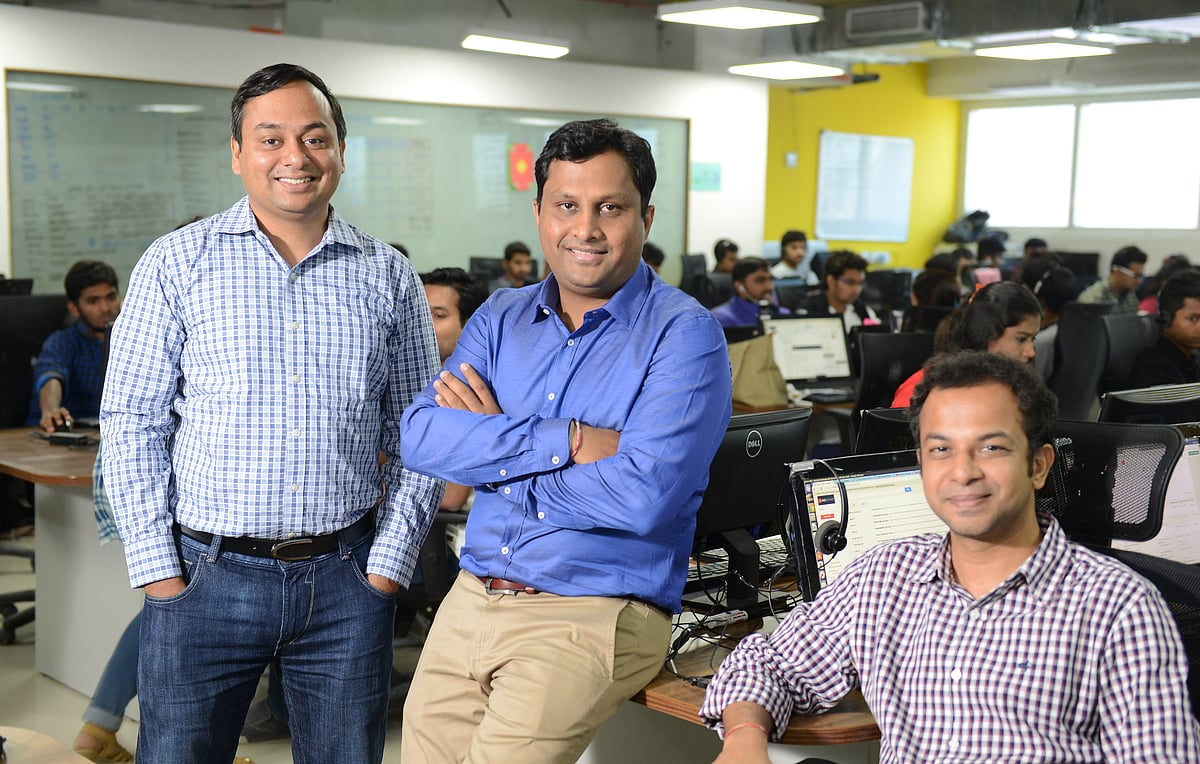
The eventual founding team had all experienced frustrations with house hunting. Agarwal and Garg also had a friendship that predated business: they were IIM Ahmedabad classmates, living on the same floor of dorm 16 in 2002. Their later account of NoBroker’s origins describes friends comparing experiences as work took them to different cities. A shared irritation had acquired enough detail to become a project.
The comfortable job was part of the problem
Agarwal had followed an established educational route before attempting something less predictable. He graduated in civil engineering from IIT Kanpur in 2000, then completed IIM Ahmedabad’s postgraduate programme in 2004. The engineering degree gives his later career in property a pleasing symmetry, although the intervening jobs took him through software, consulting and banking.
At Cognizant, he worked on web-based Java applications. He later joined PwC’s management consulting business, working in banking and financial services, before moving to ANZ Bank as head of strategy. Finance interested him; so did consulting. He was leaving a career that had things to recommend it.
By his account, the bank offered a good salary, comfortable working conditions and an intelligible future. Another designation, a larger pay packet, perhaps a posting overseas: the next steps were easy to imagine. Their very predictability troubled him. Continuing might make it progressively harder to leave.
His way of handling the risk was numerical. He was 35 when he made the jump, he recalled in 2022, and reckoned that he had another 25 working years ahead. Spending two on a company would still leave time to recover if it failed. It was a reassuringly bankerly way to enter entrepreneurship: put a boundary around the possible loss, then begin.
The first rush of congratulations did not last. Friends returned to their own lives. Agarwal remembered sitting with his computer and a website attracting only a handful of customers, considering what a normal working day would have paid. His two-year calculation helped him keep that comparison from settling the matter.
“We are going to learn from customers.”
Amit Kumar Agarwal, 2021
A name that had to be enforced
NoBroker’s first website went live in March 2014. Launching a site was the visible step. Making the promise in its name reliable was a continuing job. Property portals already existed. Simply moving listings onto a screen would leave plenty of room for brokers to operate through the screen too.
The platform therefore needed ways to distinguish owners and home seekers from intermediaries presenting themselves as either. In a July 2015 interview, Agarwal described an algorithm that checked new registrations and excluded brokers. Screening participation belonged at the centre of the product. If the contact at the end still demanded brokerage, the customer had reached the old problem by a new route.
Funding required another sort of explanation. Investors asked for an American or Chinese equivalent. Agarwal was trying to make a case about an Indian experience; a recognisable overseas example would have made the conversation easier. He described having to argue from the local problem when no such comparison was available.
The team initially pooled savings and bootstrapped. Its marketplace also had a practical funding need: more suitable properties attracted more seekers, and more seekers gave owners a reason to list. Elevation Capital became its first investor, leading a $3 million seed round in February 2015. The money arrived before that year’s confrontation at the office.
launches in March
first investment round
Series E funding
A marketplace measured in neighbourhoods
By 2017, Agarwal was writing publicly about the dilemmas behind expansion. A property marketplace could become wider, entering more cities, or deeper, building a stronger network within an existing one. For NoBroker, he argued, depth deserved priority.
His explanation was pleasantly concrete. A home has particular dimensions, a particular location and a particular price. It needs someone seeking that combination. A large collection of unrelated listings does little for a person who wants one suitable flat near work. The match happens within a much smaller geography than the company’s ambition.
That view helps explain why he paid attention to completed deals rather than treating the total value of property as the decisive measure. An expensive house creates an impressive-looking number. Finding the person who will actually take it is the service. The distinction sounds obvious until a presentation requires a very large number in a very large font.
seeker↔Property
owner
Same locality. Compatible budget. Suitable space.
A conceptual illustration of Agarwal’s marketplace argument.Careful spending followed the same reasoning. In 2019 he described a company that remained frugal even after raising money. Customer registrations alone were insufficient reassurance. He wanted customers who used the service and recommended it. Expanding locality by locality was less theatrical than colouring in a map, but rather more relevant to someone searching within a commuting radius.
Learning which jobs to stop doing
Agarwal’s account of becoming a founder includes a useful admission: he initially thought he could handle support functions himself. There seemed little reason to hire finance or HR specialists before the company was large enough to keep them fully occupied.
Experience changed his mind. The founders found themselves doing work that consumed time they needed for building the business. Specialists improved both the work and the founders’ ability to concentrate. In 2016, NoBroker hired chartered accountant Ashish Shand, who later became head of finance. Agarwal has described that appointment as one of the company’s better decisions.
His advice about leading people is similarly practical. He stresses frequent, transparent communication: colleagues can understand the business and its difficulties, and hiding things from them is a poor substitute for explaining them. He also credits his father, a civil servant, as a formative influence. His father’s perseverance and cheerful response to adversity remained a reference point when business became difficult.
The shared work did not exhaust the founders’ friendship. In 2022, Agarwal described families holidaying together and watching their children grow up. At home, he had also found time to play football indoors with his sons, to his wife’s exasperation. Some negotiations, apparently, remain outside the platform’s remit.
The business after the introduction
Removing brokerage left a perfectly ordinary commercial question: how would the company earn money? NoBroker developed paid assistance and services around the home, including moving, cleaning, painting and financial services. Its community management platform, NoBrokerHood, extended the relationship beyond the property search.
Agarwal described expansion as a response to customer requests. People finding a home had other tasks to complete. Offering help with those tasks could produce revenue while keeping the original proposition intact. The business gradually occupied more of the journey between deciding to move and actually living somewhere.
In November 2021, NoBroker raised $210 million in a round led by General Atlantic, Tiger Global and Moore Strategic Ventures, taking its valuation above $1 billion. Google added $5 million to the Series E round in 2023, with plans to collaborate on the home search and residential community experience.
Personal recognition followed. In 2024, IIT Kanpur gave Agarwal its Distinguished Alumnus Award. IIM Ahmedabad recognised him with a Young Alumni Achiever’s Award in entrepreneurship. Institutions that had helped prepare him for corporate life were now recognising the business he left it to build.
The next calculation
By July 2026, Agarwal’s public goals centred on profitability. He reported revenue growth of roughly 20-30% in FY26 and said the company was targeting about 30% in FY27. Individual functions were operationally profitable, he said, while central costs still needed to be covered.
He expected full profitability within 12-15 months. That was a forward target. It gave a concrete measure for the next stage of a business already carrying a billion-dollar funding milestone in its history. Paying for head-office rent and technology teams is less glamorous than joining a valuation club. It is also a fairly durable subject for a chief executive’s attention.
Agarwal began with an objection to paying again for an introduction that had already happened. Answering it has required algorithms, capital, specialist colleagues and years of work with two friends. The transaction he hoped to simplify was short. Building a company around it has proved an altogether longer tenancy.