A jewellery website can be a very quiet place. In GIVA’s first months, Ishendra Agarwal and his co-founders were receiving only one or two orders a day. They had launched a business around the idea that fine jewellery could become an everyday purchase. The customers were taking their time. Then a listing on a gifting portal brought a sudden jump to roughly 250 orders in a day. Packing occupied the founders day and night. Stock ran out. The silence, it turned out, had been easier to organise.
That early episode captures the peculiar education of Agarwal, GIVA’s co-founder and CEO. He could identify an opportunity, build a proposition and put it online. Making the business work required a continuing willingness to become a beginner. A rush of orders presented one lesson. Physical shops would supply several more.
A precious metal, a less precious occasion
His original question concerned the distance between what jewellery cost and how often somebody might want to wear it. In 2019, established fine-jewellery businesses already offered gold pieces to working women. For someone wanting variety without committing a large sum, the choices looked less satisfactory. Agarwal saw a place for silver: a precious metal with prices that made buying a piece for oneself more plausible.
He put ₹10 lakh of his own money into the venture. Nikita Prasad, a jewellery designer trained at NIFT, and Sachin Shetty, who had worked in investment, joined him as co-founders. Early products ranged from ₹499 to ₹3,999. Around ₹1,500 was the price at which, he said, many purchases happened. A business proposition had acquired a recognisable shopping budget.
“That’s why we chose silver,” he explained. There is a useful plainness to the answer. Silver gave the company somewhere to begin, and buyers an entry point. The occasion could be as modest as liking a pair of earrings. An ordinary Tuesday was quite sufficient.
An engineer arrives by way of dinner
The route to jewellery passed through several other businesses. Agarwal studied electrical engineering at IIT Kanpur, completing bachelor’s and master’s degrees. During college, he started Essence Times, a youth media magazine, and HidnChat, an anonymous social application. An anonymous chat product and a jewellery label make an unlikely pair on a career page. Both, however, required finding out whether people wanted what he was making.
His early professional work included Twigly, a direct-to-consumer food startup, where he worked closely with the founding team. He subsequently became a management consultant at Boston Consulting Group and spent time in venture capital at Guild Capital. The sequence put him near consumer businesses from several directions: the work of running one, the work of analysing one, and the work of deciding whether to fund one.
There was also a family connection to jewellery. He came from a middle-class business family with longstanding ties to the trade. His eventual choice therefore combined a familiar category with a set of experiences acquired elsewhere. The engineer had taken a circuitous route back to the shop counter.
The little promises around a necklace
Price could attract attention. Trust had to survive the transaction. In discussing the silver market, Agarwal described a fragmented field of local sellers, with few brands operating at national scale. His concern was the customer’s ability to rely on what a seller said about purity. A precious metal becomes a difficult online purchase when the buyer cannot confidently establish what is precious about it.
GIVA’s response included authenticity certificates, a return window and lifetime replating. These services addressed questions that sit just outside the photograph of a product: what arrives, whether it matches expectations, and how a piece can be cared for later. They also made practical demands on the business. A promise to a customer eventually becomes work for someone.
Listening could shape the jewellery itself. In an early account of its design process, Agarwal described the Black Pearl Moon Set as a product that grew out of an Instagram customer’s feedback. He also discussed adjustable rings as a response to sizing difficulties. Such details are more revealing than a general declaration of customer focus. They show the precise point where an observation can become an object.
“Focus on execution above all else.”
Ishendra Agarwal
His explanation of the design process joined creative judgement to observation. The company studied page views, click-through rates and conversions while also asking employees for criticism and ideas. Jewellery has to please the eye; a business still needs to know which pieces people stop to examine. Agarwal treated those activities as connected, giving design teams both room to think and information to think with.
A website learns to open a door
By January 2022, the next experiment had an address. GIVA was planning two or three standalone stores, with ₹2 crore earmarked for the initiative. It had already partnered with Shoppers Stop. Agarwal described a sequence of testing metro locations before moving further into smaller cities. The plans were tentative enough to reveal the actual work ahead: begin with a few shops, find out how they perform, then decide what can be repeated.
The sales map supplied a reason to look beyond the metros. At the time, he said roughly 45 percent of sales came from Tier II cities, compared with 40 percent from Tier I metros. Customers outside the largest cities were already buying. Physical expansion would need to follow demand as well as ambition.
Opening stores also changed the founder’s job. Selecting a location, setting up a shop, allocating inventory and training staff required knowledge that online marketing had not supplied. Agarwal and Aditya Labroo spent months learning those mechanics. Every store multiplied the number of daily decisions that could influence a customer’s experience.
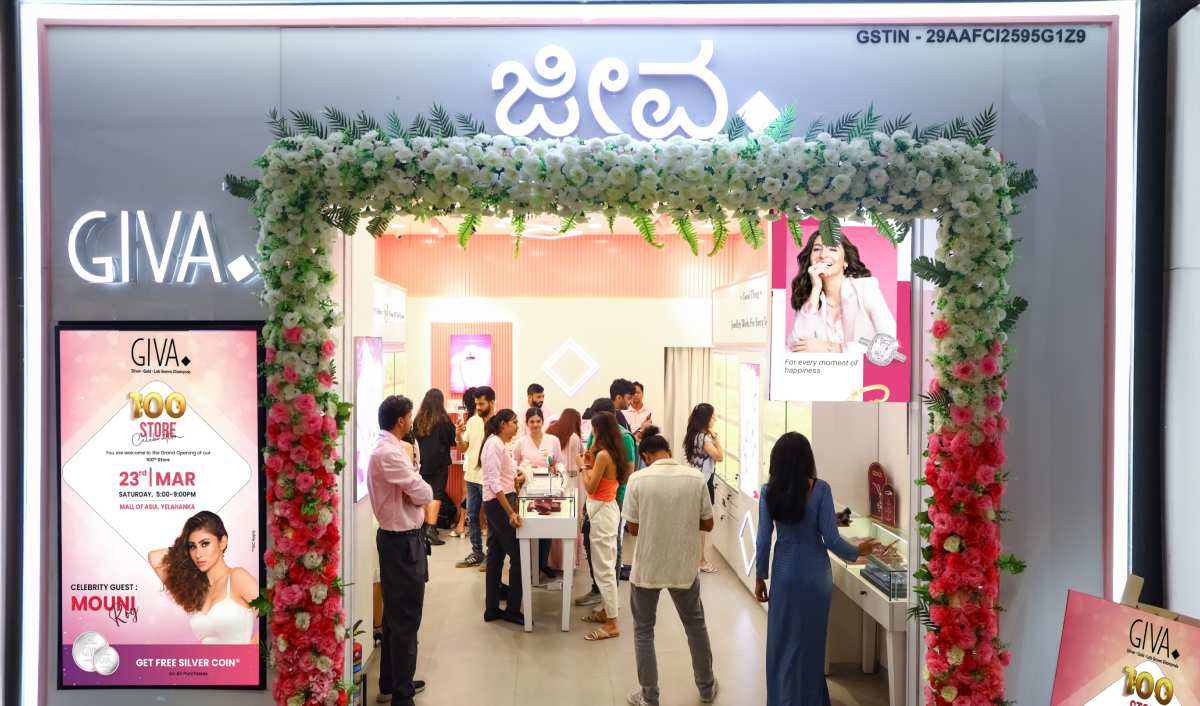
The 100th store opened at Phoenix Mall of Asia in Bengaluru in March 2024, with Mouni Roy at the inauguration. The city in which GIVA had begun supplied the setting for a conspicuously physical milestone. Flowers framed the entrance; shoppers gathered at counters. The online business now had places where customers could linger.
In April 2025, the 200th store opened at Forum South Mall, also in Bengaluru, inaugurated by Karisma Kapoor. The repeated return to the city gives the expansion a pleasing geography. However far the network spread, another round number could still be celebrated close to home.
More counters, more homework
The internal machinery was expanding too. During 2024, GIVA added a 35,000-square-foot warehouse and a plating unit in Jaipur. Four collections introduced 350 designs. Those details describe a less photogenic part of the founder’s work: keeping products moving and creating the capacity to service what has been sold. A necklace needs very little space. Enough necklaces require a warehouse.
The financial picture makes the demands of scale visible. In FY25, GIVA’s operating revenue reached about ₹518 crore, compared with ₹273.6 crore a year earlier. Its consolidated net loss increased to around ₹72.3 crore from ₹58.7 crore. The figures belong together. More customers and a larger business had arrived alongside a larger loss.
For Agarwal, expansion meant more than selling the original silver catalogue in additional places. Gold and lab-grown diamonds joined the offering in 2023. His announcement at the time framed the addition as an extension of accessible fine jewellery. The customer who wanted gold or diamonds was still part of the audience he hoped to serve.
That newer business received its own dedicated setting when Heer by GIVA opened an offline store in Bengaluru on March 23, 2026. The launch included a poetry session with Priya Malik. Jewellery retail had made room for shayari: a reasonable reminder that purchases with emotional meaning need not be conducted entirely in the language of inventory.
A guitar survives the business plan
There is another, smaller inventory worth keeping. In a 2021 personality questionnaire, Agarwal named his guitar as his most treasured possession. He had played during college and considered himself a novice. He was an enthusiastic cricket follower, with Sachin Tendulkar’s shoes an appealing hypothetical destination. He admired his entrepreneurial father and the example he set in balancing work with personal life.
He described a habit of asking what, why and how. The phrase fits a career full of changes in subject. Its charm is that it also leaves room for unfinished learning: the guitar player who would like to play better, the founder who has another kind of shop to understand.
The next ordinary purchase
GIVA’s reach has already extended to Sri Lanka, where it operates stores as well as an online business. Agarwal has spoken about entering further overseas markets. The ambition raises the same practical questions in another setting: which designs people choose, what they will spend, and how a new name earns familiarity.
Back in India, his February 2026 account of the business described an approximately even division between online and offline sales, with men’s jewellery contributing more than 12 percent. The audience was widening along with the routes to reach it. Silver remained central, while gold and lab-grown diamonds gave customers further choices.
The early gifting-portal rush is a useful place to leave him. For months, the founders wanted more orders. Then the orders arrived, and wanting became packing. Much of Agarwal’s subsequent story follows that pattern: an idea succeeds far enough to create a job he must learn. Somewhere between the next product and the next shop, there is another ordinary purchase to earn.