The first business Que Dallara ran had a rather demanding landlord: family life. At 16, she converted her family's 1,500-square-foot house into three classrooms. She taught. One student became more than 100. Eventually there were five employees. Before she had an executive title, she had people to pay. A family home had acquired a second occupation, and its teenage operator was learning how quickly an idea becomes a set of obligations.
It is a useful place to begin with Dallara, now chief executive of MiniMed. The familiar executive biography starts with universities, advances through employers and arrives at a boardroom. Hers has an earlier balance sheet. She needed to help support her family and pay for education. Teaching offered a service she could provide, with space already available. The expansion was concrete enough to count in pupils, rooms and wages. A business plan can look quite elegant until someone needs their living room back.
Dallara has described those early lessons in terms of payroll and cash flow. Technology appealed because it allowed more work to be done at lower cost. That interest would accompany her through consulting, consumer software, connectivity and industrial software. The teenage classroom business gives those later moves a human scale. Long before she was discussing enterprise systems, she had reason to care whether a useful tool saved time and money.
Her mother had already changed the rules
Dallara's family fled Vietnam when she was a child and rebuilt their lives in Australia. She grew up with a single mother raising four children. Poverty was part of the experience she later discussed publicly, including memories of asking for rice as a refugee. It would be glib to turn that history into a cheerful management exercise. The family needed security. The work that followed had an immediate purpose.
Her mother had been a lawyer in Vietnam. In Australia, she worked for the postal service for 40 years. When she encountered unfairness there, she joined the union and worked to change the rules. Dallara credits her mother's example with shaping her own expectations of what a person can accomplish, whatever job they happen to hold. Her account gives as much attention to what her mother did inside an ordinary workplace as to the professional status she had left behind.
There is a family resemblance between that example and the daughter's subsequent career choices. Both accounts involve looking closely at the workings of an institution and deciding that something can be improved. That resemblance is an interpretation, rather than a claim that every later decision was settled in childhood. But it helps explain why the postal career deserves room in this story. Her mother's influence was active, practical and sustained over decades.
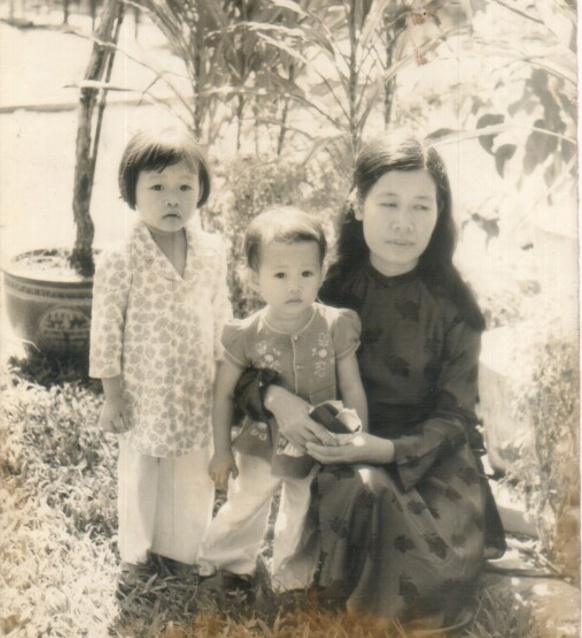
Before the boardrooms: Dallara with her mother and younger sister. Photograph courtesy of Medtronic.
Mathematics meets the customer
At the University of New South Wales in Sydney, Dallara earned a science degree in applied mathematics with first-class honours and a commerce degree in finance. She later completed an MBA at INSEAD in France. Mathematics, finance and management make an unusually coherent course of study for someone who would spend much of her career moving between technical products and commercial decisions. Each discipline supplies a different way to interrogate an attractive proposal.
She began her professional career as a consultant at McKinsey in Sydney. Her early employers also included Telstra and itv|world. At Microsoft, her remit took in strategy, mergers and acquisitions, integration and governance for the consumer software and services businesses. Those responsibilities put her around the machinery through which a large technology company enters markets and absorbs new capabilities. Integration is an unglamorous word for work that has to survive the excitement of announcing a deal.
TE Connectivity added a different set of operating problems. Dallara joined in 2007 and held roles including vice president and general manager of Energy Americas, and general manager of Managed Connectivity. She later became senior vice president for corporate strategy and analytics, overseeing strategic growth, business-unit performance management and big-data analytics. The progression matters: running a business and reviewing the performance of several businesses demand different distances from the detail.
Her career consequently resists a tidy division between the person with the strategy and the people charged with delivering it. She has occupied both sorts of role. There is commercial work in understanding what a customer will buy, analytical work in deciding where to invest, and operating work in making the promised service dependable. The companies changed. Those questions kept recurring, in different combinations.
- 2007TE Connectivity
General management, strategy & analytics - 2017Honeywell
Commercial excellence & strategy - 2018Honeywell Connected Enterprise
President & CEO - 2022Medtronic
Executive committee & operating leadership - 2026MiniMed
CEO & director at Nasdaq listing
A software job with a factory attached
Honeywell hired Dallara in January 2017 to lead commercial excellence and strategy, reporting to Darius Adamczyk. The company was pursuing a closer combination of its industrial knowledge and software capabilities. Her responsibilities extended across marketing, regional growth and new product opportunities. For a business with physical equipment and long-established customer relationships, software represented another way to put accumulated technical knowledge to work.
In October 2018, she became president and CEO of Honeywell Connected Enterprise. The assignment brought software innovation, analytics and connected operations together. It also gave her a particularly revealing customer problem. Industrial companies could produce enormous amounts of information while still struggling to see how the whole operation was performing. A collection of working systems could leave the person responsible for the business with a surprisingly incomplete view.
Honeywell launched Forge in June 2019 to help customers collect, analyse and act on operational information. It was intended for environments including buildings, airlines and industrial facilities. Dallara described disconnected systems and scattered data as obstacles to understanding performance. The proposition was practical: make existing information easier to use, so managers can decide where attention and investment belong. A screen earns its place when somebody can make a better decision after looking at it.
The work also brought a return connection to Microsoft. In October 2020, Honeywell announced a collaboration linking Forge with Microsoft's Dynamics 365 Field Service. An initial focus was building maintenance. Facility managers had to identify a problem, determine when to address it and assign the appropriate person. Those are wonderfully specific verbs for a software partnership. They describe the working day that all the architecture, data and integration are supposed to improve.
In public conversation, Dallara has traced her affection for technology back to the economics of that first business. “I really fell in love with technology,” she said. There is something refreshingly unsentimental about the reason: it helped her do more, more cheaply. Across a much larger organisation, the same standard remains a useful way to judge a demonstration. The software has to make somebody's actual work easier to perform.
The title changed. The questions stayed.
Dallara joined Medtronic's executive committee on May 2, 2022, reporting to chairman and CEO Geoff Martha. The appointment took her from Honeywell's software business into another large operating organisation. Her experience in developing and commercialising products was part of the rationale for hiring her. The move continued a career built across sectors, with technical development and business execution repeatedly meeting in the same job.
A year later, she was included on Fortune's list of future Fortune 500 CEOs. Public recognition can make a career appear more inevitable than it felt along the way. The dates tell a less polished story of accumulated responsibilities: consulting, strategy, general management, analytics, commercial leadership and then a succession of chief executive roles. There were several kinds of apprenticeship inside the career that followed the classroom business.
Her public advice has included developing mastery in something one does. That is an interesting emphasis for an executive whose résumé spans several industries. Breadth takes much of the visual space on the page; mastery suggests the depth required beneath it. Her own description of leadership includes establishing direction, making decisions and getting people organised to execute. She also stresses understanding the details, which makes the relationship between the plan and its execution central to the job.
In November 2023, Dallara joined the board of Lattice Semiconductor, alongside fellow appointee John Forsyth of Cirrus Logic. She was assigned to the compensation committee. Lattice cited her experience in general management and enterprise transformation across industries. The board role added another connection to the underlying technology economy, and another form of responsibility: helping oversee a company rather than managing its daily operations.
“Innovation doesn't happen without taking on some risk.”
Que Dallara / 2023
The next classroom has a ticker symbol
MiniMed began trading on Nasdaq on March 6, 2026, under the symbol MMED, with Dallara as CEO and a director. The listing marked a new stage for the business she had joined in 2022. The initial offering comprised 28 million shares at $20 each and closed on March 9. A public listing supplies a date for the photographs. Building the organisation that follows it takes rather longer.
That distinction matters here. MiniMed's move toward standalone operations involved continuing arrangements with Medtronic, including technology, manufacturing and support services. Medtronic still held approximately 89.86 percent of its outstanding common stock as of September 3, 2026. The business had its own listing while the ownership transition continued. Corporate independence has plumbing, and the plumbing rarely makes it into the opening-bell photograph.
By September 2026, Dallara was reporting MiniMed's first-quarter fiscal 2027 results: $843 million in net sales, with reported growth of 16.6 percent. The company also disclosed that an extra week in the reporting calendar contributed approximately four to six percentage points. Those details belong together. For a leader whose background includes finance, analytics and business-unit performance, the distinction between growth and the calendar's contribution is familiar territory.
Dallara is based in Los Angeles, a long way from the Australian house where her first customers came for lessons. The scale of her work has changed beyond recognition. Its basic obligations are easier to recognise: understand the people being served, know the economics, organise colleagues and deliver what was promised. At 16, those obligations came with classrooms and a payroll. Today they come with a board and a ticker symbol. The living room was a busy place to start.
Keep the conversation going
Explore Dallara's work and hear her tell the story.
Que Thanh Dallara on LinkedIn ↗MiniMed ↗Listen: the classroom business and the career that followed ↗Read & watch: Dallara in conversation with Salesforce ↗Watch: The Connected Call to Action keynote ↗MiniMed's Nasdaq listing announcement ↗