A carton of Chinese food is an unforgiving software test. The order has to reach the kitchen. The kitchen has to make it. Somebody has to deliver it. The customer, quite reasonably, expects dinner rather than an explanation of the architecture. Gautam Ghai has worked on both sides of that proposition: the digital system and the meal it was supposed to help deliver.
Today, the London-based co-founder and CEO of SourceFuse works on a different scale of coordination: helping enterprises build software, modernize older systems, and run their cloud operations. Yet his detour into food offers a useful way into his career. Across its different chapters, he returns to the awkward distance between something that sounds promising and something a customer can actually use.
There is a certain comedy in an enterprise technology founder also having to consider takeaway packaging. It makes the usual talk of seamless experiences rather more concrete. A customer opening a box has already reached a verdict. The presentation can wait.
A business plan with three cities in it
Ghai graduated in information technology from Shaheed Sukhdev College of Business Studies at the University of Delhi in 2003. Before founding SourceFuse, he worked at Ernst & Young. The move from consulting to entrepreneurship brought him into the orbit of Kelly Dyer, a technologist with ambitions to build an international business.
Mutual connections introduced them. Ghai was leaving Ernst & Young to start a technology company; Dyer was looking for a business partner. They worked on their plan during trips to New Delhi, London, and New York. SourceFuse was founded in 2006, with its beginnings in Charlotte and Delhi.
That geography matters. Their partnership crossed borders from the outset, well before Ghai would describe London as one of his homes. The business grew around helping other companies change their software. Its work required understanding what an existing organization needed to accomplish, then figuring out which technology could get it there.
- 2003Graduates in information technology, University of Delhi
- 2006Co-founds SourceFuse with Kelly Dyer
- 2022Joins MadeBrave’s board as SourceFuse expands in the UK
- 2026SourceFuse marks 20 years and introduces SourceFuse AI
The takeaway chapter
By 2015, Ghai had another business to explain: Happy Hakka, a Chinese-food venture co-founded with Arushi Vaish, Puneet Saini, and Chander Mohan. Its proposition was delivery-centered food with ordering available online, by telephone, or through an app. SourceFuse helped develop its delivery network.
The interesting part was how thoroughly the digital and physical pieces were joined. Orders connected to kitchens; delivery routes were optimized; the point-of-sale system was integrated. Meals arrived with accompaniments, cutlery, and tissues. The ambition reached all the way to the customer's desk.
Read alongside his software career, Happy Hakka looks like a practical exploration of the same problem: how many separate steps must work before a customer receives the promised result? Here the dependencies included a kitchen and a delivery route. The food made the consequences unusually easy to understand. Nobody needs a consultant to explain why the cutlery should be in the bag.
Explaining scale, microphone in hand
Ghai has also spent time talking founders through the problems that arrive when a product starts finding customers. At a startup gathering co-hosted by SourceFuse, AWS, and PubNub, he opened the session with a keynote about the Indian startup economy, internet adoption, and mobile growth.
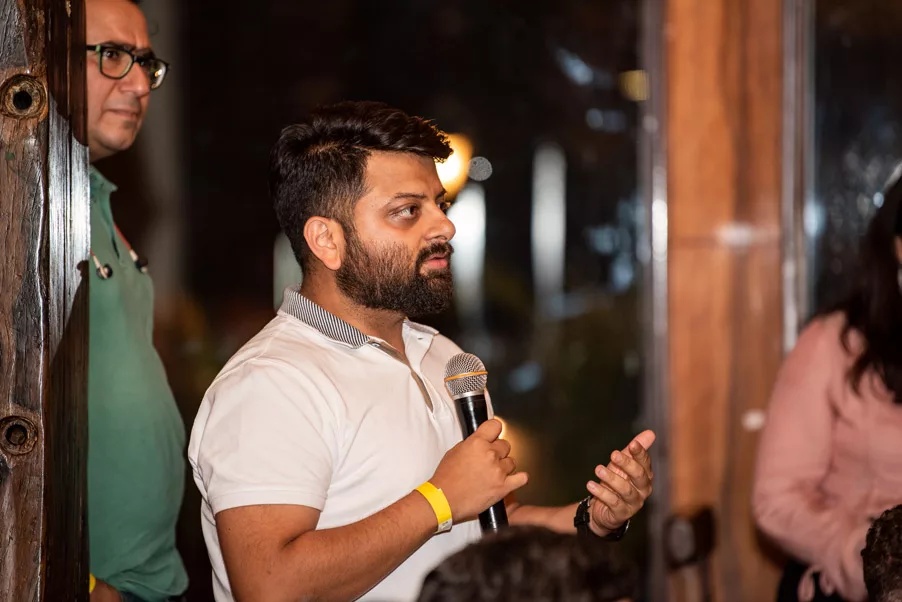
The conversation brought together people building companies and people providing the infrastructure behind them. Ghai pointed to Indian businesses including Zoho and Freshdesk as examples of software companies reaching international markets. There was a useful symmetry: a founder whose own company began across two countries discussing how others could build beyond their first market.
In that setting, scale had several meanings. There was the size of a market, the ability of an application to handle demand, and the question of how a young business should spend its attention. Put a collection of founders in a room and the cloud eventually has to come back down to earth.
London, with some help on arrival
SourceFuse's UK expansion acquired another dimension in May 2022, when Ghai was appointed to the board of MadeBrave, the creative agency founded by Andrew Dobbie. The appointment followed SourceFuse's invitation into the UK government's Global Entrepreneur Programme.
Ghai's stated ambition for the board role covered the agency's clients, team, and operations. It was a meeting of creative work and technical implementation: the things an agency could imagine and the systems that would support them. The connection also widened his professional world beyond the immediate business of cloud engineering.
Later, reflecting on the programme, he described leaving India to establish himself in a new country as “equal parts exciting and terrifying”. He credited experienced dealmakers, help establishing a UK headquarters, and access to investors, partners, and other founders. He specifically thanked Jude Ower and Anmol Nayyar.
That account gives the international expansion a human scale. A company can announce a new market in a sentence. The founder still has to move a life. Ghai's description of the programme emphasizes belonging as well as business support, and London appears in it as a home rather than simply another address on a corporate slide.
When the discussion turns to the rules
At the India Global Forum in London on June 26, 2024, Ghai took part in a dialogue on reforming governance with technology. The room included leaders from companies such as Infosys, Tech Mahindra, Wipro, and Mphasis. The agenda covered compliance, costs, digital tools, and the relationship between innovation and regulation.
His comments placed UK-India collaboration in AI and cloud computing at the center of the opportunity. The discussion also considered data protection and public trust. These are less photogenic subjects than a new product launch, but they determine whether technology can be used inside institutions with responsibilities beyond the next demonstration.
This strand fits his work with established businesses. Modernization involves rules, existing systems, and people who need tomorrow's operations to keep functioning. Progress has to survive contact with all three. The forum put those practical constraints into a wider conversation about government and international cooperation.
The AI bet comes with homework
By December 2023, Ghai was publicly describing generative AI as a strategic bet for SourceFuse. He paired the technology investment with workforce development and upskilling. His argument was that a company needed people equipped to work with the technology alongside the technology itself.
In April 2025, SourceFuse introduced ArcMod.ai, a tool intended to analyze older codebases, map their components and dependencies, and produce architecture documentation. Its place in the story is revealing: before changing a complicated system, someone has to understand what is already there. Discovery is an unglamorous word for a task that can decide the fate of the whole project.
The product gave the AI strategy a specific job. It addressed the preliminary investigation that modernization requires, rather than treating AI as a subject suitable only for a keynote. Ghai's comments on the launch focused on giving technology leaders a clearer understanding of their systems so they could make decisions.
His January 2025 Talking Out Cloud conversation with AWS's Chris Casey and SourceFuse's Kamal Singh Bhasin added another piece. In his published takeaways, Ghai emphasized customer fit, specialization, certifications, and returns on investment. He also highlighted access to global talent and the effects of generative AI on developer workflows. The partnership discussion stayed tied to the work a customer needed done.
Twenty years, and a demand for proof
On May 4, 2026, SourceFuse marked twenty years of operations and announced SourceFuse AI. The company described AI as running through consulting, architecture, engineering, and operations. Ghai used the anniversary to return to the importance of asking questions before writing code.
The anniversary followed a more specific milestone in July 2024, when SourceFuse became an AWS Premier Tier Services Partner. At that announcement, the company reported more than 150 AWS certifications, five competencies, and seven service delivery programmes. Those were company credentials, earned across a workforce, rather than personal awards for its CEO. They make the team visible in a story that might otherwise be reduced to its founders. Ghai leads alongside colleagues responsible for operations, finance, people, and engineering, with Dyer now listed as executive chairman.
The next month brought AWS Managed Service Provider validation, announced on June 2. The assessment involved an independent audit of the company's managed-services capabilities. For a business that helps build and modernize systems, operating them is a continuing obligation: performance after delivery remains part of the customer relationship.
“I did not want a badge. I wanted proof.”
Gautam Ghai, on AWS MSP validation
That was how Ghai described the ambition to his team. The language is blunt for an industry capable of turning a certification announcement into a small opera. It also supplies a useful test for the AI chapter: the claims have to show up in the daily work of running customer environments.
His public priorities extend to who gets the skills to do that work. Discussing SourceFuse's Harmony initiative, he praised practical cloud training and mentorship for young people, particularly women and students from underserved backgrounds. The programme involved ITI Mayur Vihar and GlobalHunt Foundation. His emphasis was access to tools, experience, and employment opportunities.
There is a consistent question beneath these different ventures and commitments. What has to happen between an intention and its useful result? For Ghai, the answer has included a co-founder, international connections, software teams, creative partners, cloud training, and, once, a kitchen. His career becomes more interesting when those connections remain visible. The work happens in the joins. The customer gets to judge what arrives.