Dani Golan had model airplanes behind his desk. During a 2016 video conversation, Michael Krigsman noticed them, along with a large aircraft photograph, and asked the obvious question. Golan had flown in the Israeli Air Force. The little planes were a reminder of an earlier working life, before the meetings concerned databases rather than flight plans.
Asked what flying had taught him about leadership, Golan began with the unit. A pilot belongs to a team. He carried that lesson into Kaminario, the storage company he cofounded and led. Technology would change. Business conditions would change. His confidence rested on the people who would have to respond. The aircraft models made a good conversation starter; the answer was about everyone else in the room.
That distinction matters when looking at Golan’s career. The fighter-pilot detail is memorable enough to swallow a biography whole. Yet his subsequent work has involved a rather different discipline: deciding which parts of a business deserve to survive its next change. A company can retain its people and technical knowledge while giving up the product category that once explained it to the world.
Today he is founder and CEO of Silk, a company selling a software layer for demanding cloud workloads. Its ancestry runs through memory appliances, flash storage and a decision to leave hardware manufacturing to a partner. In September 2026, it announced a $45 million growth capital facility aimed at its next market: the data infrastructure beneath AI applications. There have been several changes of course. The models on the desk seem appropriate.
An engineer develops an interest in people
Golan’s education supplied two different ways of looking at an enterprise. At the Technion, he earned a bachelor’s degree in electrical engineering, graduating summa cum laude. At Northwestern’s Kellogg School of Management, he earned an MBA. One qualification concerned how systems work; the other opened a wider set of questions about the organizations that buy, build and sell them.
Intel was an early employer. He arranged a move to the United States while pursuing business studies, taking his wife and child with him. Explaining the attraction of management, he said, “The most fascinating thing in life is people.” For someone trained to handle technical complexity, human complexity offered another field of study. It also offered considerably fewer neat answers at the back of the textbook.
His career subsequently took him through EMC, where he worked on new ventures, and Performix Technologies, where he served as president and general manager. NICE Systems acquired Performix in 2006. These were useful vantage points for a future founder: enterprise technology from inside a large supplier, then the operational responsibilities of a smaller business. Before starting a storage company, he had already worked on both technology and the machinery of selling it.
The sequence helps explain the combination visible in his later interviews. Golan will discuss architecture, then move readily to distribution, pricing and customers. Engineering credentials alone would not have required him to care about inventory costs. Management experience gave him reasons to ask who should hold the inventory in the first place.
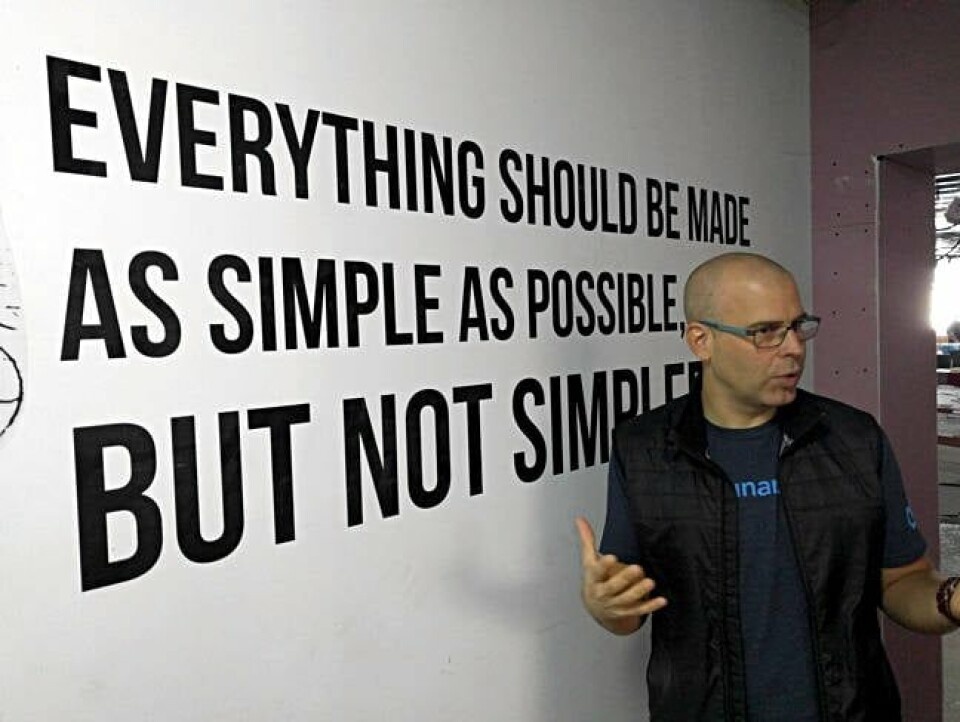
The first idea did not get the last word
Kaminario began in 2008, with Golan, Moshe Selfin and Ofir Dubovi among its cofounders. Its initial proposition was a memory appliance. In a 2016 interview, Golan explained that the team took roughly two years to recognize the limitations of that market: it was small, expensive and likely to mature slowly. The company turned to all-flash storage at the beginning of 2011.
This was a consequential distinction inside a business that most people would simply call storage. A working technology still needs a market large enough to support the company built around it. Golan’s account makes the early turn sound less like a revelation than a revised assessment. The invention was one thing. How many customers would buy it, and when, was another.
By 2017, he was describing cloud and software-as-a-service businesses as a focus for Kaminario, while discussing NVMe as a coming change in flash technology. The customer’s direction of travel was becoming part of the product discussion. Selling faster equipment would only take the business so far if customers were reorganizing where their applications lived.
There is a useful tension here. Enterprise buyers want suppliers to endure. They also need those suppliers to keep changing. A founder has to offer enough continuity to be trusted and enough flexibility to remain relevant. Golan’s early pivot established a pattern that would become more visible when the company reconsidered the box itself.
- 2008Kaminario begins with memory appliances
- 2011The move to all-flash storage
- 2018Tech Data partnership; software focus
- 2020Cloud software and the Silk name
- 2026Capital for the AI data layer
Let somebody else build the box
In January 2018, Kaminario announced a software-centered business model and a partnership with Tech Data. The distributor would take on supply-chain, integration and product-support services for the company’s storage systems. Kaminario would concentrate more of its resources on software. Customers could still receive an integrated appliance; the responsibilities behind that appliance were being rearranged.
Golan’s explanation was practical. Giving up inventory holding costs would simplify operations. Tech Data brought purchasing power, logistics and reach that Kaminario could not readily reproduce. A storage company’s ambition had collided with the ordinary business of moving physical objects around the world. Even an elegant technical idea can spend an undignified amount of time waiting for a shipment.
The change also challenged the company’s public identity. Kaminario had sold arrays, but the software inside them was the asset it wanted to carry forward. By April 2020, its storage software had been adapted for AWS, Microsoft Azure and Google Cloud. Golan was talking about a subscription business and a different competitive arena. The useful work could travel beyond a proprietary appliance.
In July 2020, customers received a new name: Silk. The announcement explained that the legal entity would continue under a changed name, with the existing customer commitment carried forward. The choice was meant to suggest strength and flexibility. After years in an industry fond of metal boxes and technical abbreviations, a piece of fabric was a reasonably economical reintroduction.
“The most fascinating thing in life is people.”
Dani Golan, 2016
A business built between other businesses
Silk’s proposition places Golan in an unusual commercial position. He is selling something that sits between a customer’s database and a cloud provider’s infrastructure. The business depends on making those existing investments work better together. It requires convincing an enterprise that another software layer can reduce the friction already created by the layers underneath.
In July 2021, Silk announced $55 million in financing led by S Capital, with participation from investors including Sequoia, Pitango, Globespan, Ibex and Vintage. The company named eToro and Payoneer among its customers. Its stated use for the capital included engineering development and sales and marketing. This was money for building the product and for explaining why a database needed it.
The operating results supplied more concrete markers. Silk reported annual recurring revenue growth above 50 percent for fiscal 2022, followed by 70 percent for fiscal 2023. The latter announcement described customers including investment-software provider SimCorp, retailer Frasers Group and Wayfair. These are company-reported growth rates, measuring particular years rather than promising a permanent trajectory.
Those customer examples put some texture on an otherwise abstract pitch. A retailer cares about the online experience. An investment-software company must run demanding applications for clients. Wayfair’s example concerned leaving its data center while continuing to run business-critical applications. Golan’s product lives in the technical detail; the reason to buy it lives in the customer’s working day.
The next queue is forming under AI
By fiscal 2024, the company’s account of its growth was increasingly about AI. It reported 48 percent year-over-year growth and described Silk Echo, a capability for making a dynamic digital twin of production data available to other workflows. The premise is straightforward: a new application needs access to useful information without obstructing the systems already doing the daily work.
That makes the current AI discussion a continuation of Golan’s earlier work on access and performance. More processing capacity does not remove every delay. Information has to arrive where it is needed. The commercial question is whether Silk can make that movement reliable and economical enough for companies to put more demanding applications into production.
The leadership team has changed with the assignment. In August 2025, Silk appointed Ed Filippine president, responsible for go-to-market functions, customer success and global expansion. In a later public welcome to business-development chief Aaron Shoffa, Golan emphasized the move from AI demonstrations to continuously operating inference systems and the partnerships needed to support them. His language returned to people chosen for a particular next stage.
Then came the September 23, 2026 financing announcement. Avenue Capital Group led the $45 million growth capital facility, with support from new and existing investors. Silk said the proceeds would fund engineering and expansion among cloud providers, alongside its enterprise presence on AWS, Azure and Google Cloud. Golan summarized the frustration he wanted to address: “Organizations are spending enormous sums on compute only to wait on the data layer beneath it.”
A growth capital facility for engineering and cloud-provider expansion. Led by Avenue Capital Group.
There is still a bicycle
Away from the product descriptions, a few details interrupt the executive biography. His investor S Capital describes a husband and father of four who makes time for yoga and mountain-bike marathons. The activity suits someone whose work has repeatedly required a revised route, though a bicycle is entitled to be a bicycle without becoming a management lesson.
His public conversations offer a more useful clue than any hobby could. The recurring subjects are teams, customer needs and adaptation. Read across the changes from memory to flash, from appliances to software, and from cloud migration to AI access, and a consistent question emerges: what should the company keep doing when the environment around it moves?
There is no final answer in the latest financing. Capital provides room to work; customers decide whether the work is useful. Golan is still occupied with a familiar problem in a new setting: getting information to the place where something depends on it. The aircraft models can remain on the desk. The business has another route to fly.
Further reading & conversations
- Silk · company website ↗
- Dani Golan · LinkedIn ↗
- Dani Golan · X (legacy Kaminario account) ↗
- Watch: Who Is Kaminario? · YouTube, 2015 ↗
- Watch: Leadership Lessons from a Fighter Pilot · CXOTalk, 2016 ↗
- The 2016 career profile · The Register ↗
- Silk’s September 2026 financing announcement ↗
- Silk · company blog ↗