The annual budget at Encore Electric had become an exercise in endurance. Excel files, broken formulas, and delayed approvals consumed nearly 2,000 hours each cycle, according to its published customer account. The electrical contractor put Prophix to work automating the budget and standardizing the process. The reported saving: more than 1,800 hours. That is a lot of time to spend discovering that the spreadsheet has become the job.
For Prophix, this is familiar territory. The Canadian software company sells tools to the people who must turn departmental guesses, payroll plans, and accounting records into a defensible picture of the business. Its opportunity lives in the gap between having financial data and being able to use it before the next meeting.
Today, the company reports more than 3,000 customers across over 100 countries. Its Prophix One platform covers planning, forecasting, reporting, consolidation, and reconciliation. The ambition has grown from helping finance prepare the numbers to helping it manage the whole journey from plan to close. Artificial intelligence is the latest addition to that pitch.
The spreadsheet was carrying too much
What failed first at Encore was the working process: formulas broke, approvals stalled, and assembling a budget took too much effort. The response was concrete. Standardized templates made contributions more consistent. Automated workflows moved the work through its steps. Centralized reporting gave stakeholders a shared view of budgets and actual results.
Another customer illustrates the problem at a smaller scale. SoundOff Signal had 20 cost-center managers returning Excel workbooks to accounting, which then combined them into a master file. Its finance team wanted a workflow that would do that collection work for them. The appeal is easy to understand for anyone who has ever opened three attachments to establish which one counts.
Prophix’s customers extend well beyond conventional corporate offices. The Miami HEAT uses the software for financial planning in a live-events business. Jamul Casino uses it for budgeting, personnel planning, reporting, and analysis. Their businesses differ, but both need to connect operating assumptions with the money those assumptions imply. A budget has to survive contact with the people running the operation.
A place between the ledger and the boardroom
Prophix occupies the financial performance management market, also commonly discussed as corporate or enterprise performance management. Think of it as the layer that helps finance organize actual results, build plans, and explain differences. It connects with operational systems rather than asking a company to start its accounting life over.
The product range follows that responsibility. FP&A tools handle budgets, rolling forecasts, scenarios, and workforce plans. Consolidation brings multiple entities together, including currency translation and intercompany eliminations. Reconciliation helps teams work through account balances. Reporting turns the resulting information into material managers and boards can examine. Lease accounting and disclosure management extend the range of finance work covered.
That breadth is useful when the business has outgrown a single tidy model. A group operating across currencies must reconcile its view of the whole with the books of its parts. A project business needs to understand both company performance and the individual jobs behind it. Prophix’s expertise sits in making those relationships manageable for finance.
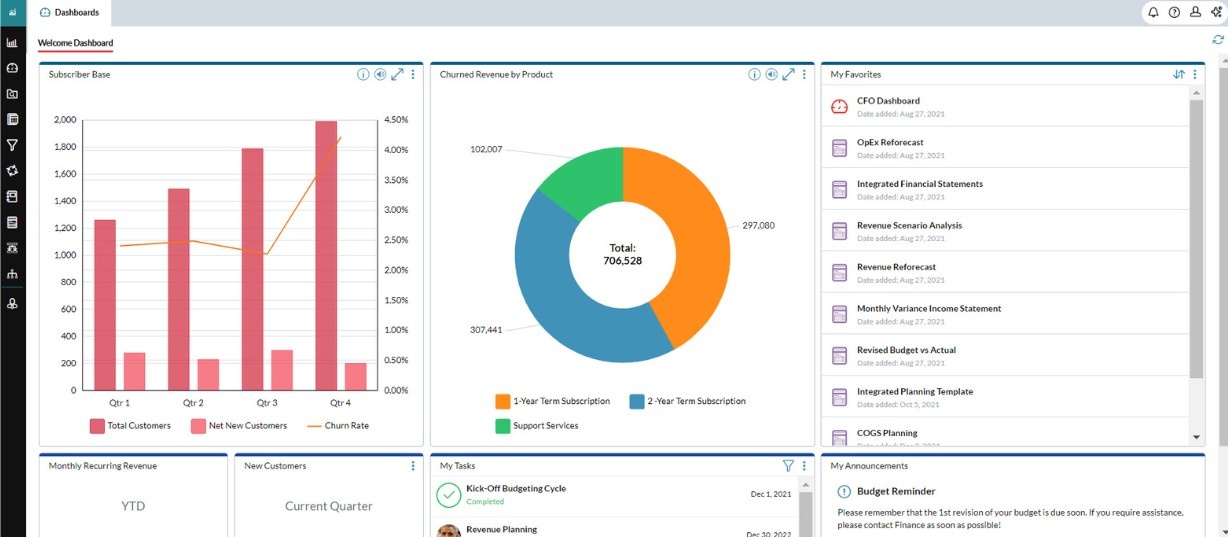
Its partner network describes connections to more than 120 systems, including Microsoft Dynamics 365, Sage, Acumatica, Deltek, and SYSPRO. Connectivity matters because the planning tool must meet the records where they already live. The work still includes deciding which fields, entities, and definitions belong together. A connector can transport a number; the business must agree what it means.
The pandemic changed the independence calculation
Prophix began in 1987 as a software distributor. Implementing financial applications exposed an opportunity to create a planning and reporting system of its own. Founder Paul Barber led the company for more than three decades before handing the CEO role to Alok Ajmera in 2020.
Its long preference for independence met a practical limit during the pandemic. The Globe and Mail reported that new bookings in the second quarter of 2020 fell to half the previous year’s level. Barber and Ajmera had earlier resisted outside investors, concerned about short-term demands and the company’s culture.
“It woke us up to the limitations of being bootstrapped.”
Paul Barber, speaking to The Globe and Mail in January 2021
In January 2021, Hg announced a majority investment, with management and employees participating alongside it. The stated priorities included product development, sales and marketing, the cloud transition, and international expansion. Contemporary reporting put the transaction’s valuation at US$500 million to US$600 million. That is a historical deal valuation, not money raised or a present-day price tag.
The cultural detail remains worth watching. Prophix calls its employees Phixers. Its careers materials describe paid volunteering, donation matching, and a $50,000 donation to an employee-selected charity for each quarter that meets revenue goals. Those are specific practices behind a subject the founders had treated as a reason to resist outside ownership.
Buying its way further into the close
The next substantial step came in October 2021, when Prophix acquired Brussels-based Sigma Conso from Fortino Capital. The attraction was financial consolidation expertise, along with a stronger presence in Europe and Asia. Prophix subsequently said the acquisition brought more than 600 customers in over 20 countries into its community.
That purchase helps explain the company’s present shape. Budgeting looks forward; closing the books establishes what happened. Prophix wanted to cover more of both. Its later account of the integration describes centralized access to multiple applications and the incorporation of Sigma Conso’s consolidation technology into the broader platform.
This is also where its competitive proposition becomes more specific. BARC’s planning research places Prophix among products used in midsize or departmental implementations. Alternatives across the broader market include Planful, Vena, Workday Adaptive Planning, Oracle Cloud EPM, and OneStream. Prophix’s case rests on the combination of finance-oriented administration, planning, and consolidation. Buyers still have to test that combination against their own complexity.
- 01Connect
actuals - 02Build
plans - 03Reconcile
& consolidate - 04Report
& review
A real bill, with a date attached
The business model is enterprise software subscriptions, supported by implementation, consulting, and training. Since November 2025, Prophix One has also been available in AWS Marketplace, giving AWS customers another route to purchase and manage it. The buying channel changes; the need to scope the project remains.
A Nucleus Research study of Lochmueller Group, dated August 2018, offers a useful cost example. It records an initial investment of $92,036, a 95 percent ROI, and a 1.4-year payback. Costs included software subscriptions, consulting, employee implementation and training time, and miscellaneous expenses. Cloud deployment avoided hardware costs. These figures describe that project in that period; they are not a current Prophix quote.
Subscription + consulting + implementation time + training + incidental expenses
Mission Health Communities provides a different measure of the return. Its published Prophix story reports a 15 percent faster monthly close, more than $200,000 saved in personnel costs, and 110 percent ROI over 18 months. The care provider operates across more than 40 U.S. locations. Those outcomes belong to that deployment, rather than forming a promise for every buyer.
The practical lesson is to count the whole effort. A subscription sits beside the hours required to prepare data, build the model, train people, and establish a working routine. Savings should be measured against the process that actually existed. Otherwise, the business case risks becoming another impressive spreadsheet whose assumptions nobody wants to discuss.
AI now has to show its work
Prophix announced its One Intelligence engine in April 2025 and an initial suite of agents that September. Its April 2026 release added Copilot for Microsoft Teams, bringing role-based FP&A answers into a familiar workplace application, and Architect Agent, designed to turn customer data and reports into models ready for validation.
The same announcement described a Consolidation Agent, then scheduled for spring, that would query audit-trail report data in natural language. Its stated boundary was revealing: answer when the report supports a confident response and identify capability limits. That is a more useful test for finance AI than how conversational the answer sounds.
The expansion also runs through partnerships. In May 2026, Prophix and Taxvibes announced work connecting consolidated financial data with tax calculations and reporting. The goal is to reduce the exports, re-entry, and reconciliation between finance and tax. It follows the same commercial logic as consolidation: once the numbers are organized, there are more adjacent jobs to tackle.
Start with the bottleneck you can name
The customer stories suggest a practical starting point: pick a recurring process with observable waste. Encore had its budget cycle. SYSPRO identified budgeting and cost-center reporting as early objectives; its published case describes an implementation taking six to eight weeks. That sequence gives a project something concrete to deliver before expanding its ambitions.
The inference for a prospective buyer is straightforward. Establish who owns the inputs, agree the calculation rules, and measure the starting workload. Ask a demonstration to reproduce a troublesome reconciliation or a real forecast change. A polished dashboard tells less than watching the software handle an awkward detail from your own business.
The same reasoning sets limits. A small organization with straightforward accounts may have little complexity to repay the implementation effort. A business with disputed definitions or nobody available to own the model has preparatory work to do. These are conditions to assess, not defects that another feature automatically resolves.
Prophix has built its proposition around finance’s least glamorous obligations: collecting, checking, combining, and explaining. Its AI ambitions will be judged against those obligations too. For the customer, the satisfying result is wonderfully ordinary: the numbers arrive, they agree, and there is still time left to decide what to do.