The reason to consider Vena is not that your finance team loves spreadsheets. It is that the rest of the company already understands them. Budget owners know where to type, analysts know how to model, and executives recognize the output. Replacing that shared language can turn a software rollout into a long, expensive vocabulary lesson. Vena takes the opposite route: keep native Excel in front, then place centralized data, permissions, workflows and audit trails behind it.
That makes Vena useful for a Microsoft-first organization whose spreadsheet estate has outgrown email attachments but whose people have not outgrown the grid. Think of a finance group coordinating forecasts across departments, reconciling several entities, pulling actuals from an ERP and rebuilding the same management pack every month. A two-person startup with one tidy model may be buying more machinery than it needs. A sprawling organization already committed to a different planning interface may prefer a clean break.
The spreadsheet survives its intervention
Vena began in Toronto in 2011, founded by George Papayiannis, Don Mal and Rishi Grover. The name means “vein” in Latin, chosen to suggest data flowing through a connected business. Its original proposition still defines the product: Excel does the visible work while Vena supplies the controlled system beneath it. The company shifted the product into cloud SaaS in 2014, appointed former HubSpot sales chief Hunter Madeley as CEO in 2019, and raised a $300 million Series C led by Vista Equity Partners in 2021.
In practice, analysts create or adapt Excel templates, connect them to Vena's multidimensional CubeFLEX data model, and publish them into a governed process. Contributors can enter assumptions, attach commentary and submit work for review. Finance gets rollovers, notifications, approvals, version control and a record of who changed what. Reports refresh from the same underlying data instead of breeding slightly different cousins across shared drives.
What earns a seat in the monthly close
The platform covers annual budgets, rolling forecasts, scenario analysis, workforce and revenue planning, management reporting, account reconciliation and close. Vena Insights embeds Power BI for interactive dashboards, DAX calculations, anomaly detection and predictive analysis. A PowerPoint connection can refresh charts, tables and reports with current Vena data. Integrations reach common ERPs, CRMs, warehouses and file stores, while an API supports custom imports.
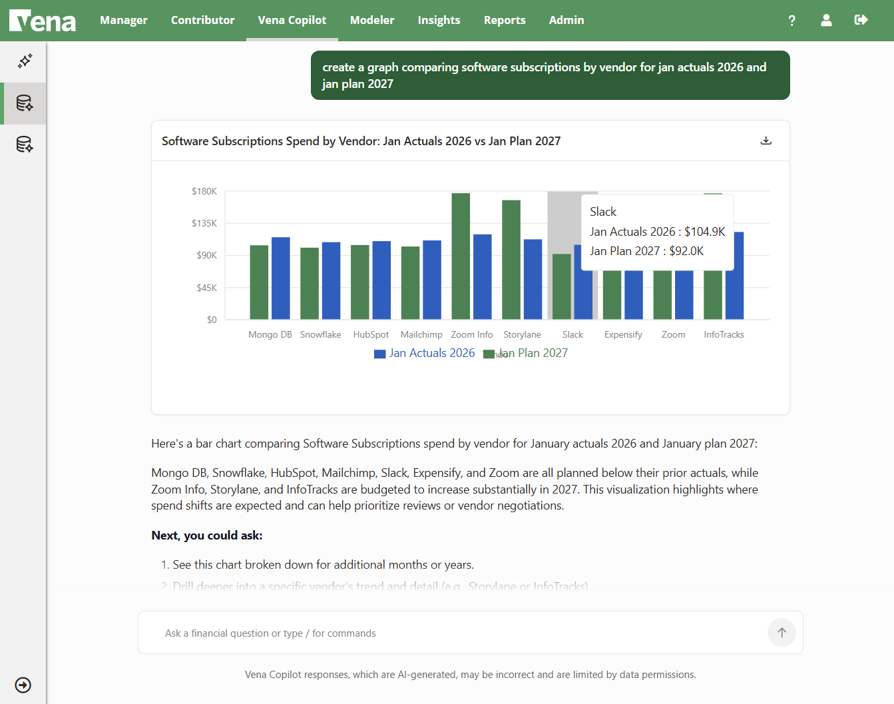
Vena Copilot adds natural-language analysis and finance-oriented agents. It can answer questions against governed organizational data, produce reports and operate inside Microsoft Teams. The 2026 roadmap widened again. Vena acquired Acterys in March, adding a Power BI-native planning and write-back platform, then acquired Morpheo AI in August. Morpheo's technology feeds Vena Omega, an announced context engine designed to remember a company's definitions, calculations, assumptions, approvals and previous decisions rather than treating each prompt as a first meeting.
The real feature is institutional memory with cell references.Our read on Vena's practical appeal
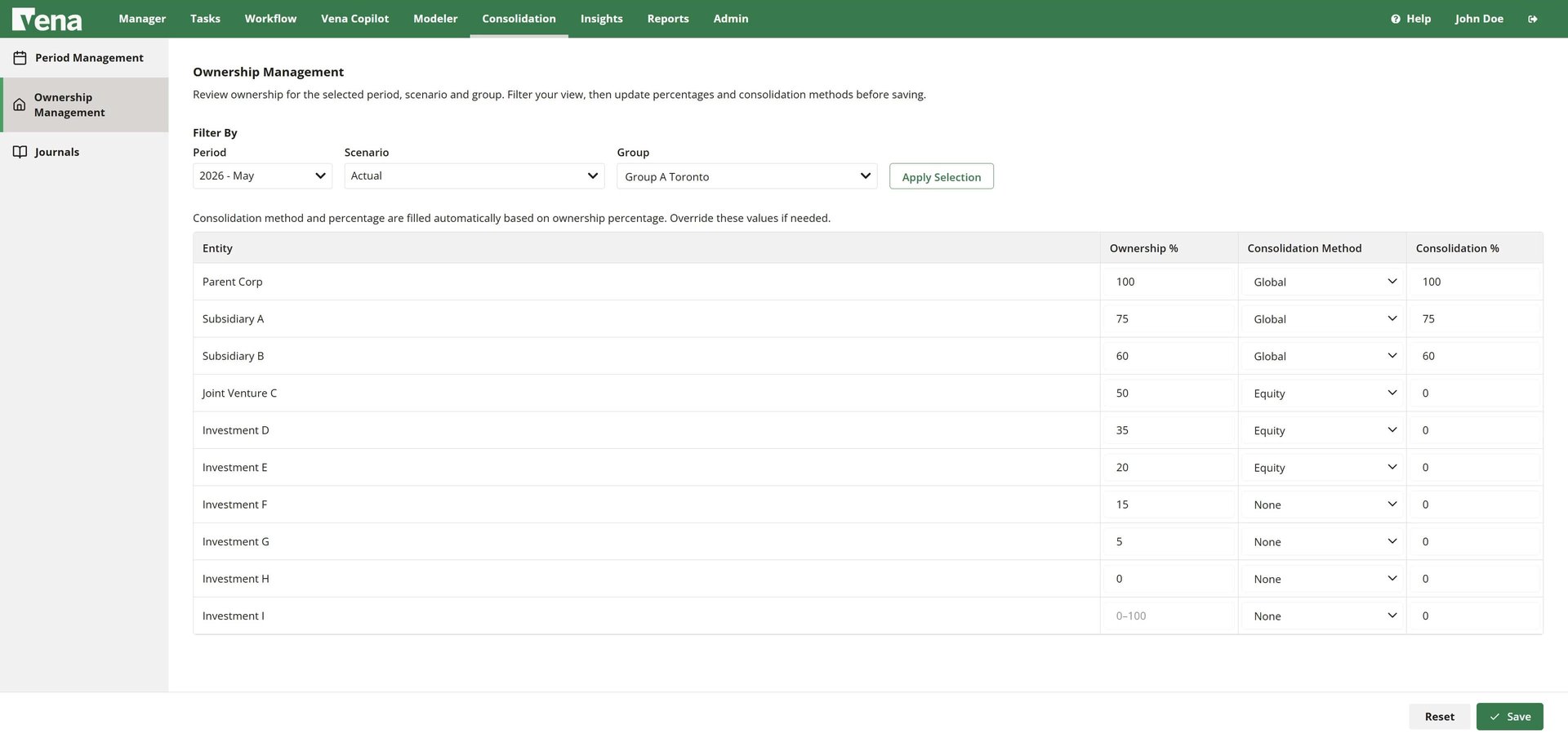
The newest standalone product, Vena Financial Consolidation, became generally available in August 2026. It handles intercompany matching and eliminations, foreign exchange translation, ownership structures and consolidated reporting. Vena says OEG uses the system across more than 90 entities and 19 currencies. That is a more revealing proof point than a polished demo: complexity is where a central model and governed close can actually pay rent.
| Capability | What Vena changes | Question to bring to the demo |
|---|---|---|
| Budgeting | One model, routed inputs, approvals and live actuals | Can our real templates be reused without awkward compromises? |
| Reporting | Refreshable Excel, Power BI and PowerPoint outputs | How fast do our largest reports load and drill through? |
| Consolidation | Rules for entities, ownership, eliminations and FX | Which close requirements are configured versus customized? |
| AI | Agents grounded in governed finance data and permissions | Can every answer be traced to its source and logic? |
| Administration | Finance-owned models, roles, workflows and sandboxing | Who on our team will maintain this after launch? |
The demo is the easy part
The consistent warning in public reviews is implementation. Vena is flexible because it can reflect a company's existing logic; that same flexibility means a weak model can become an elaborately governed weak model. G2's review summary praises the Excel integration and interface while noting that setup can be complex and time-consuming. In FP&A discussions on Reddit, users split sharply. Some credit Vena with ending version-control headaches at a comparatively reasonable cost. Others describe slow models, brittle integrations or builds that became difficult to change.
These accounts are not a verdict on every deployment. They are a prompt to scrutinize the partner, scope and owner. Bring a difficult model to the proof of concept, not the clean sample file from sales. Test the heaviest data load. Ask the proposed implementation lead to explain dimensions, integration failure handling and change control. Price the requests you expect six months after launch. Before signing, name the employee who will understand the design when the consultants leave.
Strong fit
- Excel is already the finance standard.
- Many budget owners contribute to a shared plan.
- Version control and auditability are real problems.
- The team can assign a capable model owner.
Pause first
- Your planning process is still simple and small.
- Nobody can administer the model after go-live.
- You want public, self-serve pricing.
- Your team is actively trying to leave Excel behind.
Choose the argument you want to have
Vena sits in a busy category, but the alternatives make different bets. Workday Adaptive Planning and Anaplan offer mature planning environments that can move teams toward purpose-built interfaces. OneStream and Oracle Cloud EPM reach deeply into enterprise consolidation and performance management. Planful and Prophix cover broad finance processes, while Cube and Datarails also court spreadsheet-centered teams. Pigment emphasizes collaborative, browser-based modeling and presentation. Product names alone will not settle this contest. The useful comparison is how each system handles your actual model, contributors, source data and reporting calendar.
Build a short trial around one awkward process. Give vendors the same source extracts, the same departmental input sheet and the same executive output. Time a refresh, change a dimension, add a cost center, trace one number back to the ledger and repair a deliberately broken integration. Then ask a budget owner, not only an analyst, to complete a task. Vena should win when Excel familiarity removes adoption friction without sacrificing control. A rival should win if its native interface makes the process clearer, its administration requires less specialist attention, or its consolidation depth better matches the job. Software selection gets calmer when the test is a Tuesday, not a theatre production.
Pricing without the price
Vena publishes two packages but no dollar amounts. Professional includes the core platform, a customer success manager, standard support, the customer portal and Vena Copilot. Complete adds Vena Insights, premium support, a sandbox and Expert Managed Services, among other capabilities. Nonprofits and Microsoft Dynamics 365 Business Central users may qualify for discounts. Every deal requires a quote.
Treat the license as one line in a wider cost model. Add implementation, integration work, training, partner help, internal administration and future changes. Clarify which users need paid access, what support response times actually mean, how the sandbox is priced, and whether Copilot usage has limits. Ask for a three-year total, renewal caps and a written statement of what counts as out-of-scope work. A cheap first year can become a costly spreadsheet if nobody prices the human maintenance around it.

Results worth interrogating
Vena's case studies supply useful scale, with the usual vendor-story caveat. The Kansas City Chiefs report cutting four-hour gameday settlement work to 15 minutes, a 95 percent reduction, after consolidating planning and reporting. Capstone Infrastructure says its monthly close fell from ten business days to five. Footwear retailer Schuh reports halving its budgeting cycle. Those outcomes share a pattern: the benefit came from standardizing inputs and automating the journey around the workbook, not from a miraculous new formula.
Market signals are solid but should remain in perspective. Vena announced $100 million in annual recurring revenue in 2024 and its 2,000th customer in 2025. At research time, G2 showed a 4.5 out of 5 rating across 375 reviews. Gartner placed Vena as a Niche Player in its 2026 financial close and consolidation assessment, while Nucleus Research placed it in the Leader quadrant of its 2026 CPM matrix. Awards tell you the company is established. They do not tell you whether your chart of accounts will behave on Tuesday morning.
The YesPress verdict
Vena is a sensible answer to an unfashionable truth: finance does not need another campaign to eradicate Excel. It needs control, shared data and repeatable processes around the work people already know. For a Microsoft-centered organization with multiple contributors and a credible internal owner, that compromise can shorten cycles without detonating adoption.
Buy the implementation, not the presentation. If Vena can run your ugliest model, refresh it at full scale and leave your team able to change it, the platform deserves the shortlist. If the plan depends on permanent consultants or a pristine demo dataset, keep looking.