Consider a question that sounds almost insultingly simple: how much cash do we have? At Sourcegraph, the code-search company, the answer once required a journey through disconnected systems and an outsourced accounting operation. The figures existed. Getting them into a useful conversation was the problem. A finance team can possess all the ingredients for an answer and still spend its afternoon looking for the bowl.
- Mosaic connected business systems to automate finance reporting and planning.
- Its buyers were growing companies whose questions had outgrown manual workflows.
- HiBob acquired it in 2025; the offering is now Bob Finance.
Mosaic.tech built its business around that interval between knowing something happened and understanding what to do about it. The proposition was practical: bring operational and financial data together, make the calculations repeatable, and let finance spend more time advising the business. The interesting part is what happened next. A company built for the finance office found a new home in HR software.
01 / The people who knew the delay
Mosaic was founded in April 2019 by Bijan Moallemi, Joe Garafalo, and Brian Campbell. The three had worked together at Palantir. Their expertise came from running finance operations inside technology businesses, where growth makes yesterday’s reporting arrangements feel suddenly inadequate. Moallemi became CEO, Garafalo COO, and Campbell chief product officer.
The founding premise was that finance leaders needed better access to business data, rather than another request to be more strategic. It is an appealingly unsentimental diagnosis. You cannot advise on next quarter’s hiring while spending the morning reconciling last quarter’s exports. The job description may promise foresight; the workflow keeps assigning archaeology.

02 / The handoff fails before the arithmetic
Sourcegraph’s experience gives the idea a concrete shape. Its revenue, expense, and headcount information lived in separate systems. The finance team needed timely answers about spending and cash while the company grew. Mosaic’s published case study says integrating the platform reduced ERP data retrieval from three days to minutes, with Xero and Salesforce information accessible together.
“We had a system in place, but that system would not scale with our ambitions.”Tommy O Donnell, Manager FP&A, Sourcegraph
The case study also reports a one-minute cash-position snapshot and five-minute expense drilldown. Those are customer-story results, not a stopwatch guarantee for every buyer. Their significance is the removed handoff: questions no longer had to travel through the accounting provider before finance could investigate them. What failed first was the route to the answer.
03 / The argument underneath the chart
Mosaic combined analytics with financial modeling, budgeting, and forecasting. Historical customer lists included Pipe, Fivetran, Drata, Kandji, and Sourcegraph. These are businesses where finance must connect revenue expectations, operating costs, and hiring plans. The product’s natural audience was the finance team at a growing company, with department leaders contributing to the plan.
Metric Builder, introduced in 2023, addressed a subtler nuisance: standard metrics do not necessarily fit a particular business. A reusable custom calculation lets a team carry its own definitions into different reports. Today’s Bob Finance documentation describes visual metric creation, custom formulas, and combinations of financial and operational data.
This is useful because a chart can conceal a disagreement. If two teams calculate the same supposed metric differently, a prettier dashboard merely dresses the quarrel for dinner. The value lies in agreeing on the definition, then making it repeatable. That is an organizational task as much as a software feature.
The product also developed an AI layer called Arc. Its historical page described conversational requests for insights and executive-ready narratives, alongside features marked as forthcoming. The distinction matters when evaluating software: a demonstrated capability and a roadmap entry deserve different places in a purchasing decision.
04 / Capital bought a bigger product agenda
The company announced an $18.5 million Series A led by General Catalyst in January 2021. A $25 million Series B led by Founders Fund followed in 2022; Mosaic’s announcement linked that expansion to plans including a Topline Planner for revenue modeling. In June 2023, OMERS Ventures led a $26 million Series C.
These figures describe investment raised, rather than the cost of developing a particular feature. For customers, the commercial proposition was cloud finance software sold to businesses. Its current home uses a demo-led sales process. A sensible evaluation therefore asks for a quotation and a demonstration using the buyer’s actual systems, definitions, and planning requirements.
05 / When the hiring plan joins the forecast
HiBob announced the acquisition in February 2025, with a stated aim of connecting workforce strategy and financial outcomes. It promised continued support for Mosaic’s existing customers during the transition. Bob Finance launched in November 2025. Mosaic’s website now redirects to HiBob’s finance offering, and its LinkedIn page explicitly identifies the change.
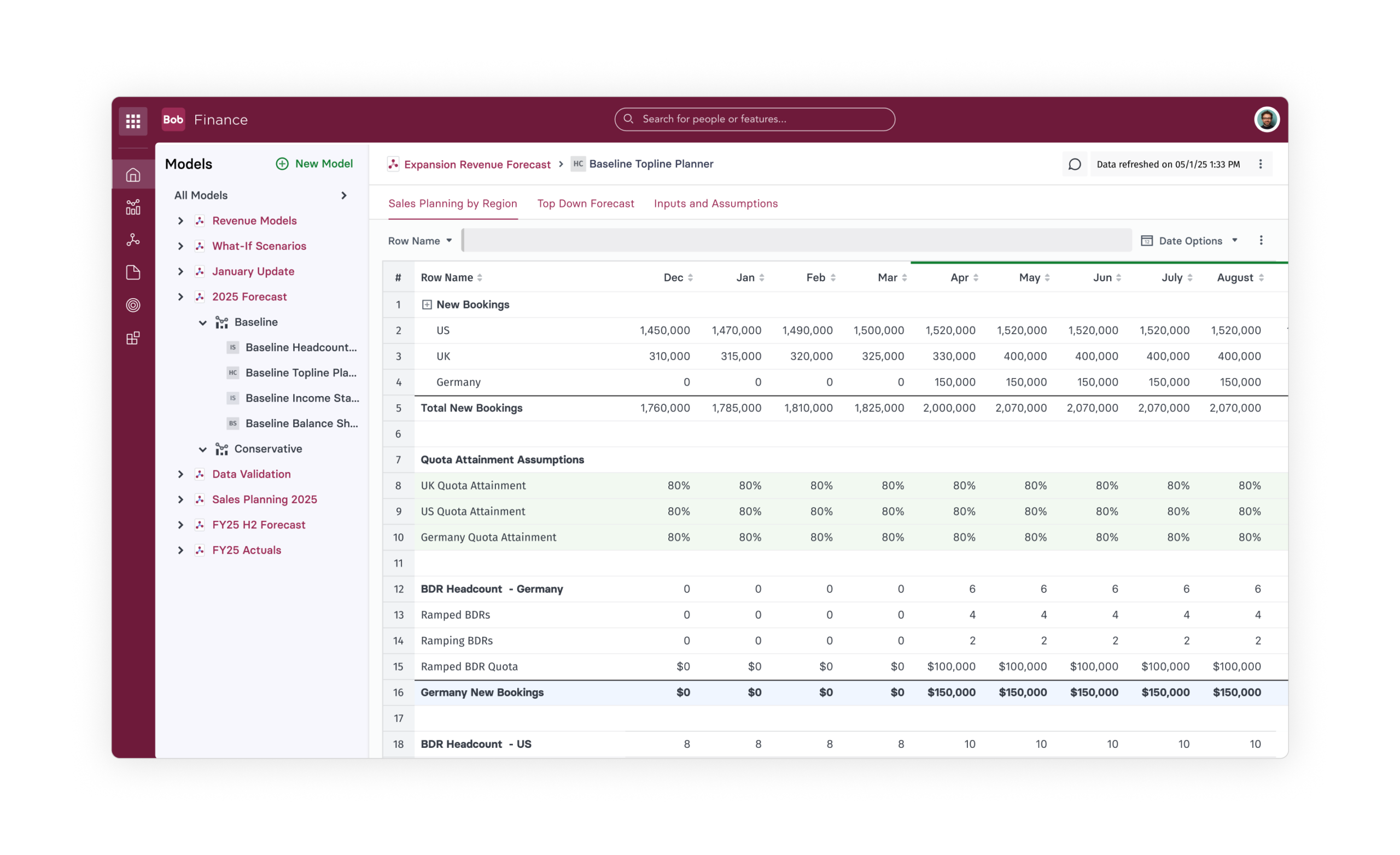
The direction is easy to understand. A hiring plan contains financial assumptions: salaries, start dates, and the timing of growth. Current Financial Planning documentation includes headcount forecasting, revenue planning, expense budgets, and alternative scenarios. Financial Insights supplies connected reporting and configurable metrics. Buyers can examine proposed spending against different versions of the future before approving it.
06 / Copy the question before buying the tool
Workday Adaptive Planning and Pigment also offer planning, scenarios, and collaboration. Mosaic’s positioning was connected finance for growing businesses; its current distinction is its place inside HiBob’s people platform. That makes the relationship between workforce decisions and financial forecasts central to the buying conversation.
The transferable practice is modest. Pick one recurring question. Identify its source systems, agree on the metric, assign an owner, and measure the time needed to answer it. Then change an assumption and see whether the forecast follows. You can begin that exercise without signing a contract.
Connected planning is less persuasive when source records are unreliable, definitions remain disputed, or a model needs capabilities the product cannot demonstrate. That is an inference from the workflow, not a documented Mosaic failure. Software can shorten the distance to a decision. People still have to decide whether the assumptions deserve the journey.