Natalie Quan’s problem was not arithmetic. At CalCPA, the professional association for California accountants, the CFO had numbers in a financial system, numbers in budgeting software, and numbers in reports. Getting them to agree required downloading, remapping and uploading. Every new account could set the machinery rattling again. Accountants, it turns out, are perfectly capable of becoming prisoners of accounting.
- Planful connects budgeting, forecasting, consolidation and reporting in a cloud platform.
- Its useful trick is shortening the wait between fresh data and a decision.
- Excel remains welcome. Disconnected budgets become rather less welcome.
CalCPA’s published customer account says Planful cut monthly reporting from eight hours to thirty minutes. Budgeting finished two weeks earlier. A nightly feed from Sage Intacct replaced the transfer ritual; departmental users gained access to their own numbers. Ease of use and integration had helped win the competitive evaluation.
“We only had one version of the budget instead of five.”Natalie Quan · CFO, CalCPA
Five budgets are a small constitutional crisis. Which one has authority? Who has amended it? Who is still arguing with last Tuesday? Planful’s appeal begins with an unglamorous proposition: people can have a more useful disagreement when they agree on the numbers.
The tax nobody puts in the budget
Planful sells financial performance management software to businesses. Finance and accounting teams use it to assemble budgets, revise forecasts, consolidate entities, manage the close and deliver reports. HR can model people costs. Operational managers can bring business assumptions into the financial plan. The customer buys subscriptions, with configuration and services around them.
The market includes mid-sized organizations and enterprises whose complexity has outgrown a collection of files. Planful reports more than 1,500 customers in over 100 countries. Bose, Five Guys, the Boston Red Sox and Specialized appear on its customer roster. These businesses share no obvious product category. They do share the need to make spending, staffing and revenue assumptions meet somewhere.
That meeting can be expensive to arrange. An anonymous industrial producer in another Planful customer account had more than twenty instances of nearly a dozen ERP systems. Raw-material costs rose sharply during the pandemic. Finance manually extracted data into spreadsheets, while price changes arrived two or three months after the cost increases. The company’s FP&A director described falling behind by $2 million to $3 million a month.
The first failure was the information delay. The underlying systems recorded what happened, but the business could not translate those records into pricing action quickly enough. Planful centralized financial data and supported cost scenarios. Sourcing, product, commercial and finance teams could discuss the same exposure. The customer moved from changing prices annually to reviewing them twice a month.
Those are vendor-published results from a particular business. Their broader lesson is straightforward: a report’s usefulness depends on when it reaches somebody who can act. You can balance the books impeccably and still spend weeks selling at yesterday’s margin.
A company named after a habit
Planful began as Host Analytics, founded by Jim Eberlin. The old name was literal enough: the company’s account of its early years describes machines hosted in customers’ offices to run financial planning and analysis. In an interview about his entrepreneurial career, Eberlin recalled pitching the service as renting a usable system rather than maintaining an expensive one.
He also described selling his previous consulting business to finance the venture. When a competitor obtained venture backing, he sought institutional investment. His account includes a disastrous first pitch, coaching from the investor who heard it, and eventual term sheets. Advanced Technology Ventures and Trident Capital backed Host’s first institutional financing in 2008. Even financial software has to survive a conversation about money.
Vector Capital completed its acquisition of Host Analytics in January 2019. The investor’s account says the business needed more capital and strategic support to expand. In January 2020, Host became Planful. Then-CEO Grant Halloran argued that customers were beginning to treat planning as an organizational habit. The new name expressed that ambition better than the old description of the plumbing.
Vector led another equity round in June 2020, joined by StarVest Partners and Monroe Capital. The company used the announcement to describe demand for more frequent forecasting during the pandemic. That timing matters. A budget approved for a familiar world becomes an awkward companion when the world changes in March.
Excel gets to keep its chair
Planful’s technical expertise sits between accounting structure and planning flexibility. Consolidation involves currencies, intercompany activity, eliminations and reporting hierarchies. Planning asks what happens if sales soften, compensation changes or another business unit arrives. Having these activities together gives finance a path from recorded results to revised expectations.
Connections do much of the quiet work. Planful lists integrations with ERP systems such as NetSuite and Microsoft Dynamics, workforce systems including Workday, and CRM tools such as Salesforce. It can also connect with data warehouses and reporting tools. Actuals, employee information and sales assumptions can enter the planning process without each department maintaining a private export ritual.
Yet Planful has made room for the application finance already knows. Spotlight connects Excel, PowerPoint and Word files to Planful data. A board package can refresh its numbers without someone manually repairing every presentation. BARC’s 2026 assessment also documents Google Sheets access. This accommodation is commercially sensible: affection for a spreadsheet rarely disappears because a vendor has published a diagram.
Planful competes in a crowded market containing Workday Adaptive Planning, Anaplan, Oracle Cloud EPM and OneStream, among others. Its case rests on the combination of planning, consolidation, reporting and finance-specific intelligence. Buyers should test that combination against their own entity structures and workflows. A category label cannot tell you whether your particular consolidation will be pleasant.
Ask a question. Inspect the answer.
The newest interface is conversation. Planful launched Analyst Assistant in October 2025, using OpenAI technology alongside its own calculation engine. A user can ask what drove a quarterly operating-expense variance and receive explanations and visualizations. The company says the assistant respects role permissions and dimensional security, and customer information is not used for model training.
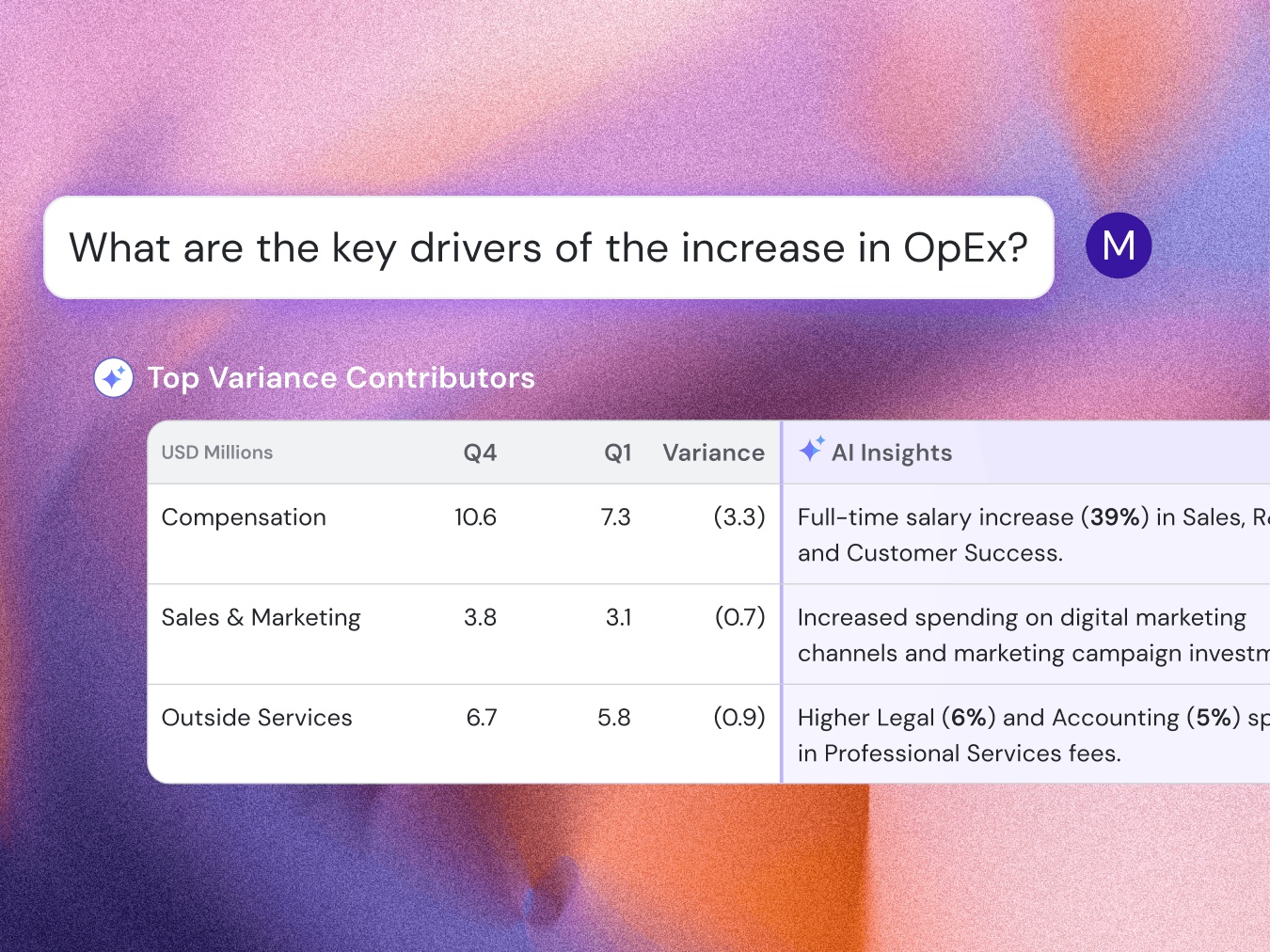
Planner Assistant followed in April 2026. It uses Planful Predict and customers’ planning models to generate forecasts and flag anomalies. The current product page describes projections based on account trends, seasonality and step changes. It also marks scenario write-back as coming soon. Producing a projection and committing it to the official plan remain distinct steps.
Rocket Software’s earlier experience with Predict helps explain the practical appeal. It connected data from Oracle ERP, Workday and Snowflake and developed rolling forecasts. Its finance team used anomaly detection to pressure-test assumptions against historical patterns, including seasonality. An unusual number becomes a reason to investigate. The machine has supplied a question; the finance professional still needs a judgment.
The subscription and the homework
Planful’s pricing depends on company size, user count and modules. Its subscription agreement puts quantities, fees, support and professional services in the customer’s order form. A sensible buying comparison therefore includes the software and the work surrounding it: mappings, model design, implementation assistance and the people who will own the process.
The product cannot decide whether two departments mean the same thing by revenue. Nor can a historical forecasting model anticipate every structural change by inspecting last year. Those are operating responsibilities. If managers continue to circulate private budgets, or nobody maintains account mappings, a connected platform will inherit the disagreement. A small business with simple reporting may have less reason to take on that work.
What can a reader copy before buying anything? Pick a recurring decision, such as a hiring approval or price review. Identify the numbers it needs. Assign owners, agree definitions and measure the time between new information and action. Then ask a vendor to demonstrate that exact journey. CalCPA’s reporting and the manufacturer’s pricing illustrate different journeys; neither requires worshipping the dashboard.

Planful describes its culture through customers, teams, progress, intention and action. John Herr became CEO in October 2025; Ken Ferguson joined as chief revenue officer in July 2026. The company’s future now includes selling AI to finance professionals whose jobs require them to distrust convenient answers. That is a demanding audience, and a useful one.
The test remains pleasantly plain. When the next number changes, how long before the business changes with it?
Take a closer look
Explore the Planful website, platform, on-demand product demo and audience-led product walkthrough. Follow the newsroom and blog, or find Planful on LinkedIn, X, Instagram and Facebook.