The purple backpack went everywhere. Inside were the medical records of a three-year-old boy named Gabe - every visit, every new document, the paper version of certainty for his mother, Jen Ganly. When she met Jean Ross in 2023, Ross spent weeks digitizing the pile and connecting accounts from different hospital portals. The backpack is a fine piece of luggage. As healthcare infrastructure, it is a warning.
Ross had seen its cousins for years: notebooks in critical care, binders in living rooms, medication lists reconstructed from memory. A cardiovascular ICU nurse who later coordinated care for older adults, she understood the strange bargain the healthcare system makes with families. Hospitals keep sophisticated charts. Families are still asked to remember the story.
So Ross teamed up with Jim McIntosh, a neighbor in Fishers, Indiana, who brought more than 25 years of software experience and his own history with complex care. He had undergone 12 surgeries after being born with a cleft lip and palate; later, he became the father of a daughter with Down syndrome. Development began in November 2020. Primary Record emerged as a secure place where a family could collect portal data, upload the stray PDF, record a note, organize medications and invite the people actually helping.

01 / The job
A family health record, minus the fiction of a solo patient
Primary Record calls itself a family health home base. One organizer can create medical profiles, connect records from multiple patient portals, attach more than 70 kinds of files, add images and notes, and invite collaborators with different permissions. The record can include the clean clinical nouns - conditions, medicines, labs, immunizations - alongside the messy verbs of real care: who noticed the dizziness, what the specialist said, which sibling can edit, and what should be shown at the emergency room.
Its AI Chat Assistant searches and summarizes information already in the profile. Audio notes can be transcribed. A live report or medication list can be shared with a QR code. It is less a diagnostic oracle than a retrieval layer: find the detail buried in six years of records before the ten-minute appointment ends.
This makes Primary Record different from a patient portal in one important way. A portal is usually a window into one institution’s version of one person. Primary Record is controlled by the individual or authorized representative, follows that person across institutions, and lets a family define itself. It also accepts context that a clinical system never captured. Changes made in Primary Record do not write back to providers’ systems - a limitation worth knowing before anybody mistakes organization for omniscience.
“Families have become the connective tissue of a fragmented healthcare system.”Jean Ross, co-founder and CEO
02 / The turn
What failed first was the small version of the idea
The founding observation was right: families needed better tools. The incomplete assumption was that handing them an app would fix coordination. It could not. A record becomes useful when someone maintains it, understands it and brings it into the next decision. Many families were already exhausted. Schools, senior-living facilities and transplant programs could praise the idea as a “game-changer” while still treating it as an optional extra. There was no dependable reimbursement lane for the work.
That changed the company’s mind about who must be in the product. Interviews with families caring for medically complex children and aging parents showed that care was a multiplayer activity. Later usage supplied a cleaner signal: by April 2026, Primary Record said more than one-third of its users actively shared health records with somebody else. The file cabinet was becoming a coordination network.
Primary Record Professional followed the work outward. Care managers, private patient advocates, life care planners and community teams could manage clients, share files and messages, and stop rebuilding records in their own spreadsheets. Some professional firms began bundling the family subscription into their services. The customer was no longer merely the person with a diagnosis. It was whoever had become the human integration layer.
The company’s 2025 partnership with Fasten Health strengthened the data plumbing. Fasten had done the procedural work to connect with more than 20 certified health IT systems and a network of more than 52,000 providers. Primary Record could focus on turning access into a usable, permissioned story. In August 2026, a partnership with HealthCall pushed the model further into mobile integrated health and community paramedicine - the moment a professional arrives at someone’s home and needs more than a thin referral.
That positioning avoids a theatrical fight with Epic or Oracle Health. Those systems are upstream sources. Primary Record competes more directly with the caregiver’s binder, spreadsheet, shared password and memory - plus consumer record organizers and health apps that are designed around a single user rather than a permissioned care circle.
03 / The money
Freemium at the kitchen table, SaaS in the care team
For families, the entry price is zero. The free version includes four monthly portal refreshes, four transcribed audio notes, four Chat Assistant questions and 500 MB of uploads. In August 2026, Family Unlimited cost $13 a month when billed annually, or $16 month-to-month. It removes those usage limits. Canceling premium access does not erase profiles, documents or notes; the account returns to the free tier.
That is the consumer wedge, not necessarily the whole economics. Primary Record sells professional software, works through advocates who incorporate it into paid services, and is courting community and institutional programs in value-based care, rural health and mobile integrated health. Public reporting put 2024 revenue below $20,000 and projected 2025 revenue above $250,000. The projection is not a result, but it shows the intended turn from promising utility to paid workflow.
The company closed a reported $1 million pre-seed round in December 2023; IU Angel Network disclosed a $65,000 investment. Supplied company data puts total funding at roughly $1.765 million. That is modest by health-tech standards, which makes distribution choices unusually consequential. A direct subscription has to earn a place beside medications and appointments. A professional channel can make the software part of care delivery rather than one more bill for a tired family.
The clever bit is not putting records in an app. It is giving the person already doing the coordination a reason to keep the app current.
04 / The proof
The boring standard underneath the human story
Primary Record rides a policy and technical shift created by the 21st Century Cures Act and standardized FHIR patient-access interfaces. In plain English: patients gained a legal and increasingly practical route to direct electronic records into an app of their choice. Primary Record uses that foundation without requiring every hospital to install a new EHR or agree to a bespoke integration.
But the founders are careful about what FHIR does not solve. A clean medication resource cannot identify the neighbor driving to appointments. A hospital record may not contain the over-the-counter supplement, the power-of-attorney document, the home vital or the caregiver’s observation. Connectivity is the foundation. Participation supplies continuity.
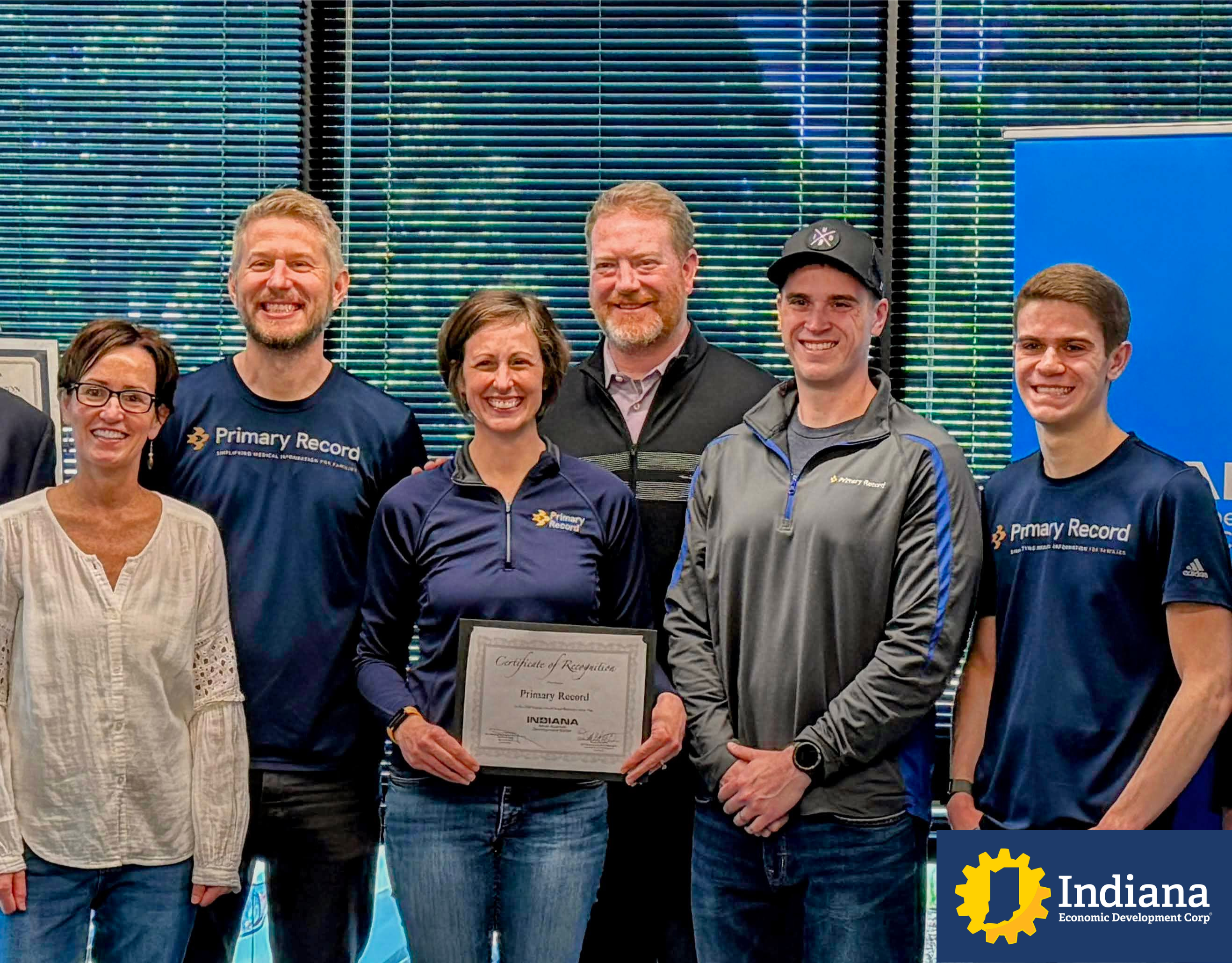
That distinction earned technical credibility. Primary Record won first place in the 2025 AMIA/HL7 FHIR App Competition, was featured in HL7’s 2026 “Setting the World on FHIR” case-study series, appeared on a ViVE panel and was invited to an HL7 webinar. Two years earlier, Indiana had named it the state’s 2024 Small Business of the Year. Awards do not prove outcomes, but here they validate both halves of the pitch: the software uses a real interoperability standard, and the small company has made itself legible to institutions.
Study the workaround before naming the category
Primary Record’s reusable move is observational: find the operator carrying the system on their back, inventory the binder tabs, portal logins, shared texts and spreadsheets, then build around the handoff. The initial product may look consumer. The durable buyer may be the professional whose time the workaround consumes.
05 / The boundary
When this model does not work
Patient-directed interoperability is not magic plumbing. A portal connection can fail quietly or return incomplete data. Primary Record has argued that those breaks are safety issues because families may assume a list is current. The product also depends on someone having the consent, time and digital confidence to maintain access. In a crisis, even a well-organized record is not a substitute for clinical judgment.
Editing the family record does not correct the provider’s chart. Formal errors still require the provider’s process.
If a provider blocks, omits or poorly exposes data, the family-held story can begin with a blind spot.
Caregivers need valid permission. A shared portal password is not a sound substitute for role-based access.
A neglected record goes stale. Adoption works best when a family member or paid professional owns the upkeep.
The market fit is strongest where care crosses boundaries often: a medically complex child, an older parent with several specialists, a rural patient moving among disconnected systems, or a community paramedic entering the home. It is weaker for a healthy person with one provider and one adequate portal. It will also struggle wherever organizations admire coordination but refuse to fund it.
Primary Record began by asking why families still carried binders. Six years later, the better question is why the people outside hospital walls remain invisible to the data architecture. Its answer is neither to wait for a universal record nor to crown AI as the doctor. It is to let the information move with the patient, add the context a chart missed, and invite the actual care team into the room. Sometimes the next healthcare platform does not start in a lab. It starts in a purple backpack.