“Let me know if you need anything” sounds like a gift. For the person caring for a sick parent, it can arrive as another assignment. Decide what is needed. Decide whom to ask. Explain the situation again. Find a time. Follow up. The offer is generous; the administrative work is still yours. ianacare begins with that awkward little gap between affection and assistance.
- A free app turns family support into shared tasks, calendars and updates.
- Covered services add a human navigator for resources, benefits and care planning.
- Healthcare partnerships bring the same approach into dementia support through Medicare GUIDE.
The job hiding inside the favor
In family care, the person doing the work often becomes its switchboard too. A sibling needs an update. A neighbor could bring dinner. An appointment requires a ride. Each transaction looks small until one person is managing all of them. The coordination can consume the very energy that help was supposed to restore.
ianacare’s organizer lets a caregiver build a private support team, post needs and keep people informed together. The calendar gives an offer a destination. A request can go to the team without becoming a separate negotiation with every member. A completed task is visible. Good intentions acquire a date.
“It didn’t make me feel like a burden for asking them for that help.”Amanda Hayes · caregiver, in an ianacare testimonial
Before the app, 75 questions
Jessica Kim came to the problem through her mother’s pancreatic cancer. In a leadership interview, she described caring for her parents while working and raising three children. Entrepreneurship was familiar territory; this combination of nursing duties, family obligations and exhaustion was something else. She eventually left her job to care for her mother.
Her co-founder, Steven Lee, had watched his family deal with his grandfather’s Parkinson’s disease. He brought experience in speech recognition and video advertising, including serving as CTO at Tremor Video before its IPO. Their company name supplied its own explanation: iana means “I Am Not Alone.” It was a statement about the experience they wanted families to have.
But sympathy was only part of the founding work. In a 2023 interview with investor Rob Go, Kim described how she and Lee went through 75 questions before becoming partners. They discussed uncomfortable possibilities, including an investor demanding that one founder step down. A pleasant conversation about the mission would scarcely have been enough.
Go also highlighted Kim’s insistence on thinking through the business model early, informed by earlier ventures. The caregiver could use a free tool; employers and healthcare organizations could buy broader support. Choosing the payer shaped the company being built.
A calendar with someone behind it
The software handles shared tasks and updates. Enhanced services add a Care Navigator who helps with a personalized plan, local resources, available benefits and difficult family conversations. Users can communicate by chat, phone or video. The help center makes access conditional on a participating employer, health plan or membership organization. The company describes navigators with backgrounds in social work and nursing, alongside education and live events for caregivers. Finding a service, understanding a benefit and discussing a family disagreement can belong to the same conversation.
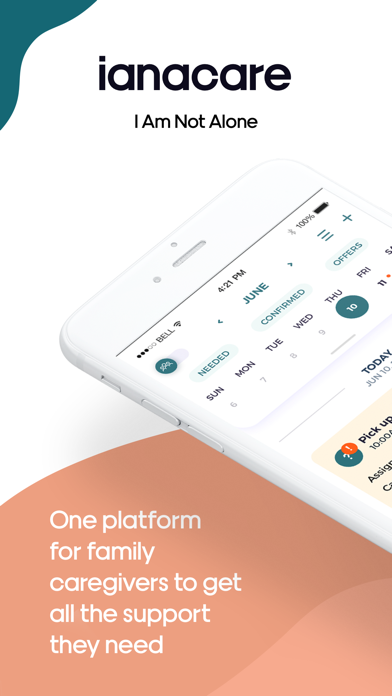
- 01 / Make the need visiblePost the task and the date.
- 02 / Share responsibilityBring your support team into one place.
- 03 / Get guidanceUse covered navigation for the complicated parts.
The current app also includes iana, an AI care companion with questions and answers, action plans and quick care logging. Its own product description says it does not substitute for professional medical advice. That boundary matters: a useful next step and a clinical decision are different responsibilities.
ianacare sits in a market that includes Wellthy and Cariloop, both of which offer employer-funded caregiver support. Human guidance alone does not distinguish it. Its particular combination brings a personal support-team organizer together with navigation, education and healthcare partnerships. The ordinary alternative remains a collection of texts, calendars and somebody’s memory.
The six-week test
A 2022 paper in the Journal of Medical Internet Research examined 176 employed caregivers before and after six weeks using the app. Researchers found a 9.1 percentage-point decline in the probability of doing most care tasks alone, and a 12.5-point decline in reporting feeling overwhelmed.
Those are associations from a pre/post survey, without a randomized comparison group. Participants volunteered, and the study took place during the first pandemic spring. It is an encouraging signal about sharing work, with limits on what it establishes. It does not prove every later feature delivers the same benefit.
When Medicare pays attention
In August 2025, ianacare announced a partnership with Care Dimensions, a Massachusetts hospice and palliative care provider participating in Medicare’s GUIDE model. The arrangement includes caregiver education, service referrals, respite coordination, medication reminders and ongoing navigator support. Clinical care and practical family support have a place in the same arrangement.

GUIDE began in July 2024 as an eight-year national test. It funds coordinated dementia care and caregiver support, including respite for qualifying patients. Participating providers cannot charge enrolled patients for GUIDE services. Eligibility is specific: it includes a confirmed dementia diagnosis and qualifying traditional Medicare coverage, rather than Medicare Advantage.
The underlying business is also changing shape. Employers buy help because care affects employees’ working lives. Healthcare partners need families who can carry out care at home. ianacare reports $19.7 million raised, following a $12.1 million Series A announced in January 2022. The current website describes a reach of more than 50,000 families, clinicians and employers. That company-reported figure includes several kinds of participants; it is not a tally of paying customers. Capital buys staff and expansion; willing relatives still supply much of the everyday help.
Give Thursday an owner
The practice a reader can borrow is simple: replace an open-ended offer with one task, one date and one person responsible. Keep the update where everyone can find it. Ask who funds the professional help before depending on it. These habits work even before a family opens an app.
They also require something software cannot manufacture. Someone must be willing to take the shift. A local service must have capacity. A covered navigator must be available. The achievement worth watching is whether more of those small jobs leave the caregiver’s shoulders. Thursday’s ride is an excellent place to begin.