The spreadsheet was a revolution before it became furniture. It replaced ledger paper, made arithmetic obedient and gave every manager a little window onto the business. Then retail grew faster, more global and more granular. The window acquired thousands of tabs. By the time Prashant Agrawal began building Impact Analytics in 2015, a tool designed to arrange numbers had quietly been appointed to predict weather, taste, geography, fashion and human appetite. It was a magnificent promotion for the spreadsheet and a dreadful job description.
Agrawal explains the mismatch with the instinct of a former consultant and the timing of a practiced speaker. Imagine 300 stores, 100,000 stock-keeping units, 90 days and four backrooms. The resulting allocation problem produces more than ten billion combinations. A merchant can know the customer, the cut of a jacket and the mood of a neighborhood. No merchant can contemplate ten billion futures before lunch.
This is the problem on which Agrawal has built his present life: deciding which work belongs to calculation and which belongs to judgment. Impact Analytics makes software for demand forecasting, merchandise planning, assortment, inventory and pricing. The vocabulary is dry because the consequences are not. A coat sent to the wrong store becomes a markdown. A missing size becomes a lost customer. A promotion offered too early donates margin; offered too late, it leaves a warehouse full of regret.
The education of a decision-maker
Agrawal's route to this narrow and complicated territory was anything but narrow. At Cornell, he studied economics and government. At Columbia, he completed a joint JD/MBA. The degrees amount to three different ways of looking at power: how incentives move people, how rules constrain them and how organizations attempt to proceed anyway.
His early career collected institutions as if testing their decision machinery. He worked in McKinsey's New York and Mumbai offices, moved into investing at Courage Capital Management, founded an India-focused social portal called Indipepal and served as a senior adviser in the Office of Tony Blair. Then came Boston Consulting Group, where he worked in corporate finance and private equity in India. He also wrote, as a columnist and contributing editor for GQ India and a columnist for Mint, with work appearing in publications including the Financial Times and The Wall Street Journal.
The CV could look restless. A more useful reading is that Agrawal kept changing vantage points while studying the same object. Consultant, investor, adviser, writer and founder all spend their days turning incomplete evidence into a recommendation. Only the audience changes. In one room it is a client. In another, a cabinet office. In a third, a reader who can close the page at any moment.
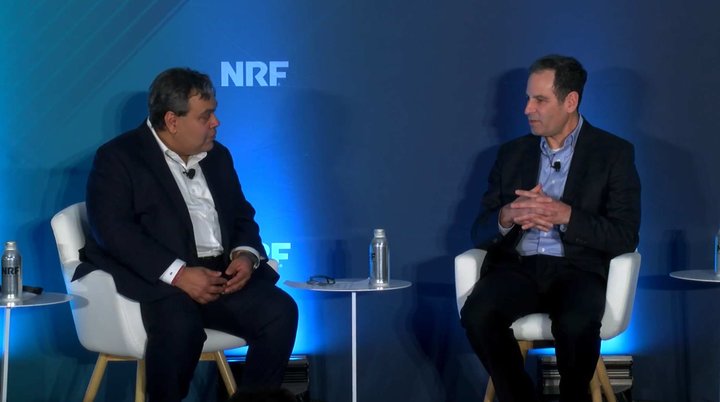
“People spent more time preparing data than acting on it.”Prashant Agrawal, speaking at NRF 2026
A company built for Monday morning
Impact Analytics started with Pet Supplies Plus and says that relationship continues. Longevity matters in enterprise software because the real test comes after the demo, when a planner opens the system on a Monday morning and must decide whether to trust it. The founder's pitch can win a contract. Only repeated usefulness keeps one.
Over the following decade, the company expanded across fashion, specialty retail, grocery and consumer goods. Its customer list has included Coach, Levi's, Dollar General, Ralph Lauren, Gap and Tapestry. Its latest company account describes more than 75 enterprise clients and a global team above 800. In 2026, Agrawal told an NRF audience that more than two million models were running at store-SKU level.
Numbers at that scale flatter the engineer. Agrawal usually brings the discussion back to the operator. Forecast accuracy has value only if it reduces lost sales, weeks of supply or unnecessary markdowns. A system that identifies an exception but cannot explain why it matters has merely automated confusion. A beautiful prediction that arrives after the buying meeting is a historical document.
From spreadsheet labor to decision work
Conceptual illustration of Agrawal's argument, not measured company data: reduce preparation and redirect attention toward exceptions, interpretation and action.
His favored formulation is “decision infrastructure.” It is less glamorous than artificial intelligence, which is probably its virtue. Infrastructure has to be dependable, legible and available. In retail, the same organization needs the same answer to the same question. Security matters. So do guardrails. The system must speak merchandising and finance, not merely data science.
“Retail is both art and science. AI strengthens the science so leaders can focus more on the art.”Prashant Agrawal, NRF 2026
The professor returns to the case
In 2024, Agrawal added another room to his working week: the classroom. As an adjunct professor at Columbia Business School, he teaches AI and advanced analytics in retail. The return is tidy - an alumnus carrying live operating problems back to the institution where he studied business - but the more interesting fit is intellectual.
Founders are rewarded for velocity. Teachers are punished for skipping steps. A classroom asks where the number came from, which assumption has been hidden and why a neat answer should survive contact with a skeptical student. Retail supplies inexhaustible cases. Every choice has a clock attached, and every clean dataset conceals weather, a local event, a late shipment or the fact that green suddenly looks tired.
Teaching also reinforces Agrawal's public manner. He reaches for examples rather than incantations. Ten billion combinations beats a lecture on combinatorial optimization. His favorite piece of business advice is an equation simple enough to write on a shopkeeper's receipt: revenue minus profit equals cost. The point is bracingly plain. Technology must eventually appear in an income statement, not just a keynote.
After prediction, action
Recognition arrived alongside growth. In 2024, Agrawal won EY's Entrepreneur Of The Year award for the Mid-Atlantic region. Impact Analytics appeared on the Inc. 5000 eight years in succession from 2018 through 2025. In May 2025, the company announced Series D growth funding led by Blue Cloud Ventures, with existing investors Sageview Capital and Vistara Growth participating. The stated plan was geographic expansion and deeper work on agentic AI.
Growth has also made Agrawal a regular translator between two tribes that often admire one another from a safe distance. Data scientists talk about models, features and accuracy. Merchants talk about sell-through, availability and the peculiar indignity of discovering that the popular size is in the wrong postcode. On the Chiefly Digital podcast, he framed the opportunity through concrete returns in pricing, buying and allocation. On conference stages, he tends to place a retail operator beside him. The arrangement is useful theater because it makes the software answer to a person with a weekly number to hit.
His public argument contains an important concession: experience remains valuable. The model can locate a pattern across stores faster than any team. It cannot stroll through one of those stores, hear a customer hesitate or understand every reason a planner may distrust the input data. Adoption therefore becomes part of the product. Explain the logic, fit the workflow, measure the business result and allow the recommendation to be challenged. Enterprise software has always required diplomacy. Giving it more agency merely raises the diplomatic stakes.
“Agentic” is one of those words at risk of being polished smooth by conference carpets. In Agrawal's account, it means software moving from prediction toward governed action: noticing a supply-chain anomaly, interpreting its consequence and helping execute the response. The ambition is substantial. It also makes his older insistence on trust more important. The cost of a bad dashboard is irritation. The cost of a bad autonomous action can be inventory.
At NRF in 2026, he stressed deterministic answers and enterprise security. He also emphasized human guardrails in a later European appearance. These are sober qualifications from a founder selling the technology. They reflect the particular difficulty of enterprise AI: the software must be adventurous enough to find what people miss and conservative enough to respect the organization that pays for the result.
The spreadsheet will survive all this. Useful old things rarely disappear; they simply return to the jobs they do well. Agrawal's wager is that retail will stop asking rows and columns to contain every possible future. The machine can work through the permutations. The merchant can notice that a city has changed, that a customer wants something new, or that the sensible recommendation feels wrong for a reason no model has yet named.
Ten billion decisions sound like a monument to computation. Look closer and the story is about attention. Every minute recovered from preparing data can be spent questioning it, acting on it or walking the floor where its consequences appear. The cleverest system may be the one that leaves people with more time to be observant.