The most revealing thing about DTN is that you probably use its work without ever seeing its name. The company sits several steps behind ordinary life. It helps a grain buyer judge where corn is stored. It helps a refinery decide whether a customer can load product. It tells a highway crew when pavement will freeze, a utility where a storm may damage its network and a tournament official when thousands of spectators should leave a golf course. This is data with mud on its boots.
DTN calls the category “operational decisioning.” The phrase is boardroom-polished, but the job is concrete: gather messy signals, model what comes next and push an answer into the exact moment somebody must act. A free forecast can say snow is coming. DTN wants to say which route needs treatment, when the crew should leave, what material it should spread and what the road may look like afterward.
01 / The originThe first clever move was financing the box
DTN began in Omaha in 1984, inside the grain company Scoular, as an attempt to communicate with farmers faster. Its original name was Dataline. The product was gloriously physical: a receiver picked up commodity prices, weather and agricultural reports sent over FM sideband signals, with satellite distribution added as the network grew. In late 1986, the service cost $17.50 a month.
The important insight was not the signal. Customers preferred leasing the receivers to buying them. Scoular did not want to carry that financing, so executive Roger Brodersen bought Dataline in 1986 and later took it public to raise the money. Subscribers got the receiver and terminal; DTN got monthly revenue and a direct place on the farmer's desk. By October 1987, it reportedly had 13,500 subscribers in 10 states.
That arrangement contains the company's entire future in miniature. Remove friction from adoption. Charge for a continuing flow. Become part of a recurring decision. The receiver would disappear, but the habit remained.
02 / The breakFree information attacked the channel first
The first thing to fail was not demand for weather or crop prices. It was the assumption that a proprietary terminal was the best way to receive them. During the late 1990s, CNBC, The Weather Channel and agricultural websites made generic information plentiful and cheap. DTN entered a financially uncertain period. The consumer internet had turned yesterday's paid scarcity into today's browser tab.
What changed the company's mind was competition from abundance. DTN could no longer win merely by delivering numbers. It moved closer to specialist work: proprietary reporting, market analysis, forecasting, trading tools and systems that connect to how a customer operates. Private investment firm Veronis Suhler Stevenson acquired DTN in 2000. Telvent paid $445 million for it in 2008, when DTN had about 700,000 subscribers, expected annual revenue of $180 million and more than 90 percent of sales coming from subscriptions. Schneider Electric inherited it with its 2011 purchase of Telvent. Then, in 2017, Switzerland's TBG bought DTN for $900 million and restored the stand-alone brand.
The transaction prices are useful because DTN is private and most of its enterprise products are sold by quote. The public evidence says something more durable: buyers valued the recurring, vertical information business at twice as much in 2017 as Telvent paid nine years earlier.
03 / The machineA forecast becomes a workflow
Today DTN runs a broad portfolio under one platform thesis. WeatherSentry packages forecasts, alerts and expert support for utilities, transportation, aviation, marine operations, mining, sports and public safety. ProphetX delivers commodity market data, news and charting to more than 5,000 customers, according to DTN. Its Fuel Operations Hub handles pricing, allocation, terminal automation, inventory and digital commerce. MyDTN serves farmers. APIs and feeds put observations and forecasts into other companies' software.
The DTN value chain: four steps from noise to action
Agriculture shows the strategy most clearly. DTN acquired Grain Discovery in July 2025, gaining digital bids, contracts, grower relationship tools and sustainability traceability. In 2026 it launched Ag Hub, combining that transaction layer with Grain Intelligence and Farm Intelligence. DTN describes the underlying asset as a field-level digital twin of U.S. agriculture. It connects parcels to operators, crops, acreage, yields, bins, input estimates and contact records, then plugs those records into major CRM and ERP systems.
The point is fewer swivel-chair decisions. A grain originator should be able to see where grain may be available, decide whom to call, publish a bid, execute a contract and preserve traceability without shuffling between screens. “Our customers do not operate in silos, and their technology should not either,” agriculture chief Grey Montgomery said at the Ag Hub launch. Corn, unfortunately, still does.
| Customer | Expensive question | DTN layer |
|---|---|---|
| Utility | Where should crews be staged? | Asset-specific forecasts and outage-risk guidance |
| Grain buyer | Where is supply, and at what bid? | Farm records, yield models and digital contracting |
| Fuel terminal | Can this truck load this volume now? | Credit, allocation and real-time loading controls |
| Road agency | Which route gets salt, and when? | Pavement forecasts and treatment recommendations |
04 / The proofThe useful metric is avoided trouble
Accuracy matters, but operations buyers ultimately pay for an outcome. DTN's own 2024-2025 verification found its day-ahead temperature forecasts across more than 300 European cities were 15 to 22 percent more accurate than high-resolution ECMWF forecasts, depending on season. The comparison is company-produced, so treat it as a performance claim, not independent certification. More persuasive are customer workflows where the value can be counted.
Selected measured outcomes
Road figures come from historical MDSS deployments and studies. The bar lengths are illustrative, not a shared scale.
A five-winter New Hampshire study estimated that maintenance decision support could deliver the same service with 23 percent less salt and an 8:1 benefit-cost ratio. Indiana estimated $11 million in savings during a 2008-2009 deployment, equal to 27 percent of its winter budget. Those results are old and location-specific, but they expose the economic logic: better timing can reduce material, fuel and labor without accepting worse roads.
The same logic appears elsewhere. Chevron used DTN TABS to automate credit limits and volume controls at terminals, replacing updates that could take from 15 minutes to hours. National Grid selected DTN after comparing vendor accuracy, adaptability and professionalism. The PGA TOUR has used on-site DTN meteorologists since 2005; one forecaster, Wade Stettner, produced nearly 4,000 forecasts over 20 years and supported Olympic golf in Rio, Tokyo and Paris.

05 / The next betAI weather still needs a human on the course
DTN's newest phase is both technical and organizational. In 2025 it announced a collaboration that feeds NVIDIA Earth-2 AI weather models into DTN's forecasting engine, running on AWS. DTN says AWS has hosted its global forecast system since 2020, reducing latency and doubling the frequency of high-resolution forecast generation. In July 2026, Manuel Zepeda became chief executive with a mandate to accelerate AI-enabled operational decisioning.
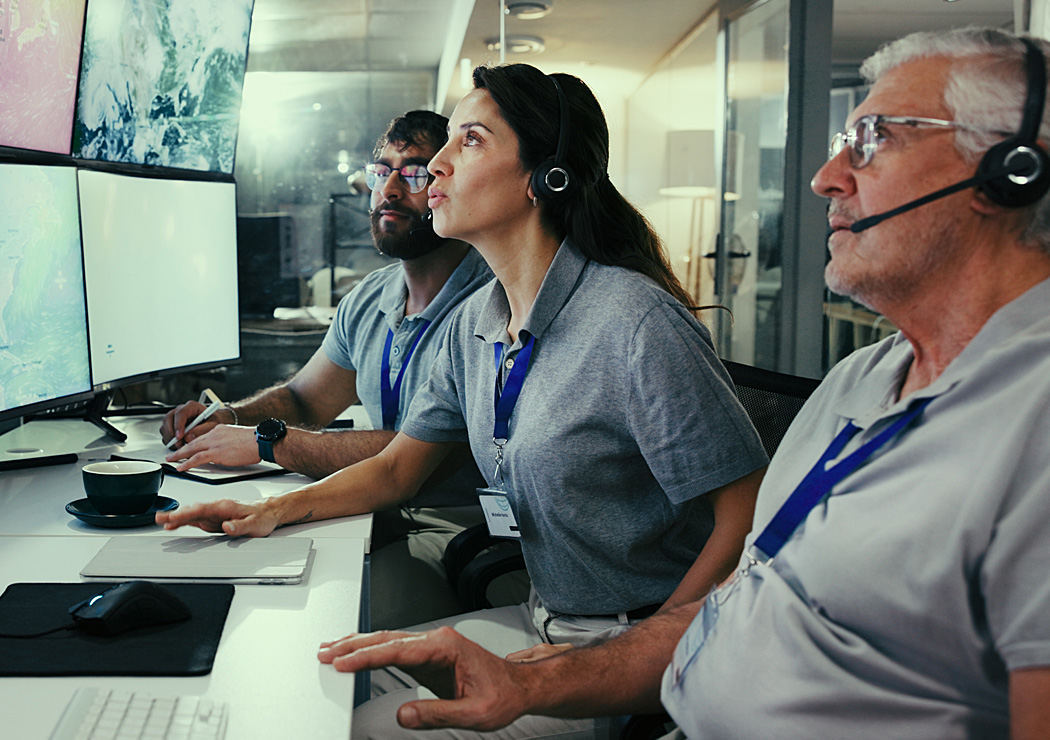
Yet the company's more interesting advantage may be the 1,200 people around the models. DTN operates weather centers in Minneapolis, Utrecht, Sydney and Manila. Its meteorologists and “risk communicators” translate probability into an operational conversation. A model can flag lightning. A human who knows the venue can discuss evacuation time, shelter capacity, television schedules and the consequence of waiting five more minutes.
This is also where DTN differs from its alternatives. It competes with enterprise weather vendors such as Vaisala, The Weather Company, AccuWeather for Business and Tomorrow.io; market-data giants such as Bloomberg and LSEG; agriculture platforms such as Bushel and Climate FieldView; and terminal specialists such as PDI and Implico. But its most common rival may be a public forecast, an ERP screen, three spreadsheets and an experienced manager's intuition. DTN wins when joining those fragments produces a decision valuable enough to justify another subscription.
The part a founder can copy
- Find a recurring decision where being wrong has a visible cost.
- Collect context that a horizontal tool does not understand.
- Turn prediction into a recommended action, not another dashboard.
- Place the answer inside the customer's existing workflow.
- Measure time, margin, material or risk avoided.
The conditions matter. This playbook does not work as well when the decision is infrequent, the mistake is cheap, free data is sufficient or nobody can measure improvement. It also fails when proprietary inputs go stale, integrations add work instead of removing it or customers suspect the recommendation favors a seller. DTN's repeated emphasis on neutrality is not decorative. In grain and energy markets, trust is part of the product.
Forty-two years after a box carried crop prices across an FM signal, DTN is still selling a version of the same promise: less uncertainty at the moment of commitment. The technology has moved from receivers to cloud clusters and AI models. The valuable unit has not. It is the next decision.