In June 2025, Pramod Rao caught the Bengaluru metro at seven in the morning, reached Cubbon Park before 7:45, and joined a group of strangers carrying rubbish bags. They were there to pick up litter. For someone who had spent years thinking about how people gather online, this was a pleasingly literal version of community work: show up, introduce yourself, leave the place a little better.
There were about fifteen or sixteen of them. They walked for forty-five minutes, collected discarded packaging and bottles, and talked. Afterwards, Rao stayed to discuss how the group might keep going. Then he treated himself to dosa and filter coffee at Airlines Hotel. A growth meeting with a rather good breakfast attached.
Four months earlier, he had announced that Threado AI, the company he co-founded with Abhishek Nalin, was winding down. The Sunday outing belongs in his story because it makes an old interest visible in a new setting. Across restaurant reviews, software communities, customer support and now sustainability, Rao keeps returning to what happens when people find something worth doing together.
The customer who became employee thirteen
Rao studied at the Indian Institute of Technology, Kharagpur, from 2003 to 2007. He began his career at Bain & Company, spending roughly three years learning to investigate unfamiliar businesses and solve clients’ problems. It was an education in asking useful questions. The products on the other end of those questions, however, generally belonged to someone else’s daily life.
At Bain he worked with Deepinder Goyal and Pankaj Chaddah, who were building the restaurant-discovery venture that became Zomato. Rao joined in 2010 as employee number thirteen. His responsibilities eventually included user growth, partnerships, brand marketing, content and community, and he became vice president of marketing. Over roughly eight and a half years, he worked inside a business whose scale and scope kept changing.
The attraction had a personal starting point. He used the service himself when it was still Foodiebay. He understood the customer’s interest in a useful restaurant listing because he shared it. Much later, looking back, he would treat that familiarity as a serious advantage: the person building the product could judge it against something more immediate than a presentation.
The restaurant site also offered a practical lesson in participation. Reviews, menus and people following other food enthusiasts made discovery a social activity. Each contribution could help the next visitor. That experience supplied Rao with a way to think about growth that would travel well beyond restaurants.
A room full of people can still go quiet
After leaving Zomato in 2019, Rao explored what to build himself. Threado, founded in 2020, initially took the form of a forum. The founders imagined combining useful aspects of existing communication tools. Yet another place to talk was a reasonable product idea. Whether people needed another place to talk was a separate question.
Conversations with community builders shifted their attention toward the work that follows the welcome message. Members become inactive. Questions remain unanswered. The people running the group struggle to notice who needs help while keeping up with everyone else. A busy channel can conceal a surprisingly lonely experience.
Through On Deck’s community-builder, founder and scale fellowships, Rao found people confronting those problems at different stages. Those conversations helped sharpen Threado’s direction. It would sit alongside existing platforms and help community teams understand activity and take action. A question awaiting a reply, or a member drifting away, could become visible to the people responsible for responding.
“How do you scale intimacy?”
Pramod Rao, on the problem behind Threado
There is a wonderfully awkward ambition in those five words. Intimacy is usually described in small numbers; software companies prefer large ones. Rao was interested in the practical middle: helping a small team remain attentive as the group around it grew. Threado’s dashboard was an attempt to give that attention a workable daily routine.
The eighth idea, and a useful gift
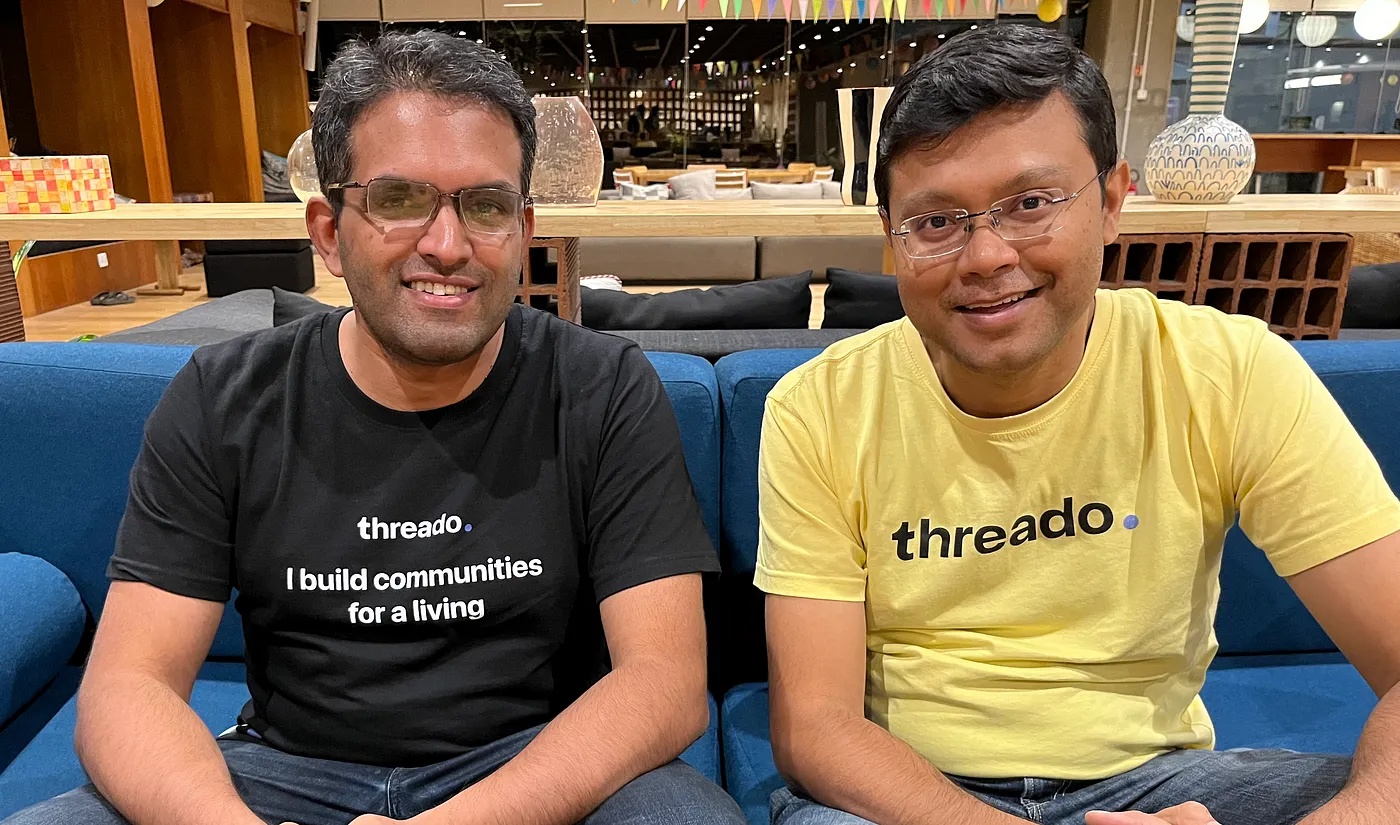
Rao described Threado as his eighth startup idea. Earlier attempts had addressed problems he considered worthwhile but had not personally experienced. The community work connected more directly with his own background. He spent eight or nine months on the early forum project before meeting Nalin, who became co-founder and chief technology officer.
While the software developed, the team released Community OS, a collection of practical resources for community builders. It included a fifty-point checklist and curated tools, experts and reading. People could use it immediately. It also gave the founders a way to learn what their prospective customers found useful.
Community OS reached first place for the day on Product Hunt in November 2021. For a company whose central question concerned participation, providing a useful resource was an apt introduction. It offered a reason to interact before asking people to adopt a new product.
Rao’s account of his working day had similarly concrete details. His dogs, Nama and Laya, required a morning walk, creating a period away from his phone. He preferred meetings grouped together, books over podcasts and samosas over gulab jamun. The last preference probably deserves no framework at all. Some decisions can remain pleasantly uncomplicated.
The old colleagues came back as backers
In July 2022, Threado announced a $3.1 million seed round led by Vertex Ventures Southeast Asia and India, with participation from Gemba Capital, Speciale Invest and PointOne Capital. Goyal and Chaddah were among the angel investors, alongside Chargebee co-founders Krish Subramanian and Rajaraman Santhanam.
The connections reached back into Rao’s working life. People with whom he had helped build one company were now backing his attempt to build another. Threado reported that more than two hundred communities used its product at the time. Its stated plans included strengthening the team, improving the product and growing in North America.
Gemba founder Adith Podhar described meeting Rao in mid-2021 and discussing the community software opportunity before Nalin joined as co-founder. Speciale’s investment account paired Rao’s growth and marketing experience with Nalin’s engineering background. Their partnership brought different kinds of knowledge to the same problem.
These were commitments to an opportunity, made at a particular moment. The investment announcement belongs in the story alongside what came later. A seed round gives a team room to pursue its hypothesis; the customers and the work still decide how far that hypothesis can go.
The support question grows larger
Within a community, an unanswered product question is already a support problem. By August 2023, Threado had launched an AI offering for answering queries across Slack, Discord and the web. In July 2024, its AI Agents release extended the focus toward customer-facing and internal teams.
Rao described the 2024 direction as a response to information scattered across workplace tools. The intended assistant would bring relevant knowledge into the places where people already worked. Customer queries, troubleshooting, content and sales conversations were all part of the broader territory he outlined.
The change is easy to understand as a sequence of adjacent problems. First, notice the member who needs attention. Then help answer the member’s question. Then help the employee find the information needed to answer it. Each step expands the work, the audience and the demands on the product.
Rao also kept talking with practitioners. A Threado fireside chat brought Zapier support director Lauren Fearn into a discussion about AI and customer experience. A separate conversation with Sri Laxmi explored his startup journey and AI support. The listening that had shaped the community dashboard continued as the company moved into a broader market.
One percent done, until the final handover
At Threado, Rao carried over Zomato’s “1% done” mindset. In 2022 he described a remote team of twenty-five, hiring around authenticity, humility and curiosity. His approach was to give people ownership and support, then make room for them to work. Weekly reflections with team leads and conversations with other founders supplied opportunities to learn.
That culture appeared in a specific customer relationship. In December 2023, Rao described Scaler as an early partner whose input had helped shape Threado. Scaler’s Sakshi Rastogi praised the team’s detailed attention to support, singling out Shalini Nair Tekwani. The exchange put a name and a working relationship behind the company’s interest in customer experience.
On February 17, 2025, Rao announced the wind-down. He thanked customers, investors, his co-founder and the team. His immediate priorities were helping customers make a smooth transition and helping colleagues find their next opportunities. He listed people across marketing, engineering, design, testing and customer success, and invited employers to consider them.
The announcement gives the company story its ending and the people in it their due. Years of work do not become meaningless because a business closes. They do, however, acquire a different shape. In Rao’s account, the final responsibilities were practical and personal: finish the handover, help people move forward, acknowledge what they had built together.
A mug, a board game, a Sunday morning
After Threado, Rao began publishing Sustainably Curious, a podcast and newsletter about everyday sustainability. His guests included Share At Door Step founder Anushka Jain and Sustainable Sundays founder Anjali Lakra. The conversations explored how people make participation easier, whether through donations or local activities.
He also built ReuseMe.ai, a mobile app that used a photograph of an everyday object to suggest ways to reuse it. In June 2025 he described making it with Bolt and submitting it for a hackathon. That same dispatch included joining strangers for Cartagena at The Boardgame Den on Church Street and helping organize another Cubbon Park cleanup. Software experiments and actual tables of actual people occupied the same week.
By March 2026, Rao was publicly describing another building effort. Looking back at Threado, he said the work had moved toward market needs and away from the founders’ own problems and expertise. For the next project, he had imposed a requirement on himself: it had to be something he used every day because he needed it.
“Energy is the first thing to go when you stop building for yourself.”
Pramod Rao, March 2026
That brings the story back to the Foodiebay customer who joined the team. Rao’s latest rule gives personal use a place beside market demand. And the Sunday mornings add a second measure: what happens when people turn up? In Cubbon Park, the answer involved a few bags of litter, some new acquaintances and breakfast. A modest result, plainly visible, with enough reason to come back.
Keep the conversation going
- Sustainably Curious - essays and conversations
- Pramod Rao on LinkedIn
- Pramod Rao on X
- Watch: AI Product Builders with Pramod Rao
- Listen: Sustainably Curious
- A conversation on community and working habits
- Threado’s 2022 funding announcement
- Rao’s February 2025 wind-down announcement
- Rao on building again, March 2026
- Threado - historical company website